

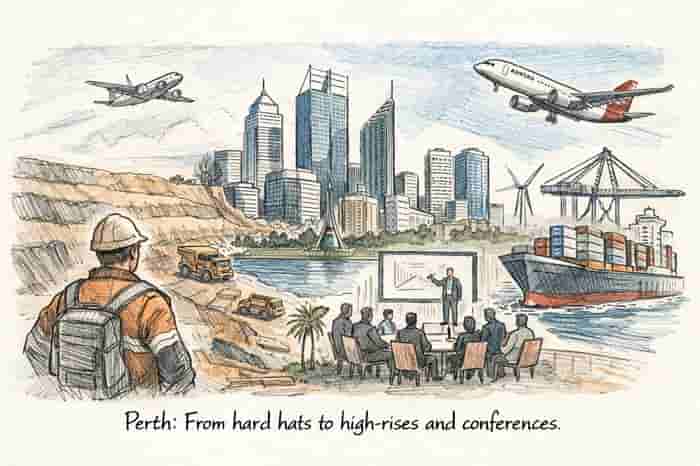
Perth has long worn the hard hat. For decades, business travel west was defined by steel-capped boots, red dirt and FIFO schedules that ran like clockwork. But the latest data suggests something rather more interesting is happening, and the travel trade should take notice.
New figures from Corporate Traveller show corporate bookings into Perth climbed 14 per cent year-on-year in the second half of 2025. That’s not a blip. It’s a signal the Western Australian capital is quietly reshaping its business identity and, in the process, redrawing Australia’s traditional travel map.
For a market historically dominated by the East Coast’s well-trodden triangle, Perth’s rise feels less like a spike and more like a recalibration.
Beyond iron ore and into influence
Let’s be clear: resources still matter. Western Australia continues to punch far above its weight economically, accounting for roughly half of Australia’s goods exports. But what’s changing is the mix and the type of traveller boarding those long-haul domestic flights.
Corporate Traveller’s data shows transportation and warehousing jumping 62 per cent, pushing the sector into Perth’s top five business travel industries. That alone tells a story. Supply chains, clean energy logistics and infrastructure planning are now driving movement just as much as mining site visits.
“Perth has gone from up-and-coming to unmissable, it’s now a main artery for the country’s economy,” says Tom Walley, Global Managing Director at Corporate Traveller.
“We’re seeing investment pouring into infrastructure, logistics, and business events. That diversification is creating new business and leisure opportunities, and regional Western Australia is reaping the rewards alongside its capital.”
It’s a telling observation. Perth isn’t replacing mining; it’s layering new industries on top of it.
The events economy quietly does the heavy lifting
Talk to anyone in the business events space, and they’ll tell you the same thing: conferences are back, and they’re travelling further.
Flight Centre Travel Group’s Corporate State of the Market survey shows more than a third of SMEs now spend over half their travel budgets on events and conferences. That’s a structural shift, not a seasonal one.
Perth has been positioning itself accordingly. Business Events Perth has secured more than 350 national and international events through to 2030, expected to deliver over 293,000 hotel room nights.
That’s a serious pipeline.
“One key trend shaping business travel into Western Australia is the diversification of industry sectors choosing the state to host business events,” says Gareth Martin, Chief Executive Officer of Business Events Perth.
“This has strengthened Western Australia’s growing reputation as a desirable destination for high-value conferences and corporate events.
“Improved accessibility, supported by airline investment and expanded international flight connectivity, continues to enhance global access and drive growth in international business travel.”
Translation? Perth is no longer the difficult sell it once was.
Regional WA rides the wave
Another standout from the data is that every one of Perth’s top domestic routes grew in late 2025. Melbourne, Brisbane, Sydney and Adelaide all posted healthy gains, but Kalgoorlie was the real eyebrow-raiser, surging 39 per cent.
“That rise in regional travel presents real opportunities for businesses expanding into new markets and for communities benefiting from that investment,” Walley says.
Mining still underpins the Goldfields, of course. But the uplift also reflects renewable projects, infrastructure works and a renewed focus on regional connectivity.
In other words, the West isn’t just booming, it’s broadening.
Airlines are following the momentum
Aviation tends to be the most honest barometer of confidence, and right now the signals out of Perth are hard to ignore.
Perth Airport handled 17.5 million passengers in FY25, up 8.5 per cent, while Western Australia’s international recovery is now nudging 99.5 per cent of pre-pandemic levels.
Carriers are responding accordingly. China Southern has moved Guangzhou to year-round, ANA is maintaining strong Tokyo frequencies, and Qantas has added direct links to Auckland and Johannesburg, the latter creating a fascinating bridge between two resource powerhouses.
Even domestically, the network continues to expand, with new QantasLink services to Newcastle and Hobart adding further depth.
For corporate travel planners, that kind of connectivity quickly changes the conversation.
The subtle shift: longer stays
Here’s the part the spreadsheets don’t fully capture: travellers are lingering.
Average trip length has edged from five days to six, a modest shift on paper but a meaningful one in practice. That extra day often turns a business trip into something more rounded, a winery detour in Margaret River, a quick Rottnest escape, or simply time to decompress after a packed conference schedule.
“The infrastructure is there, the events are there, and increasingly, the desire to stick around after the conference ends is there too,” Walley says. “Perth is certainly not a stopover. It’s a destination.”
And that sentiment is being echoed more frequently across the trade.
A quieter, deeper transformation
Perth won’t suddenly outshine Sydney or Melbourne in sheer volume, and it doesn’t need to. What it’s building is something arguably more valuable: relevance across multiple sectors.
Diversified industry growth, a maturing events pipeline, and steadily expanding air access are repositioning the city in the national psyche. Not loudly. Not overnight. But convincingly.
For the travel industry, that matters. Because once corporate travel patterns shift, they tend to stay shifted.
The West, it seems, is no longer waiting its turn.
by Alison Jenkins – (c) 2026.
Read Time: 5 minutes.
About the Writer.
 Alison Jenkins has lived most of her working life in the slipstream of aviation, where timetables matter, and people matter more. In airline sales, she built a reputation the old-fashioned way: by knowing her clients, her routes, and never missing the human detail.
Quick with a smile, quicker with a solution, she made deals with warmth and kept her edge intact.
Trade shows, FAMILS, airport lounges and hotel lobbies became her second address. And somewhere along the way, notebook in hand, she began writing the journeys rather than selling them. Her reports grew lively, observant, full of the small truths only travellers notice.
That was the moment it dawned on her: she wasn’t simply travelling. She belonged in its stories.











