

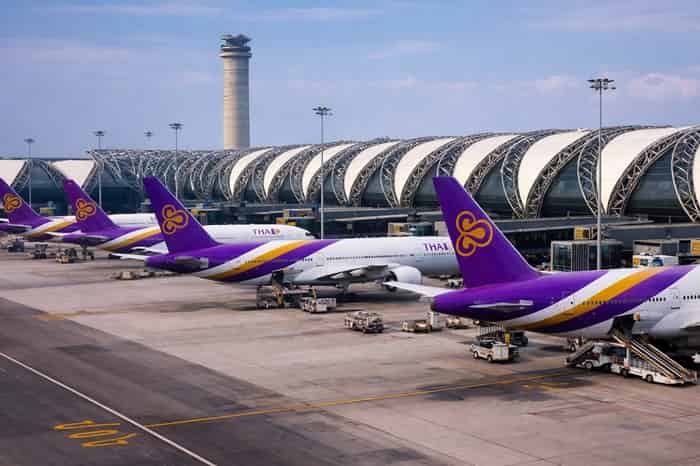
Airlines love a comeback story. Few deliver one properly.
Thai Airways has.
After years in the wilderness and a court-led rehabilitation few thought would truly stick, the Thai flag carrier is back in the black. Not cosmetically. Not temporarily. Properly.
And in this industry, that distinction matters.
By 2023, Thai Airways International had pulled off what many legacy carriers promise but rarely land: a sustainable return to profitability built on reform, not rebound. No sugar rush from revenge travel. No accounting gymnastics. Just hard structural repair.
It’s been a long road from 2021, when rehabilitation began under court supervision. The process stripped emotion out of the airline and replaced it with discipline. Not glamorous. Absolutely necessary.
The Numbers Finally Behave
Start with the figures because they finally make sense.
Revenue climbed from about THB 104 billion in 2022 to roughly THB 161 billion in 2023. By 2024, estimates suggest this will reach THB 188 billion, excluding one-off rehabilitation noise.
Looking ahead, growth is expected to moderate to around THB 195 billion in 2025 and to nudge past THB 200 billion in 2026.
That’s not explosive. It’s something better: believable.
Debt: The Elephant Finally Leaves the Room
At the start of rehabilitation, Thai Airways had more than US$11 billion in debt. Years of political interference, fleet sprawl and soft governance had taken their toll.
The reset was brutal but effective. Debt haircuts. Equity conversions. Hard negotiations.
For the first time in years, the airline is operating without a financial handbrake permanently engaged.
And unlike previous “turnarounds”, this one came with external oversight. That matters. Guardrails stop old habits from creeping back.
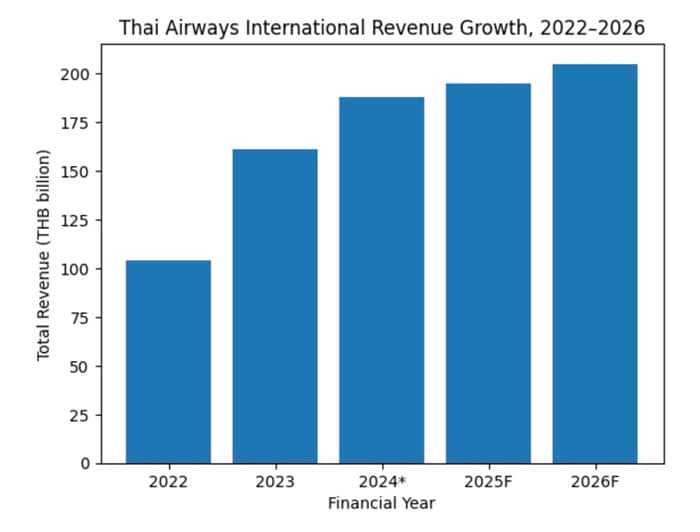
Thai Airways International revenue growth, 2022–2026. 2024 adjusted for one-off rehabilitation accounting items; 2025–2026 based on analyst consensus forecasts.
Network Discipline Replaces Ego Flying
Perhaps the most visible shift is in the network.
Routes once flown for prestige rather than profit have quietly disappeared. Secondary Europe. Patchy South Asia. Gone.
In their place: Japan, Australia and core European gateways where yields justify the metal.
It’s a smarter map. Less romantic, more commercial.
The absorption of Thai Smile into the mainline operation also cleaned up years of duplication. One brand. One strategy. Less confusion in the market.
A Fleet That Finally Grows Up
If there’s a single symbol of Thai Airways’ maturity, it’s the fleet.
Today’s backbone is clear: Airbus A350s and Boeing 777-300ERs for long haul, supported by 787 Dreamliners and a tighter regional narrow-body presence.
Older, maintenance-heavy aircraft have been retired, cutting engineering complexity and operating costs in one sweep.
The average fleet age now sits in the low teens, a meaningful shift from pre-rehabilitation days when the airline felt older than its timetable.
Newer aircraft also bring consistency on board. Cabins are more aligned. Seating is harmonised. The product feels considered again.
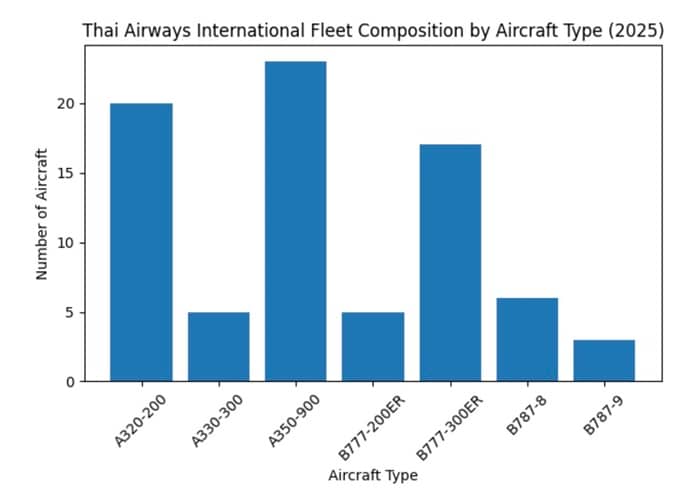
Thai Airways International fleet composition by aircraft type, 2025. Figures reflect active in-service aircraft following post-rehabilitation fleet rationalisation.
Service: Still a Work in Progress
Where Thai Airways still invites debate is the soft product.
Thai hospitality remains one of aviation’s most authentic assets, and when the airline delivers, it delivers beautifully. But consistency remains uneven.
Reviewers continue to praise the warmth and cultural identity, while noting variability across routes. Management knows it. Catering and delivery tweaks are underway.
Hardware is easy. Human delivery takes longer.
Premium Pricing Returns And Sticks
Another signal of confidence is pricing power.
Business-class fares, particularly on European and Bangkok routes, have firmed noticeably since 2022. Limited capacity and strong premium demand have pushed yields up and kept them there.
Corporate buyers may grumble quietly, but from a commercial standpoint, it’s on the right side of the ledger.
With wide-body capacity across Asia still structurally tight, there’s little evidence that premium fares will soften quickly.
A Much Tougher Playing Field
Of course, Thai Airways hasn’t re-emerged into a gentle market.
Singapore Airlines still defines premium benchmarks. Middle Eastern carriers dominate long-haul flows with scale and deep pockets. North Asian rivals remain formidable.
And low-cost carriers continue to keep regional pricing brutally honest.
Thai’s answer isn’t scalable. Its relevance.
Bangkok remains a powerful geographic hub. Alliance connectivity still matters. And restraint, finally, is part of the strategy.
What It Means for Thailand
The airline’s recovery ripples beyond its own balance sheet.
Airports of Thailand has already felt the lift, particularly at Suvarnabhumi, where passenger volumes and slot utilisation are climbing again.
But infrastructure remains the next frontier. If Thailand wants aviation-led growth to stick, airport capacity has to keep pace.
Airlines can only fly where airports allow.
The Real Test Starts Now
By 2026, Thai Airways will no longer be a turnaround headline. It’s something more interesting, a functioning airline again.
Strengths are clear: a repaired balance sheet, a modernised fleet and strong home demand. Weaknesses remain in consistency and premium delivery. Opportunities sit in premium leisure and inbound tourism growth. Risks, fuel, geopolitics, and competition haven’t gone anywhere.
But the tone has changed.
This airline no longer feels fragile.
For Thailand, the return of a financially credible flag carrier is more than symbolic. It restores confidence in the national aviation story.
And perhaps the biggest shift of all?
Thai Airways isn’t chasing glory anymore.
It’s chasing sustainability.
That’s a far harder discipline and a far better sign.
by Andrew Wood and edited by Stephen Morton – (c) 2026.
Read Time: 5 minutes.
About the Writer.
 Andrew J. Wood has lived in Thailand since 1991. He is a former Director of Skål International and a Past President of Skål International Asia, Past President of Skål International Thailand, and a two-time Past President of Skål International Bangkok.
A former hotelier with senior management experience at leading hospitality groups including Shangri-La, Minor International, Landmark and Royal Cliff, he writes regularly for international travel and hospitality publications.
His work focuses on tourism trends across Asia, sustainable tourism development, and the future of travel and hospitality in the Asia-Pacific region.











