


Europe may still trade comfortably on its greatest hits, the Roman Colosseum, the boulevards of Paris, the Greek islands shimmering under dependable sunshine, but something quietly significant is unfolding beyond those postcard staples.
Long-haul travellers are beginning to wander.
And not accidentally.
Fresh research from Mabrian and The Data Appeal Company, presented at the European Travel Commission’s (ETC) Annual Meeting in Pärnu, suggests overseas visitors are increasingly steering themselves toward lesser-known regions, a shift that could prove one of the most commercially important developments for European tourism this decade.
After years spent wringing hands over overtourism, Europe may finally have stumbled upon a solution: dispersion driven not by regulation, but by traveller preference.
Menno Van IJssel of the European Travel Commission captured the mood succinctly.
“Our Annual Meeting in Pärnu is about making European tourism future-ready. We’re delighted to welcome Mabrian and Data Appeal to bring the latest intelligence from key overseas markets. These timely insights will help destinations stay competitive and deliver more balanced value across regions, seasons and stakeholders.”
Translation? Spread visitors, protect the icons, and let secondary regions share in prosperity.

The Long-Haul Engine Is Gathering Speed
If anyone still believes distance discourages travellers, the numbers politely disagree.
By 2029, more than one in ten arrivals to European destinations will originate from six heavyweight markets: Australia, the United States, Canada, China, Japan and South Korea, according to forecasts from the ETC and Tourism Economics.
Half will come from the US alone.
Air capacity is already rising to meet that appetite. Direct seats into Europe from these markets grew 5.2% in 2025, with the United States dominating connectivity at 36.4 million seats, followed by Canada (8.7 million) and China (6.8 million).
But the eyebrow-raiser, particularly for Australian agents watching outbound demand surge, is the 59.4% spike in capacity from Australia.
Yes, it’s off a smaller base, but momentum is momentum. When airlines add lift at that scale, they are signalling confidence rather than experimentation.
Asia is hardly idle either. Capacity from China climbed 12.3%, while Japan rose 9.2%, reinforcing the steady reawakening of eastern long-haul travel.
The message is simple: Europe is not getting quieter anytime soon, but it may be getting smarter.
Beyond the Bucket List
Let’s be clear, travellers are not abandoning Europe’s headline acts.
Italy’s Lazio and Tuscany, Spain’s Catalonia and Andalusia, France’s Île-de-France, and Greece’s Attica still command enormous gravitational pull. Collectively, just ten regions account for 32.2% of overseas stays.
Yet what is changing is behaviour upon arrival.
Increasingly, visitors are pairing marquee cities with quieter counterparts, swapping packed coastlines for wind-swept northern shores, and crowded piazzas for alpine villages where dinner reservations remain refreshingly obtainable.
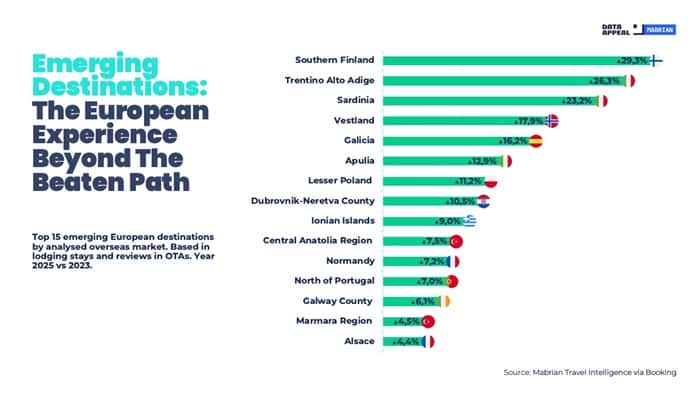
Northern Europe is enjoying particular curiosity. Southern Finland, Norway’s Vestland, Spain’s Galicia, Italy’s Trentino-Alto Adige, and France’s Alsace and Normandy are drawing travellers who appear less interested in heatwaves and more inclined toward scenery with elbow room.
Central Europe is edging confidently into the conversation as well. Croatia and Poland are gaining traction, while Greece’s Ionian Islands and Türkiye’s Marmara Region appeal to travellers who like their sea views without the soundtrack of mass tourism.
Meanwhile, culturally rich regions such as Central Anatolia and Ireland’s Galway County are benefiting from travellers chasing narrative as much as nostalgia.
Across all of them, one motivation rises above the rest: nature.
As Mabrian’s Director of Marketing and Communications, Carlos Cendra, observed:
“Overseas demand is becoming a powerful engine for diversifying European tourism.”
Not marketing spin, just market reality.
Shoulder Season Is Having a Moment
Perhaps the most encouraging revelation for tourism planners is timing.
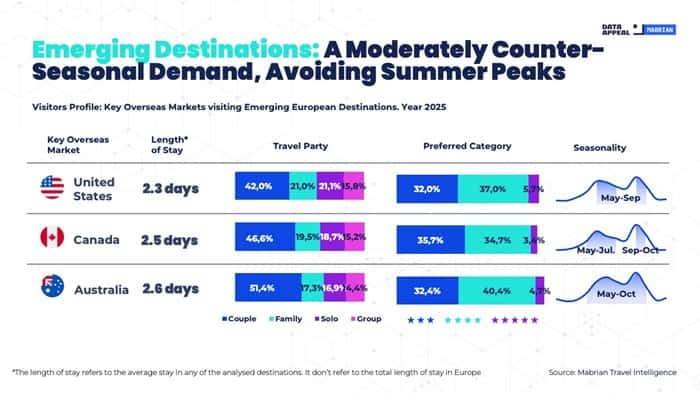
Overseas travellers are increasingly dodging the traditional crush of July and even more decisively August, opting instead for shoulder periods that offer milder weather, better pricing, and significantly fewer queue-related regrets.
Asian travellers are leading this behavioural shift, presenting destinations with a golden opportunity to smooth demand curves and stretch economic benefit across more months of the year.
For an industry long hostage to seasonality, this is the sort of trend that prompts quiet celebration in revenue meetings.
Who’s Travelling And What They Want
The profile of the emerging-destination traveller is reassuringly predictable in some respects and intriguingly divergent in others.
Americans, Canadians, and Australians overwhelmingly travel as couples, proving that shared discovery still sells.
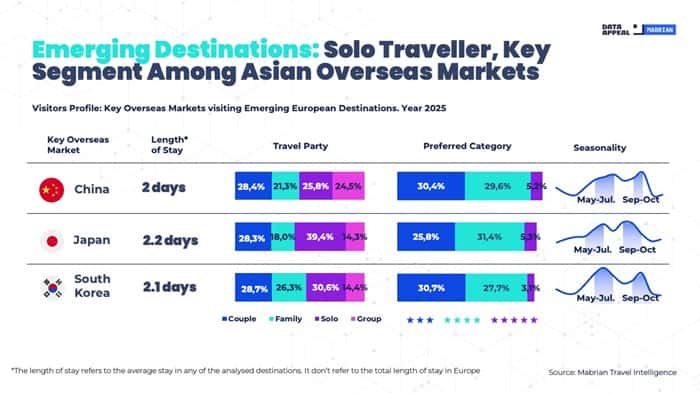
Japanese and South Korean travellers, meanwhile, are far more likely to travel solo, with solo travel representing their largest segment. Importantly, this independence is not purely corporate.
Chinese travellers show the strongest link between emerging destinations and business travel, with 16.5% visiting for professional purposes, compared with 10.5% of Japanese travellers and 9.4% of South Koreans.
Accommodation preferences offer another revealing layer.
American and Japanese visitors top the five-star charts at 5.7% and 5.3% respectively, while Canadians, Chinese, South Koreans and Americans distribute themselves comfortably across three- and four-star hotels.
Australians? Firmly planted in the four-star camp is a demographic that appreciates quality but still enjoys telling friends it was “excellent value.”
Some habits travel well.
Opportunity Provided Destinations Are Prepared
Emerging regions should resist the temptation to interpret rising interest as a guarantee of success.
A Mabrian spokesperson offered a pointed reminder:
“To capitalise on overseas demand trends and redistribute visitors beyond Europe’s most frequented destinations and peak months, it is essential that these alternative destinations provide a comprehensive range of tourist products and services, including fully operational accommodations designed to meet the preferences and needs of these long-haul travellers.”
Charm may spark curiosity, but infrastructure closes the sale.
Connectivity, accommodation standards, guided experiences and transport integration will determine whether these destinations become enduring fixtures or fleeting fascinations.
Europe’s Quiet Rebalancing
For years, the European tourism story has been one of paradoxical booming arrivals paired with mounting pressure on infrastructure and residents.
What this research hints at is something far healthier: a gradual rebalancing.
Travellers are dispersing geographically.
They are travelling outside peak months.
They are prioritising authenticity.
And perhaps most encouragingly, they are proving that real discovery still holds commercial power.
Europe’s icons will always shine. But the next growth chapter may belong to the valleys, coastlines and cultural enclaves that once sat politely outside the spotlight.
For travel advisors and operators paying attention, the takeaway is straightforward:
The map is widening.
And the smart money will follow.
Useful links:
European Travel Commission – https://etc-corporate.org
Mabrian – https://www.mabrian.com
The Data Appeal Company – https://datappeal.io
Tourism Economics – https://www.tourismeconomics.com
by Anne Keam – (c) 2026.
Read Time: 4 minutes.
About the Writer.
 Anne Keam’s story begins in Queensland, on a grain farm in the state’s wide western reaches, where the days were long and the lessons simple: work hard, look after your own, and don’t make a fuss. Those early years left their mark.
She later studied Arts at the University of Queensland, before doing what felt natural at the time, heading back home to the family property. But the world was calling. Anne packed a backpack and went looking, spending years on the road and finding herself most alive in South America. She wrote everything down along the way. Those notebooks, full of dust, colour and curiosity, eventually became her blog, a quiet, personal record of seeing the world and learning from it.











