

Every so often, the travel industry senses a shift, not the noisy kind that arrives with fanfare, but the steadier movement that seasoned operators recognise as the start of something durable.
The approaching Chinese New Year may well be one of those moments.
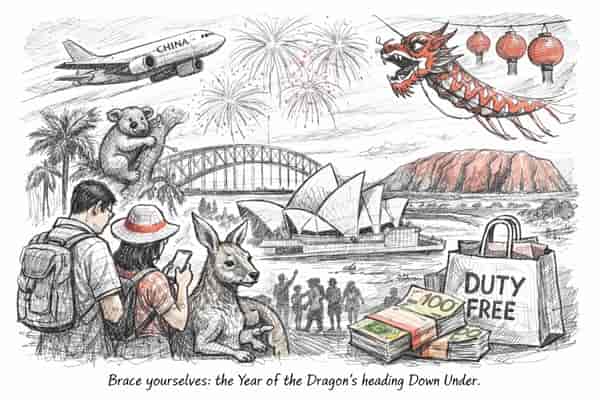
Fresh data emerging from China suggests Australia is on the cusp of welcoming one of the largest Lunar New Year visitor waves in recent memory, propelled by restored aviation capacity, relaxed visa settings and a Chinese traveller who appears increasingly comfortable looking far beyond short-haul borders once more.
For local tourism businesses, the advice is neither complicated nor subtle: be ready.
The longest celebration and potentially the richest
Officially running from 15 to 23 February, the 2026 holiday stretches across nine days, the longest Chinese New Year on record. Yet veterans of the sector know the calendar rarely tells the full story. Travel tends to swell before the first lantern is hung and linger well after the last dumpling is eaten.
Industry watchers are already pointing to a travel window extending from roughly 13 February into early March, nearly three weeks of heightened movement.
Encouragingly for Australia, multiple Chinese travel platforms have placed the country firmly on the long-haul wish list.
Beijing Business Today reported in January that travel agents’ packages to Australia and New Zealand were “basically sold out,” a phrase guaranteed to quicken pulses from Cairns to Collins Street.
Tongcheng Travel has ranked Australian summer experiences among the four defining travel trends for the holiday period, citing brisk growth across flights, hotels, escorted tours and customised itineraries. The Shanghai–Sydney corridor has even nudged into the top ten long-haul routes a reliable sign that affluent urban travellers are again thinking expansively.
UniTour International offered further encouragement, revealing that more than 80 per cent of its group departures to Australia and New Zealand were already committed by mid-December, earlier than many would have dared predict even a year ago.
Meanwhile, Airbnb reports that searches from Chinese guests for Spring Festival travel have more than doubled, with Australia holding its ground as a particularly attractive long-haul option.
Not bad, one might say, for a destination once considered “too far” during uncertain times.
Aircraft returning and with them, confidence
Capacity has always been tourism’s quiet kingmaker, and lately the crown has been getting a polish.
In December, China Southern Airlines reopened a valuable northern gateway with its direct Guangzhou–Darwin service, restoring a link that industry planners have long regarded as strategically important.
Soon after, Shenzhen Airlines launched its first non-stop Shenzhen–Melbourne route, injecting roughly 95,000 seats annually into the market and reinforcing Melbourne’s standing as one of Australia’s principal gateways for Chinese visitors.
The Victorian Government, through its Industry Partnerships Program, helped secure the route with targeted marketing support, while Melbourne Airport has sensibly boosted border-processing resources, a move travellers will appreciate after long hours aloft.
Put simply, more seats tend to mean more visitors. And more visitors tend to spend.
Friction fades from the travel equation
Policy has also played its part.
Relaxed visa settings have quietly removed one of the more tedious barriers to long-haul planning, while ongoing bilateral engagement has helped position Australia as both welcoming and dependable, qualities that resonate strongly in today’s outbound Chinese market.
Yet modern travellers measure convenience in more ways than paperwork alone.
Payment familiarity increasingly shapes destination choice, and UnionPay has spent years embedding itself across Australia’s commercial landscape. Its acceptance network now spans department stores, supermarkets, hotels, restaurants, transport providers and everyday services, while airline and accommodation platforms broadly support UnionPay for advance bookings.
Through the UnionPay App, cardholders can even settle tuition fees and utilities via BPAY, a practical detail, perhaps, but one that speaks volumes about the maturation of the market.
Seasonal promotions, merchant offers, and exchange-rate incentives provide additional incentives, ensuring visitors arrive not only ready to explore but also ready to transact.
Not a rebound, a recalibration
“This is going to be the longest Chinese New Year break in history,” said Michelle Shao, Executive Vice President, South Pacific Division, UnionPay International.
“The expansion of direct flight routes between China and Australia is supporting more flexible travel planning,” Shao added. “Longer stays and more diverse itineraries also place greater importance on seamless and familiar payment experiences. UnionPay is working with local partners to ensure merchants are well prepared to serve Chinese visitors during this peak period.”
Her broader assessment is perhaps more telling.
“The tourism data published in China recently highlights a fundamental shift in the scale and sophistication of Chinese outbound travel to Australia,” Shao said.
“What we saw in 2025 was not a rebound, but a reset to a much higher baseline of travel demand. Chinese tourism data suggests that 2026 might deliver record visitor numbers and record spending, particularly across duty-free, accommodation, dining and premium tourism experiences.”
Duty-free alone could surpass last year’s growth of more than 50 per cent, welcome news for retailers who understand that shopping, for many travellers, is practically a cultural activity.
The traveller has evolved
“Chinese travellers today are highly informed, digitally savvy and looking for depth of experience,” Shao said. “They are staying longer, travelling beyond capital cities and seeking authentic local experiences.”
For regional Australia, that sentence may be the most important in this entire story.
Dispersal has long been the industry’s ambition; now it appears increasingly within reach.
UnionPay, for its part, is working closely with merchants, tourism bodies and financial institutions to ensure the country is ready.
“UnionPay is committed to supporting Australia’s tourism ecosystem as it prepares for this period of increased activity from inbound Chinese tourists,” Shao said.
“By enabling seamless, secure and familiar payment experiences and wide acceptance, we help merchants convert demand into revenue and ensure that Chinese travellers can spend confidently wherever their journey takes them.”
Opportunity rarely knocks twice
With more aircraft in the sky, policy winds blowing in the right direction, and consumer appetite returning with confidence, the Chinese New Year 2026 is shaping less like a seasonal spike and more like the opening act of a renewed growth era.
“Current tourism indicators suggest a positive outlook for Chinese New Year travel in 2026,” Shao said. “For businesses across tourism, retail and hospitality, preparation will be key.”
Preparation, of course, has always separated tourism’s winners from its spectators.
Because when the world decides to travel again, truly travel, the destinations that prosper are rarely the ones scrambling at the last minute. They are the ones already waiting at the arrivals hall, calm, organised, and quietly expectant.
Australia, it seems, is very nearly there.
Useful Links:
https://www.unionpayintl.com
https://www.tourism.australia.com
https://www.melbourneairport.com.au
https://www.airbnb.com
by Charmaine Lu – (c) 2026.
Read Time: 6 minutes.
About the Writer.
 Charmaine has always carried a quiet kind of courage. She grew up in Shanghai, a city that never slows, yet found her own balance there, studying accounting for discipline and the arts for beauty. She needed both, and she knew it.
When she arrived in Sydney in the 1980s, she brought little more than a degree, a suitcase and the resolve to begin again. The harbour breeze felt like permission. She met Stephen, and together they built a life that bridged two cultures, a family, a home, and plenty of laughter.
Work was never just work. Long before search engines ruled the day, Charmaine was helping businesses be found by telling stories people wanted to read. That remains her quiet gift.
Her life isn’t a résumé. It’s grace under change structure and creativity, held together by a generous heart.











