On the island of Ireland, the Gaelic Athletic Association (GAA) isn’t just a sports organisation; it’s the cultural heartbeat of thousands of communities. Whether you attend a local Gaelic football derby at a tiny club on the Wild Atlantic Way, witness a game of hurling in the gorgeous Glens of Antrim or are lucky enough to immerse yourself in the red hot fervour of All-Ireland finals day, to see a Gaelic game in its full unfettered and wild glory is to experience a part of Ireland that gets to the very marrow of its culture.
Fusing myth and legend
Gaelic Games go back a long way in Irish heritage. The mythological hero of Ireland, Cú Chulainn – meaning “Hound of Culann” – is said to have got his name after he accidentally killed the beloved guard dog of an ancient lord. The hound had spotted the young hero approaching his master’s house carrying his hurl and ball, known as a sliotar, and – perceiving him as a threat – ran towards him fangs bared. To protect himself, the young hero fired the sliotar down the dog’s throat, killing it instantly. To make up for his mistake, he promised to guard Culann’s castle until a new hound was reared, and so he became known as the Hound of Culann, Cú Chulainn.
The written version of the legend dates to the 7th century, but the mythology is much older and suggests that hurling has deep roots in ancient Irish culture, given that Cú Chulainn is carrying a hurl and a sliotar, two pieces of equipment used in hurling. Centuries later, hurling is still being played in Ireland and is enormously popular. Fearless, fierce and utterly captivating, it’s often described as the fastest field sport on earth.
Its sibling, Gaelic football, though newer, is equally esteemed. Between them, these games are the most popular and played sports in Ireland, and today, the heroes of Irish culture are the young men and women whose dream is to represent their club or county on the sacred turf at Croke Park, Dublin.
Home of the GAA
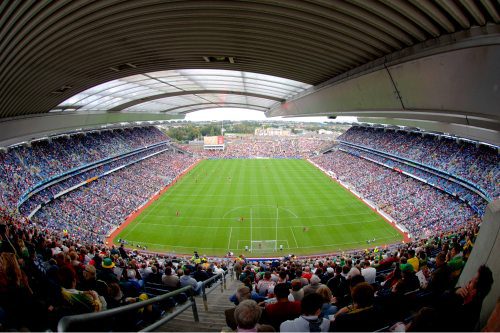
Since 1891, Croke ParkOpens in new window has been the home of the GAA, which organises the games of hurling and Gaelic football, as well as camogie (women’s hurling), ladies’ Gaelic football, handball and rounders. Given that many visitors from outside Ireland have never heard of hurling or Gaelic football, they’re often surprised by the scale of the stadium. Croke Park in Dublin is widely regarded as the largest amateur sports stadium in the world. It now ranks third behind Barcelona’s Camp Nou and London’s Wembley Stadium.
The stadium boasts an excellent museum, which takes visitors through the compelling and sometimes traumatic story of Gaelic Games in Ireland. As a totem of Irish identity, Gaelic Games were synonymous with Ireland’s struggle for self-determination and cultural preservation; a way of showing others what made us different. This museum touches on that story, but more often than not, it focuses on the great moments of the sport and the silky skills of legends such as hurlers Brian Whelahan from County Offaly, Kathleen “Kay” Mills from Dublin and footballers including County Meath’s Colm O’Rourke and County Cork’s Rena Buckley. Every one of these modern heroes is an amateur, playing solely and soulfully for the glory of their villages and the pride of their families.