

For most of the cruise industry’s modern life, passenger terminals have been treated like necessary but uninspiring infrastructure. They were places you passed through, not places that thought very hard about you while you were there.
Concrete, counters, queues. If a ship sailed on time and nobody missed it, the terminal had done its job.
That mindset no longer holds.
Passenger volumes are back, ships are larger, turnarounds are tighter, labour is more expensive, and travellers conditioned by airports that now clear people in seconds rather than minutes have little patience for maritime lag. The old terminal model, built on static schedules and manual coordination, is quietly buckling under the weight of modern expectations.
Which is why what’s happening at Singapore Cruise Centre deserves closer attention, not because it is flashy, but because it is deeply practical.
After nearly five years of digital overhaul, Singapore Cruise Centre (SCCPL) is entering the final phase of a transformation that has less to do with technology for its own sake and more to do with acknowledging a simple truth: you cannot run a modern maritime terminal on hindsight.
The problem terminals don’t like admitting
Ask most terminal operators where things go wrong, and they’ll tell you about weather, late vessels, staffing gaps, or customs delays. All true. But underneath those variables sits a more uncomfortable issue: fragmentation.
Passenger bookings live in one system. Vessel movements in another. Baggage, staffing, immigration, and public announcements are loosely connected, reconciled later, and often managed by people working with partial information.
That model worked when margins were forgiving and volumes predictable. It does not work when a 300-seat ferry needs to turn in 30 minutes, when berth space is finite, and when passengers expect airport-level flow without airport-level friction.
Singapore Cruise Centre confronted that reality early. Rather than layering yet another system on top, it chose to tackle the connective tissue itself.
Why real-time data changes behaviour, not just dashboards
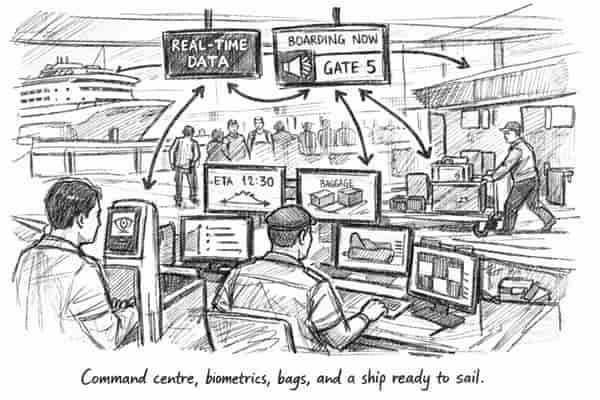
At the core of SCCPL’s approach is a real-time data integration platform built on event-driven architecture. That phrase alone is enough to make some industry readers glaze over, which is precisely why it’s worth stripping it back to what it actually does.
Instead of systems checking in with each other periodically, events are published once and shared instantly with all authorised systems that need them.
A booking confirmed.
A vessel’s ETA shifts.
A jetty sensor detects movement.
Each of those moments becomes a shared signal, not a delayed update.
The practical effect is not prettier dashboards. It is a behavioural change. Operations move from reacting after something has gone wrong to adjusting while it is still unfolding.
As Lee Siew Kit, Vice President of Technology & IT at Singapore Cruise Centre, has observed, this enables terminals to move from managing by exception to managing by anticipation.
Five seconds tells you everything
The best test of any operational upgrade is not the boardroom. It’s the passenger.
At Singapore Cruise Centre, a traveller can now clear immigration in under five seconds using biometrics alone. No passport scan. No document shuffle. No second attempt because the system didn’t sync.
That speed is not the result of a single clever gate. It works because passenger check-in data is transmitted in real time to immigration systems, well before passengers reach the gate.
When the traveller steps forward, the system already knows who they are.
For passengers, it feels effortless. For operators, it removes one of the most stubborn choke points in terminal flow. For the industry, it signals that maritime terminals are quietly catching up to aviation, without the theatrics.
Planning that starts months out and ends in the moment
Running a terminal is not one operation. There are many layers on top of each other.
Singapore Cruise Centre manages this through a four-stage operational lifecycle that blends long-range planning with real-time responsiveness.
Months ahead, seasonal data support berth planning and capacity forecasting. Days out, confirmed bookings refine staffing and resource allocation. On the day itself, live data streams from systems, sensors and frontline teams drive tactical decisions in real time.
After the last passenger boards, historical data closes the loop, reconciling billing, reviewing performance, and sharpening the next plan.
What matters here is not the framework itself, most operators have some version of this, but the fact that every stage now runs on the same live data spine.
That’s what makes the difference between planning that looks good on paper and operations that actually hold together when conditions shift.
Small fixes, real impact
Not every improvement announces itself.
Public announcements are a case in point. Previously, PA systems checked backend systems at fixed intervals, resulting in delays and message mismatches across terminals. A boarding update could reach one hall before another, or arrive late altogether.
Now, when an update is made, it is published once and received instantly by all relevant PA units.
Passengers hear the same message, at the same time, wherever they are standing. Staff spend less time correcting confusion. The terminal feels calmer, which, in high-throughput environments, is no small achievement.
Terminals don’t operate alone anymore
One of the more telling aspects of SCCPL’s transformation is how deliberately it looks beyond its own perimeter.
By standardising data sharing with ferry operators, government agencies and other partners, the centre has laid the groundwork for a broader maritime ecosystem built on shared situational awareness.
That includes developing a Maritime Passenger Terminal Digital Twin, a live, operational view that combines vessel location, speed, ETA data, CCTV analytics, and operational alerts.
The aim is not novelty. It is risk reduction, better planning, and safer operations across an increasingly complex network.
This ecosystem mindset also underpins fly-ferry and fly-cruise integration, where passenger and baggage data move securely and in real time from aircraft arrival to maritime departure and back again.
For travellers navigating air, land and sea in a single journey, reliability matters more than branding. Real-time coordination reduces delays, mishandling and the quiet stress that comes from uncertainty.
Why this matters for AI and why most terminals aren’t ready
Much is made of artificial intelligence in travel, but most operations struggle to move beyond retrospective analytics. The reason is simple: AI is only as good as the data it receives, and most terminal data arrives late, fragmented, or incomplete.
Singapore Cruise Centre’s real-time integration changes that equation.
Its AI roadmap unfolds in three phases: internal generative AI for operational knowledge retrieval, predictive analytics for disruption management, and, ultimately, a digital twin supported by agentic AI to assist decision-making and coordinated response.
None of this works without a reliable stream of live events. With it, AI becomes operational rather than ornamental.
That distinction matters. The industry is full of AI pilots that look impressive in presentations and disappear quietly in practice. SCCPL’s approach is slower, less theatrical, and far more likely to stick.
Old industry, new discipline
There is something refreshingly grounded about how Singapore Cruise Centre has gone about this.
It has not chased every trend. It has not promised an overnight transformation. It has connected systems properly, recognised that complexity requires discipline, and built a platform that enables people to make better real-time decisions.
For the wider cruise and ferry sector, the lesson is not that every terminal needs the same technology stack. It is that integration is no longer optional.
Terminals that continue to rely on batch updates, manual coordination, and institutional memory will be exposed not by technology vendors, but by passengers who no longer accept friction as part of the journey.
Singapore Cruise Centre’s transformation is not the end of a project. It is the admission that the old way of running terminals has reached its limit and that the future belongs to those prepared to connect the dots properly.
Quietly. Methodically. And with very little patience for guesswork.












