If global travel were a relay race, Asia has the baton, and it’s accelerating hard into early 2026.
Fresh analysis from Mabrian, part of The Data Appeal Company, confirms what airline networks, hotel pipelines and tourism boards have been quietly banking on: Asia is no longer just rebounding, it’s decisively driving global travel inspiration.
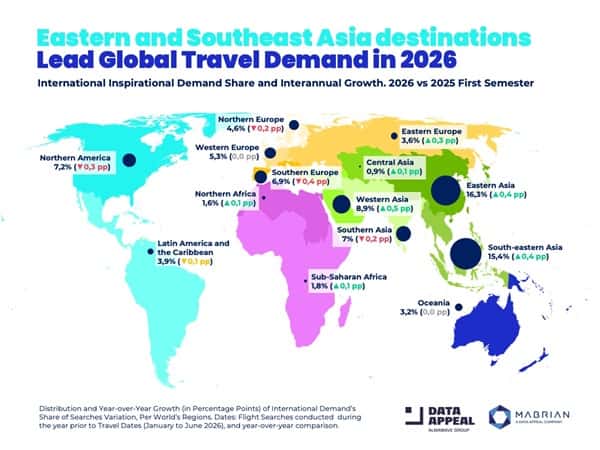
International travel demand for the first half of 2026 is forecast to grow modestly overall, but the geography of that growth tells a far more interesting story. Eastern Asia and Southeast Asia together now command 31.7 per cent of global international travel intent, making the region the single most powerful engine of demand worldwide between January and June next year.
It’s a shift that feels both new and oddly familiar, a reminder that the great travel arcs of history tend to swing east when confidence returns.
Asia’s long runway keeps extending
Mabrian’s analysis tracks global flight-search behaviour across the top 50 airports in each world region, covering 86.7 per cent of total global demand. By focusing exclusively on international searches for the first half of 2026, the study offers a clean, standardised snapshot of where travellers are dreaming and booking next.
That picture is underpinned by a 5.9 per cent increase in international air capacity compared with the same period last year. But capacity alone doesn’t explain Asia’s dominance. What is diversity?
Eastern Asia accounts for 16.3 per cent of global inspirational demand, with Japan once again leading the charge. What’s notable this time, however, is that growth is no longer funnelled solely through Tokyo and Osaka. Demand is spilling into regional centres such as Fukuoka and Sapporo a sign of a market maturing rather than overheating.
Southeast Asia follows closely behind with 15.4 per cent of global demand, led by Vietnam, whose transformation from emerging destination to global bucket-list mainstay appears all but complete. Indonesia, the Philippines, and Cambodia continue to benefit from travellers seeking value, authenticity, and a warmer welcome beyond traditional European circuits.
As in 2025, Asia’s performance confirms its role as the backbone of international travel inspiration, not a temporary rebound story, but structural momentum.
Western Asia makes a confident play
While Asia’s east and south dominate headlines, Western Asia is quietly tightening its grip on global relevance.
The region now accounts for 8.9 per cent of total international inspirational demand in the first half of 2026, outperforming the same period last year. Crucially, this growth is supported by a 3.6 per cent increase in international air capacity across Gulf Cooperation Council markets.
Three GCC destinations, Jeddah and Riyadh in Saudi Arabia, and Doha in Qatar, rank among the world’s top 10 fastest-growing destinations by travel intent, alongside Jakarta, Hanoi, Ho Chi Minh City, Seoul, Moscow, Manila and Tokyo.
It’s a list that reflects a broader recalibration of global travel flows, one less dependent on legacy hubs and more responsive to new connectivity, pricing and experience-led appeal.
“While traditionally popular regions continue to capture the largest share of global travel demand, we are seeing that lesser-known and alternative destinations are expanding their market share,” said Carlos Cendra, Director of Marketing and Communications at Mabrian. “This evolution is driven by demand growth from emerging inbound markets and more appealing value for money, signalling that inspirational demand is diversifying like never before.”
Established markets ease back for now
Not every region is enjoying the same tailwinds.
Southern Europe and North America, home to many of the world’s most visited destinations, show a minor softening in international travel intent for the first six months of 2026. Similar dips appear in Southern Asia and Northern Europe.
This isn’t cause for alarm, cautions Cendra, but context matters.
“The performance of these regions should be analysed considering that the travel intent refers to the first half of 2026, which covers the shoulder and early summer seasons but does not include the highest peak of the summer season that typically drives demand in these regions,” he said.
In other words, timing, not loss of appeal, explains much of the apparent slowdown.
Caribbean demand wobbles amid instability
Analysts are watching the Caribbean more closely.
Tensions in the region earlier this month are already rippling through forward demand indicators. Mabrian data show a global softening in international travel intent toward the Caribbean, particularly from US and European source markets.
The Share of Searches Index for travel between January and March 2026 reveals a slight decline in the Caribbean’s global market share in February and March. In the US market, the contraction is sharper: outbound demand falls from 9.1 per cent to 7.6 per cent year-on-year, with the steepest decline recorded in January.
Reduced interest in the Mexican Caribbean, the Dominican Republic, Jamaica, Aruba and Colombia’s Caribbean coast is driving the trend. European markets show a milder dip in February, followed by a partial recovery, though still below last year’s levels.
“The resilience of Caribbean destinations will be key to rapidly regaining market confidence, especially if conditions in the area stabilise in the short term,” a Mabrian spokesperson said. “To do so, it is essential for destinations to monitor source market perception and adapt their strategies.”
Reputation proves its worth
In contrast, Western Asia appears to be absorbing recent unrest with remarkable composure.
Despite protests and instability in Iran, global travel intent towards Western Asia and GCC destinations remains stable through the first quarter of 2026. A brief dip in February is followed by a March rebound that marginally exceeds last year’s levels.
As Cendra notes, the performance underscores “the critical role that a strong destination reputation plays in cushioning the impact of unforeseen events on travel demand.”
It’s a lesson the industry has learned repeatedly over decades: trust, once earned, buys time.
Why data is now the industry’s compass
Behind every trend line sits a strategic imperative.
“In today’s rapidly evolving social and economic context, data-driven travel intelligence enables destinations and DMOs to anticipate demand shifts, respond to volatility, and reinforce evidence-based strategic decision-making,” said Mirko Lalli, CEO of The Data Appeal Company.
For governments, airlines and tourism bodies alike, early 2026 is shaping up as a test of agility rather than ambition. Asia’s rise is no longer speculative; it’s measurable, sustained and commercially consequential.
And for an industry that still remembers how quickly confidence can evaporate, that kind of clarity is worth its weight in jet fuel.