

In an industry not known for its sentimentality, stability is quietly becoming the most welcome guest of all.
Fresh forecasts released by CoStar Group and Tourism Economics at the Americas Lodging Investment Summit suggest the US hotel sector is entering 2026 with its footing intact and expectations largely unchanged, a small miracle in itself after several years of economic whiplash.
The inaugural 2026–27 outlook shows modest but meaningful upgrades across the industry’s key performance measures. Occupancy, average daily rate (ADR) and revenue per available room (RevPAR) were each lifted by 0.1 percentage points for 2026, while supply growth was trimmed by 0.2 points. Demand projections dipped slightly, but not enough to dull the overall optimism.
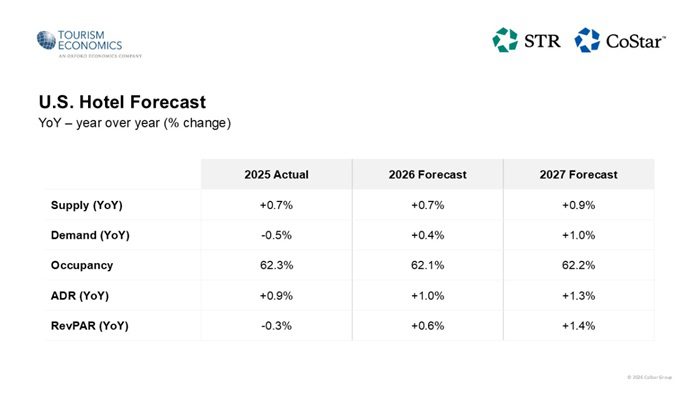
According to Amanda Hite, president of STR, the back half of 2026 is where the real action begins. “We expect top-line performance to strengthen in the second half of the year, although growth will remain moderate and concentrated among higher-tier hotels,” she said. World Cup host cities and nearby markets are expected to enjoy early gains, aided by calendar shifts and the fading impact of hurricane-disrupted comparables from 2024.
Growth is forecast to lift again in 2027, though with a dose of realism. Even a projected 1.4 per cent increase in RevPAR would remain well below the long-term average of three per cent, hardly champagne territory, but respectable given the circumstances.
From a broader economic lens, Aran Ryan, director of industry studies at Tourism Economics, sees a more supportive travel environment emerging in 2026. Real wage growth and household wealth are expected to offset softer employment conditions for younger and lower-wage earners. Meanwhile, business investment is forecast to widen beyond artificial intelligence as borrowing costs ease and tax incentives take effect.
International travel may wobble in the short term, but Ryan expects a gradual rebound as global demand strengthens and the World Cup injects fresh momentum into peak summer arrivals.
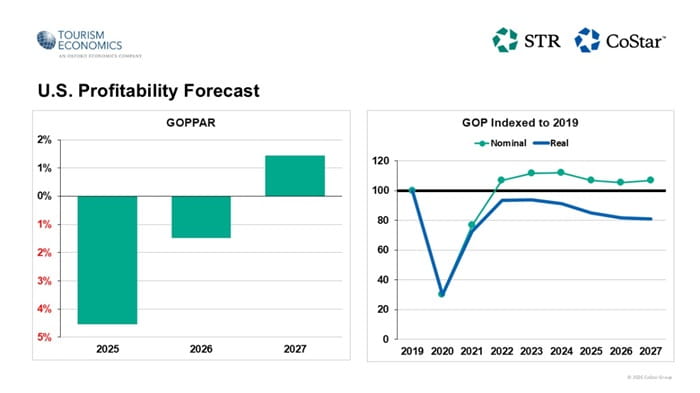
Costs, however, remain the industry’s stubborn reality. While total revenues are tipped to rise faster than last year, expenses are still expected to outpace inflation, albeit at a slower clip than in 2025. As Hite notes, growth may be steady, but discipline will remain essential.
For hoteliers, investors and lenders alike, the message is clear: the road ahead may not sparkle, but it’s solid, navigable and in today’s climate reassuringly predictable.
For more information on the forecast and supporting data, visit costargroup.com.
by Jason Smith – (c) 2026.
Read Time: 2 minutes.
About the Writer.
 Jason Smith was educated in terminals, taxis and hotel corridors, the sort of schooling no classroom could hope to provide. Half American, half Asian, he grew up inside the quiet machinery of tourism, watching his family send strangers into the world long before he travelled himself.
Bangkok came first, then the Asian Institute of Hospitality & Management, followed by a career stitched together across Singapore, Malaysia and Vietnam. Each city left a mark. Thailand eventually claimed him, along with a corner office, as Director of Sales for one of the country’s leading hotel groups.
Then the world paused. Borders closed, skies emptied, and Jason returned to America carrying time, memory and a lifetime of stories.
Now at Global Travel Media, he writes the human side of travel check-ins, departures and everything between with warmth, clarity and an instinct for connection.











