

By any measure, it is the sort of accolade that normally lands on the usual suspects. Kenya. Tanzania. South Africa. Perhaps Botswana, if the judges are feeling refined.
So when Bradt Guides, the gold-standard publisher for adventurous travellers, quietly placed Eswatini second on its authoritative list of Best Safaris in Africa, more than a few seasoned safari hands did a double-take.
Eswatini? The pocket-sized kingdom tucked between South Africa and Mozambique?
Exactly.
And therein lies the charm.
Bradt’s verdict confirms what a loyal band of insiders has known for years: Eswatini is not simply a safari destination. It is Africa, distilled.
“Africa in miniature,” Bradt calls it, a phrase that sounds like marketing poetry until you experience it firsthand. In a country smaller than Tasmania, travellers find open savannahs, misty mountains, river valleys, big game, rare birds, living culture, and a sense of intimacy that the continent’s grander reserves long ago lost.
For Australians accustomed to epic distances and complex itineraries, Eswatini offers something refreshingly old-fashioned: safari without the scaffolding.
Here, you drive yourself. You arrive without fanfare. You step quietly into the wilderness that still feels personal.
And the wildlife, mercifully, does not seem to have read the memo about staying elusive.
At Mlilwane Wildlife Sanctuary, the nation’s pioneering conservation success, guests wander on foot or bicycle among zebras and antelope, sleep in beehive huts modelled on traditional EmaSwati homesteads, and discover that safari need not always involve a LandCruiser and a checklist.
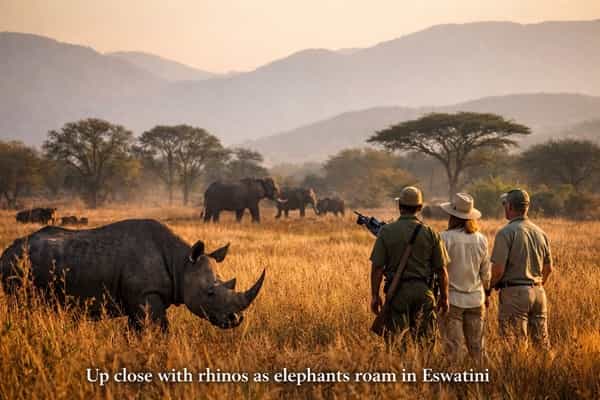
Further north, Hlane Royal National Park delivers the classic big-game theatre. Elephants drift through the bushveld. White rhinos graze with aristocratic indifference. Lions, thankfully, remain suitably aloof. It is the Africa of childhood atlases, minus the crowds and the queue for the sunset photograph.
Mbuluzi Game Reserve, meanwhile, proves that small countries can host large surprises. Over 300 bird species patrol its skies, while giraffes browse so close you can hear leaves snap between their teeth. Birders arrive with binoculars. Everyone else leaves unexpectedly converted.
Yet it is Mkhaya Game Reserve that explains Bradt’s enthusiasm most eloquently.
Regarded by conservationists as one of the world’s finest rhino sanctuaries, Mkhaya specialises in the sort of encounters that money cannot buy elsewhere. On foot, with an armed ranger and a sensible heart rate, guests track both black and white rhinos at distances that feel politely reckless. No engines. No fences. No crowds.
Just breath, dust and the quiet authority of animals that were here long before safari became fashionable.
In an era when African travel increasingly resembles a luxury conveyor belt, Eswatini’s genius lies in its restraint. Visitor numbers remain modest. Roads stay navigable year-round. Wildlife does not obey seasons quite so strictly. Planning becomes optional rather than obligatory.
For families, first-timers and self-drive travellers, this accessibility is nothing short of liberating.
Bradt Guides’ endorsement carries particular weight. The publisher has long specialised in destinations overlooked by mainstream tourism, building its reputation on meticulous research and a stubborn fondness for authenticity. That it once produced the only English-language guidebook devoted entirely to Eswatini back when the kingdom still answered to Swaziland speaks volumes about its quiet faith in the destination.
Rumours of a new edition now circulating in travel circles suggest Bradt believes the world is finally ready to notice.
From an Australian perspective, the timing is impeccable. As travellers grow weary of crowded icons and algorithm-approved itineraries, Eswatini offers a reminder of how safari once felt: personal, unrushed and faintly miraculous.
There is no pretence here. No Instagram staging. No inflated narratives.
Just a small kingdom doing wilderness properly.
And occasionally, as Bradt has now confirmed, doing it better than almost anywhere else in Africa.
by Christine Nguyen – (c) 2026.
Read Time: 4 minutes.
About the Writer.
 Michelle Warner is a storyteller with jet fuel in her veins — the sort of woman who could turn a long-haul delay into a lesson in patience and prose. She began her career in media publications, learning the craft of sharp sentences and honest storytelling, before trading deadlines for departures as a flight attendant with several major airlines. Years spent at thirty thousand feet gave her a keen eye for human nature and a deep affection for the grace and grit of travellers everywhere.
Now happily grounded, Michelle has returned to her first love, writing, with the same composure she once brought to a turbulent cabin. Her work combines an editor’s precision with a traveller’s curiosity, weaving vivid scenes and subtle humour into stories that honour the golden age of travel writing. Every line is a small act of civility, polished, poised, and unmistakably human.











