

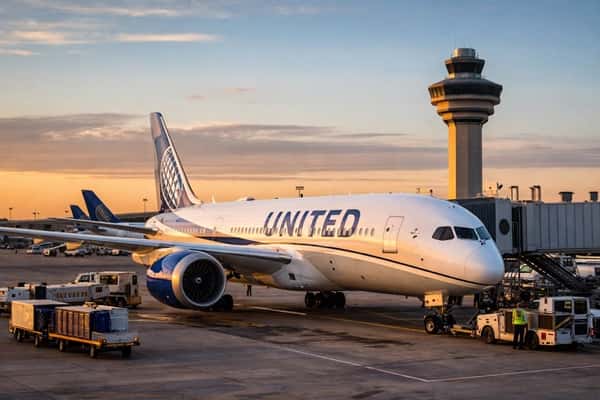
By any sensible measure, 2025 should have been a difficult year for United Airlines.
There was a government shutdown, volatile fuel prices, an anxious business market, labour noise, weather noise, and the usual cocktail of geopolitical jitters that now come standard with the boarding pass.
And yet, when the final numbers rolled off the printer, United had delivered the strongest year in its 98-year history.
Record revenue. Rising margins. Growing earnings. Loyal customers. Full planes. Fewer cancellations. And in a line that tends to separate good airlines from merely busy ones, rising trust.
For Wall Street, it was a beat.
For competitors, it was a warning.
For chief executive Scott Kirby, it was vindication.
Full-year diluted earnings per share rose 8 per cent to US$10.20, with adjusted EPS climbing to US$10.62, making United the only major US carrier to grow adjusted earnings year-over-year in 2025.
Total operating revenue hit US$59.1 billion, the highest in company history. Pre-tax profit landed at US$4.3 billion, while free cash flow reached US$2.7 billion.
And in the fourth quarter alone, United delivered US$15.4 billion in revenue, the largest quarterly takings the airline has ever recorded.
In an industry where scale often masks fragility, United is quietly building something more durable: loyalty at altitude.
Revenue, yes, but the quality mattered more
The headline numbers impressed. The composition impressed more.
Premium revenue rose 11 per cent for the year.
Loyalty revenue climbed 9 per cent.
Basic Economy, that supposedly joyless corner of aviation, still grew 5 per cent.
Business sales surged in January to their highest weekly level in United’s history. And the first fortnight of 2026 delivered the strongest ticketing week the airline has ever seen.
The pattern is unmistakable. United is no longer chasing volume. It is cultivating yield.
“Our results are built on winning more and more brand-loyal customers. It’s clear they get the most value flying United,” Kirby said. “This was the highest-revenue quarter in United’s history… and that momentum is continuing into 2026.”
In airline circles, such sentences are not uttered lightly.
Trust, earned the hard way
The November government shutdown could have derailed the quarter. Instead, it became a quiet masterclass in brand economics.
United offered full refunds to all customers, even when flights still operated. It advertised the policy loudly. It took the revenue hit. It absorbed a US$250 million earnings impact.
Then something interesting happened.
November became the highest Net Promoter Score month in United’s history.
Customers noticed.
In an industry built on fine print, United chose generosity. It was expensive. It was strategic. And it worked.
By year’s end, United posted its highest fourth-quarter customer satisfaction score on record and its strongest on-time passenger NPS since 2022.
Trust, it turns out, compounds.
Scale without chaos
Operationally, 2025 was a logistical flex.
United carried more than 181 million passengers.
It flew an average of 496,000 travellers a day.
It operated 303 widebody departures daily, the most in its history.
And despite that scale, it recorded the lowest seat cancellation rate among major US network airlines.
United Express logged 134 days without a single cancellation.
Connection Saver rescued more than one million missed connections.
Chicago O’Hare quietly outperformed its largest rival on punctuality.
These are not glamour metrics. They are profitability metrics.
Airlines make money not when planes are full, but when planes are predictable.
Premium: where the money is, and where United is going
United’s long-term bet is clear: premium is no longer an add-on. It is the engine.
In 2025, premium seats accounted for 27.4 million seats, or 12 per cent of total capacity, a record share.
And next year, the airline will unveil one of the most ambitious premium upgrades seen in decades.
The new United Elevated interior on the Boeing 787-9 introduces Polaris Studio suites that are 25 per cent larger, feature privacy doors, companion ottomans, 27-inch screens and exclusive dining.
It is not subtle. It is not cheap. And it is designed for a customer who now expects their bed at 40,000 feet to look suspiciously like a boutique hotel.
United plans to take delivery of over 100 narrowbody aircraft and around 20 Boeing 787s in 2026, more widebodies in a single year than any US airline since 1988.
That is not fleet renewal. That is network re-engineering.
Australia, Asia and the international edge
While US carriers once retreated inward, United is leaning outward.
In 2025, it became the only US airline to serve Adelaide, Bangkok, Ho Chi Minh City and Tepic.
For Australians, Adelaide’s inclusion matters. It signals a deeper Pacific strategy and renewed confidence in long-haul demand beyond Sydney and Melbourne.
And the expansion continues.
In 2026, United will launch services to Bari, Split, Santiago de Compostela and Glasgow, while adding new routes from Newark to Seoul and Washington-Dulles to Reykjavik.
International, once a risk, is now United’s competitive moat.
Technology, loyalty and the modern traveller
Much of United’s advantage now lives on the screen.
By late 2025, 85 per cent of customers were using the United app on travel day.
More than half resolved disruptions through self-service tools.
Bag tracking, live activities, and real-time connections all quietly reduced costs while lifting satisfaction.
Starlink Wi-Fi is now installed on more than 300 aircraft, with mainline rollout accelerating through 2026.
Loyalty, too, has been monetised with unusual creativity.
United launched its MileagePlus Debit Card, partnered with Lyft, expanded JetBlue redemptions, and added millions of Spotify and Apple TV viewing hours onboard.
The modern airline is not a transporter. It is a financial platform with wings.
Financial discipline beneath the gloss
For all the upgrades and ambition, United kept its balance sheet tidy.
Net leverage finished at 2.2 times.
Liquidity closed at US$15.2 billion.
Debt remained stable at US$25 billion.
The airline repurchased US$640 million in shares during the year and generated US$8.4 billion in operating cash flow.
Margins remain modest by tech standards, pre-tax margin of 7.3 per cent, but in airline land, this is disciplined, repeatable, and enviable.
Awards, culture and the softer signals
United collected more than 70 industry awards in 2025, including recognition from Forbes and Newsweek.
More telling were the internal numbers.
More than 10,000 employees volunteered over 33,000 hours.
The Special Olympics ambassador program expanded to six hubs.
United donated 32 million miles and transported humanitarian aid across four continents.
These initiatives rarely move share prices. They quietly stabilise workforces.
In aviation, morale is not a slogan. It is a safety feature.
What comes next
United enters 2026 with momentum, fleet capacity, rising premium demand and one of the strongest loyalty ecosystems in global aviation.
The risks remain familiar: fuel, geopolitics, labour, macroeconomics.
But strategically, United now holds three assets few rivals can match simultaneously:
Scale.
Premium depth.
Customer trust.
In an industry that once measured success in seat miles, United is now measuring it in relationships.
And that, in the long run, tends to be the most profitable route of all.
by Jill Walsh – (c) 2026.
Read Time: 6 minutes.
About the Writer.
 Jill Walsh has always had a pen within reach and a suitcase not far behind. She cut her teeth on media releases, then honed her craft shepherding press trips across half the globe, learning which stories travel well and which need a firmer edit.
In time, she wasn’t merely promoting places; she was representing them, translating civic ambition and local pride into words people wanted to read. Semi-retired now, Jill has swapped departure boards for deadlines, joining long-time colleague and friend Stephen at Global Travel Media on a casual basis.
Her beat is the business end of wanderlust: balance sheets, route maps, tender wins, the quiet numbers that decide where travellers actually go. She writes with tidy prose, dry humour and an old-school respect for facts, giving readers clarity without the clutter. In short, Jill brings seasoned judgement to travel’s moving parts and a steady voice when the market gets noisy.











