
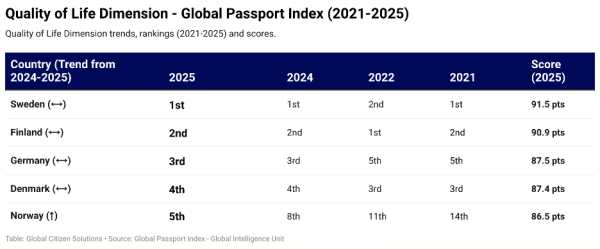
Global Citizen Solutions (“GCS”), has published the full results of the Quality of Life dimension of its Global Passport Index (GPI), ranking more than 180 countries based on their attractiveness as places to live, beyond international mobility alone. As quality of life becomes a decisive factor in relocation and long-term residency decisions, GCS’ Global Passport Index incorporates this dimension as a core component of passport strength, assessing the real-world conditions offered by the country to which a passport connects its holder.
At the global level, the Quality of Life ranking’s results confirm the continued dominance of Northern European countries as the world’s leading quality-of-life performers. Sweden ranks first globally, followed closely by Finland, Denmark and Norway, with the Nordics occupying four of the global top five positions. Their performance reflects consistently strong outcomes across institutional quality, public services, safety, environmental performance and social inclusion, reinforcing Northern Europe as the global benchmark for living standards.
“For internationally mobile families, professionals, and investors, the decision calculus is shifting,” said Dr. Laura Madrid, Lead Researcher at GCS’ Global Intelligence Unit. “Mobility still matters, but quality of life is now the differentiator — shaped by affordability, governance reliability, public services, environmental conditions, and whether newcomers feel welcomed and supported.”

Against this benchmark, Asia presents a more heterogeneous quality-of-life landscape, characterised by strong top-tier performers, sharp internal contrasts and increasing divergence between stability and structural pressure.
Japan emerges as Asia’s leading performer in the Quality of Life dimension, reflecting consistently strong outcomes in safety, infrastructure, healthcare access and public order. High life expectancy, reliable public services and urban functionality underpin its position as a regional reference point, particularly for globally mobile professionals prioritising predictability and institutional reliability.
Singapore continues to rank among Asia’s highest performers, supported by strong governance, advanced infrastructure, low crime and high institutional effectiveness. However, elevated cost-of-living pressures remain a constraining factor within its overall quality-of-life profile, highlighting trade-offs faced by high-income urban hubs across the region.
Several East Asian and Pacific economies maintain stable mid-to-high rankings, combining human development gains with improving infrastructure and environmental performance. At the same time, demographic ageing, housing affordability and climate exposure are increasingly visible constraints shaping long-term quality-of-life outcomes in parts of the region.
In South and Southeast Asia, the index reflects sharper contrasts. While select economies show incremental improvements linked to governance reforms and infrastructure investment, others experience declines driven by a combination of affordability pressures, environmental stress, institutional fragility and security challenges. These multidimensional pressures increasingly weigh on lived experience, even where economic growth remains positive.
Decline is increasingly multidimensional: the steepest drops globally are linked to compound pressures across affordability, governance, safety, and climate resilience. A high-income surprise decliner is Monaco, down 36 positions, driven by cost-of-living pressures and environmental constraints that penalise overall liveability despite wealth. The United States also falls (down 12 positions), illustrating that even mature democracies can slide when affordability pressures, inequality, polarisation, environmental shocks, and safety perceptions converge. Across Asia, downward trends are more often associated with the convergence of multiple pressures, such as climate vulnerability, air and water pollution, urban congestion, inequality and constraints on institutional capacity, underscoring the importance of resilience and governance quality alongside economic performance.
The Quality of Life dimension of the Global Passport Index is designed specifically for relocation and second-residency decision-making. It integrates indicators across human development and SDG progress, cost of living, freedoms and governance, happiness and subjective wellbeing, environmental performance, infrastructure and migrant acceptance. The analysis is fully data-based, drawing on sources including the United Nations, World Bank, OECD, Yale Environmental Performance Index, the World Happiness Report and Gallup.
For governments, investors and internationally mobile individuals across Asia, the 2025 findings reinforce a clear conclusion: passport strength is increasingly linked to the quality of life offered by the country of residence. Jurisdictions that combine institutional reliability, affordability, safety and environmental resilience are better positioned to attract talent, capital and long-term residents in an increasingly competitive global landscape.
To read the full interactive Quality of Life briefing of the Global Passport Index, visit the GCS Global Intelligence Unit.