The decorations come down. Credit card statements go up. The beach feels too far away. And somewhere in the northern hemisphere, a marketing consultant decided the third Monday of the month should be known as “Blue Monday”, allegedly the most depressing day of the year.
Accor has decided not to argue the science. It is simply changing the colour.
The French hotel giant is rebranding the moment as Blue Welldays, a global wellness campaign designed to turn seasonal malaise into what the company calls “micro-doses of well-being”. It is a neat piece of brand repositioning, part lifestyle intervention, part commercial land-grab, and it speaks to just how seriously big hospitality now takes the wellness economy.
That economy, according to the Global Wellness Institute, is on track to hit nearly US$9 trillion by 2028. At that scale, wellness is no longer a fringe indulgence for yoga retreats and green juice devotees. It is a mainstream business category. Accor wants a permanent seat at that table.
Wellness as Infrastructure, Not an Amenity
Blue Welldays sits within ALL Accor, the group’s booking platform and loyalty ecosystem, which now spans more than 5,700 hotels across 110 countries. This is not a seasonal marketing stunt. It is a strategic repositioning of wellness as an everyday utility rather than a luxury bolt-on.
Accor has been laying the groundwork quietly for years. Nearly 2,000 of its properties already feature spas or fitness facilities. Its portfolio spans brands such as Raffles and Sofitel, as well as Novotel and MGallery. And its internal wellness framework rests on five pillars: sleep, nutrition, movement, recovery and mental health.
The commercial logic is straightforward. Travellers increasingly choose hotels not just on price and location, but also on how well they sleep, how easily they can move, and how convincingly they can pretend to be improving themselves while ordering room service.
Blue Welldays is Accor’s attempt to formalise that behaviour into a brand platform.
From Myth to Micro-Ritual
Blue Monday itself is marketing folklore. The idea that a single January Monday can be mathematically proven as the most depressing day of the year has long been treated with polite scepticism by anyone with a calculator and a sense of proportion.
Accor’s answer is not to dispute it. It is to domesticate it.
Blue Welldays reframes the moment as a prompt for small, repeatable wellness rituals rather than grand lifestyle overhauls. The colour blue is recast not as melancholy, but as a palette of calm, breathing and lightness.
This is wellness stripped of sermonising. No detox edicts. No dawn-to-dusk mindfulness marathons. Just manageable, modular interventions designed to fit inside modern attention spans.
In practical terms, that means curated wellness experiences available year-round via ALL.com, supported by digital content, social activations and physical pop-ups.
A Pop-Up Pause in Paris
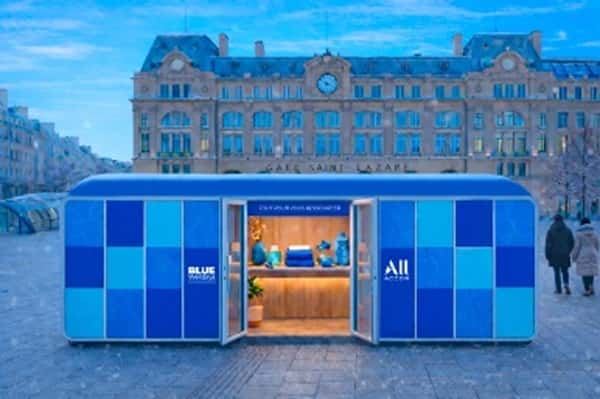
The most tangible expression of the campaign is a short-lived installation in Paris.
From January 19 to 21, 2026, Accor will take over the forecourt of Saint-Lazare Station with a free, open-access pop-up called The Blue Corner. Visitors can book 20-minute wellness sessions, which can be stacked into a one-hour experience the company calls “micro-escapes”.
The programming reads like a modern wellness sampler:
-
Sensory Meditation: a guided virtual-reality breathing session.
-
Shiro Abhyanga Massage: an Ayurvedic-inspired head massage focusing on scalp, neck and shoulders.
-
Oxygen Bar: enriched oxygen combined with subtle fragrances to restore clarity and focus.
-
Collagen & Energy Bar: hot beverages enriched with collagen and superfoods, created in collaboration with Paris’s 48 Collagen café.
It is democratic by design. No ticket price. No velvet rope. No wellness gatekeeping.
Which, from a brand perspective, is precisely the point.
Enter Paris Saint-Germain
There is also star power.
Accor has enlisted five Paris Saint-Germain players, Marquinhos, João Neves, Warren Zaïre-Emery, Khvicha Kvaratskhelia and Illia Zabarnyi, to share their personal wellness routines across social platforms.
The symbolism is deliberate. Elite athletes selling mindfulness to exhausted commuters is not subtle. But it is effective.
It positions wellness not as indulgence, but as performance maintenance. If professional footballers at the peak of physical intensity are talking about breathing, recovery and mental balance, it becomes harder for office workers to dismiss it as lifestyle theatre.
The content will be distributed across @ALL.Accor social channels and supported by an Instagram giveaway offering selected wellness routines.
The Commercial Subtext
There is nothing altruistic about any of this. Nor is it cynical.
Blue Welldays is a carefully calibrated commercial move into a category that is already reshaping travel behaviour. Wellness tourism is growing faster than traditional leisure travel. Younger travellers prioritise mental health and experiential value. Older travellers prioritise longevity and recovery. Both are willing to pay for hotels that make them feel better, not just places to stay.
Accor’s rivals are already there. Hyatt, Marriott, Aman, and Six Senses have all invested heavily in wellness-led programming. What differentiates Accor’s approach is scale and accessibility.
This is not retreat-based wellness for high-net-worth individuals. It is mass-market wellness delivered through a loyalty ecosystem.
In other words: not escape, but integration.
A Global Rollout With Local Texture
Accor is careful to emphasise that its wellness programming adapts to geography.
In Sydney, Swissôtel runs guided running clubs. In Morocco, Fairmont Taghazout Bay curates surf retreats. In Miami, the Faena Hotel offers shaman-led rituals and energy treatments. In Bali, wellness unfolds through recovery programs and movement experiences.
The ambition is consistency of philosophy without uniformity of execution.
That matters. Wellness that ignores local culture tends to feel synthetic. Wellness that absorbs it tends to feel credible.
The Business of Calm
There is something faintly subversive about a multinational hospitality group telling the world to slow down.
But it is also shrewd.
Blue Welldays positions Accor not as a purveyor of rooms, but as a steward of balance. It extends brand relevance beyond check-in and check-out. And it aligns neatly with how people already behave, seeking small improvements rather than transformational promises.
It also avoids the biggest trap in corporate wellness: overclaiming.
Accor is not promising enlightenment. It is selling stability.
And in an economy running on caffeine and cortisol, that may be the most commercially sensible pitch of all.
From Gloom to Growth Strategy
Blue Monday may be marketing fiction, but January fatigue is not.
Accor’s response is neither denial nor distraction. It is reframing.
By transforming a cultural trope of gloom into a platform for micro-wellness, the group is making a clear bet: that the future of hospitality will be measured not just in occupancy rates, but in how well guests feel when they leave.
Whether Blue Welldays becomes a permanent brand asset or a seasonal curiosity will depend on execution, not slogans.
But as strategic positioning goes, it is quietly smart.
And in a market drowning in performative wellness, restraint might turn out to be the most persuasive luxury of all.