

Australians have always voted with their cars come summer. Load up the boot, point it vaguely toward the coast, and don’t stop until the air smells different. What’s new this year is just how much economic muscle the annual migration quietly carries with it.
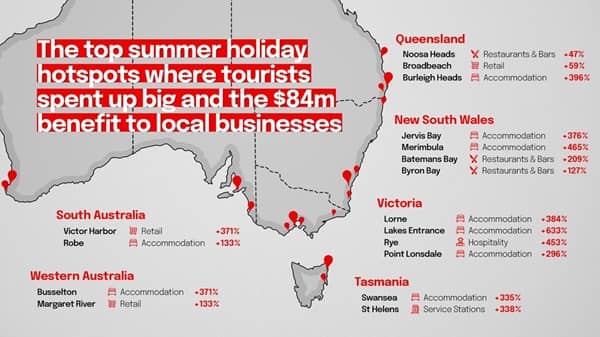
Fresh figures from the National Australia Bank suggest a two-week summer surge injected an extra $84 million into regional economies, with spending in some holiday towns jumping by as much as 80 per cent compared with a normal fortnight. For the cafés, bottle shops, bakeries and motels lining Australia’s coastline, it was the difference between getting by and getting ahead.
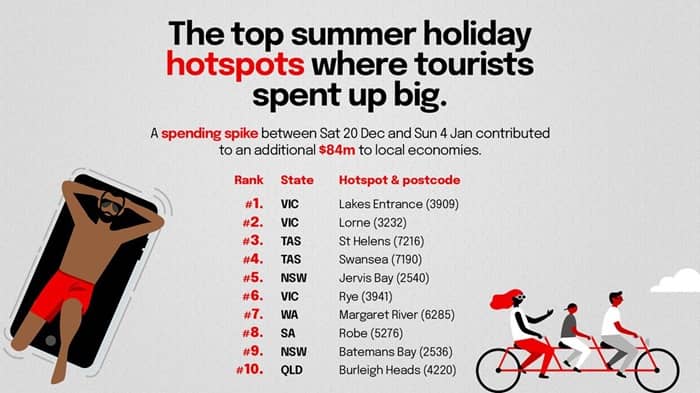
The biggest beneficiaries were familiar names to anyone who has ever battled holiday traffic: Lorne and Lakes Entrance in Victoria; St Helens and Swansea in Tasmania; and Jervis Bay in New South Wales. None are strangers to summer crowds. What stood out this year was the scale and concentration of the spending.
The bank’s analysis looked at almost half a million merchant terminal transactions, comparing peak holiday trading with a standard two-week period. The picture it paints is less about extravagance and more about volume. More people. More meals. More fuel stops. More impulse purchases that make or break a small business’s year.
Restaurants and cafés led the charge, followed closely by retail and accommodation. In Lakes Entrance, accommodation spending rose more than 600 per cent over the fortnight. In Margaret River, retail spending climbed 786 per cent the sort of figure that makes a shopkeeper forgive a month of rain.
NAB executive Julie Rynski, who oversees metro and specialised business customers, said the summer break remained the single most important trading window for many regional operators.
“The mass exodus from capital cities to holiday hotspots is crucial for smaller, local economies,” she said.
“This period often accounts for a significant share of annual turnover, particularly for accommodation, hospitality and fuel.”
What the data also reveals and what locals will recognise instantly are the small, human patterns behind the numbers. Candy stores in Batemans Bay enjoyed a sugar-fuelled rush. Boat hire surged in Lakes Entrance. Bakeries in Jervis Bay were run off their feet, long after the early-morning swims were done.
The lift in spending has knock-on effects that rarely make the holiday snaps: extra shifts for casual staff, bulk orders from local suppliers, and enough confidence to keep doors open through the quieter months.
For businesses like Jervis Bay Distilling Co, summer is less a season than a test of endurance.
Founder and head distiller Robert Bartlett said the holiday period remains unmatched for intensity and atmosphere.
“Summer is by far our busiest season,” he said.
“The cellar door fills with locals and visitors, and orders from nearby venues spike almost overnight.”
Extra staff are brought in, production schedules tighten, and the pace changes completely.
“There’s a particular energy in town at that time of year,” Mr Bartlett said.
“People are relaxed, they’re happy, and they’re in the mood to enjoy themselves. Being part of that helping shape those memories is something we genuinely value.”
While many Australians have now returned to work, businesses in popular holiday towns say the season is far from over. The Australia Day long weekend remains a final burst of trade, often determining whether the summer is remembered as merely busy or genuinely profitable.
Beyond the headlines, the figures offer a simple reminder. Domestic tourism, for all its clichés, still underwrites a vast slice of regional Australia. When Australians holiday at home, they don’t just recharge themselves. They stabilise small economies, sustain jobs and quietly keep coastal towns afloat long after the last beach towel is shaken dry.
It may not feel like nation-building. But for the businesses that rely on it, summer does an awful lot of heavy lifting.
by Jill Walsh – (c) 2026.
Read time: 4 minutes.
About the Writer.
 Jill Walsh has always had a pen within reach and a suitcase not far behind. She cut her teeth on media releases, then honed her craft shepherding press trips across half the globe, learning which stories travel well and which need a firmer edit.
In time, she wasn’t merely promoting places; she was representing them, translating civic ambition and local pride into words people wanted to read. Semi-retired now, Jill has swapped departure boards for deadlines, joining long-time colleague and friend Stephen at Global Travel Media on a casual basis.
Her beat is the business end of wanderlust: balance sheets, route maps, tender wins, the quiet numbers that decide where travellers actually go. She writes with tidy prose, dry humour and an old-school respect for facts, giving readers clarity without the clutter. In short, Jill brings seasoned judgement to travel’s moving parts and a steady voice when the market gets noisy.











