Airlines are not meant to live this long.
Aviation, by design, rewards confidence and punishes arrogance. It is an industry littered with bold logos now confined to museum walls and nostalgic Instagram feeds. For every centenary celebration, there are dozens of carriers that burned brightly, borrowed heavily and vanished quietly.
That is what makes the 100th anniversary of Lufthansa, marked on January 6, 2026, less a birthday and more an act of defiance.
Lufthansa has not endured because it has always been admired. It has endured because it has learned, sometimes painfully, how to survive history rather than outrun it.
Founded in Berlin in 1926 as “Luft Hansa”, the airline emerged at a time when flying was still half daredevilry, half engineering experiment. Europe was rebuilding, borders were fluid, and aviation promised a future that felt faster, cleaner and more optimistic than the railways that had defined the previous century.
Within months of its formation, born from the merger of Junkers Luftverkehr and Deutsche Aero Lloyd, Lufthansa’s aircraft were already in the air. What followed was rapid expansion and technical ambition, but also a lesson the airline would learn repeatedly: aviation does not operate in isolation from politics.
The history that cannot be skipped
No honest account of Lufthansa’s first century avoids its darkest chapter.
During the Nazi era, Lufthansa became entangled with the regime, operating not merely alongside it but as part of its machinery. This is not a historical footnote; it is a central fact. The first Lufthansa did not survive the war. It collapsed with the state it served.
What matters now is not denial, but acknowledgement. Lufthansa has used its centenary to confront this period openly, informed by historical research rather than selective remembrance. In doing so, it recognises that airlines, like nations, carry their past whether they like it or not.
The story of Lufthansa is therefore not a straight line, but a break.
Rebuilt from the ground up
The airline that exists today is legally and operationally a second Lufthansa.
Established in 1953 and relaunched in the skies in 1955, Deutsche Lufthansa AG was born in a Germany still learning to move again economically, politically and physically. There was no legacy network to inherit, no brand certainty to rely on, and no guarantee that international aviation would welcome a German flag carrier back.
What followed was one of the most methodical rebuilds in commercial aviation.
Lufthansa leaned into engineering, process and precision. It became a benchmark carrier, not glamorous like some rivals, but trusted. The airline helped shape global alliances, long-haul networks and operational standards that underpin modern aviation.
It also learned restraint. Survival had taught it caution.
People, not slogans
Today, Lufthansa employs more than 40,000 people directly under its core brand, drawn from 122 nations. Across the broader group, that number climbs to around 100,000 staff from more than 160 countries.
That diversity is not incidental. Airlines last when institutional knowledge is passed down, not replaced every cycle by reinvention rhetoric. Lufthansa’s culture has long been defined by professionalism rather than showmanship, a quality that does not trend well on social media but ages well in aviation.
The airline’s centenary slogan, “We are the Journey”, will appear on boarding passes and aircraft cabins throughout 2026. It is earnest, perhaps deliberately so. Lufthansa has never been a carrier that mistakes irony for strategy.
A centenary you can see
Unlike many corporate anniversaries that exist only in press kits, Lufthansa’s 100th year will be physically visible.
A permanent exhibition at Lufthansa Group Hangar One will anchor the celebrations, alongside a series of films, publications and events that trace not just success, but interruption. A poster campaign will bring archival images into city centres far from the runway, reminding the public that aviation history is not abstract; it shaped how the modern world learned to move.
And then there are the aircraft.
Flying reminders, not monuments
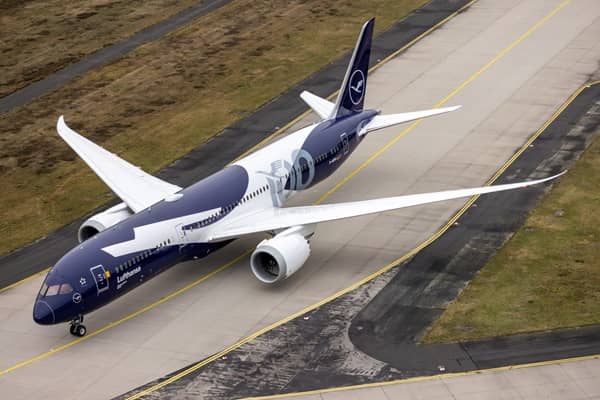
Lufthansa’s anniversary fleet comprises six aircraft across its core operations, each wearing a bespoke livery that balances heritage with modern design. An Airbus A380, two Airbus A350 variants, an A320, a Boeing 747-8 and a Boeing 787-9 Dreamliner will serve as flying reminders that longevity in aviation is earned mile by mile.
The flagship is the Boeing 787-9 Berlin, registered D-ABPU, delivered from Boeing’s Washington State factory shortly before Christmas and now based in Frankfurt. It will soon enter scheduled service, not as a museum piece but as a working aircraft with a working airline.
Two additional retro liveries will nod to earlier eras, unified by the crane logo designed in 1918 by Otto Firle, a symbol that has outlasted governments, borders and aircraft types.
What the next century demands
Lufthansa enters its second century facing challenges its founders could not have imagined: decarbonisation, geopolitical fragmentation, digital disruption and a public increasingly sceptical of air travel’s footprint.
But if history offers guidance, it is this: Lufthansa does not survive by pretending change is optional.
It survives by adapting early, absorbing criticism, and moving forward without theatrical reinvention. That approach may never win it universal affection, but affection has never kept an airline aloft.
At 100, Lufthansa is not celebrating perfection. It is acknowledging persistence.
And in aviation, that may be the rarest achievement of all.
by Bridget Gomez – (c) 2025
Read Time: 6 minutes.
About the Writer.
 Bridget has never been one to sit still. Of Portuguese heritage, she first trained as a nurse. She threw herself into work at the Commonwealth Veteran Affairs Repatriation Hospital, tending to old soldiers with stories almost as colourful as her own would become. It was rewarding, steady work, but wanderlust has a louder voice than routine.
So, she swapped starched uniforms for a backpack and set off on a twelve-month gallop around the globe. Along the way, she scribbled in journals, capturing the dust, the laughter, the odd missed train, and the occasional glass of wine too many. Those notebooks soon became a travel blog, her way of reliving and sharing the journeys with anyone willing to read.
Eventually, Bridget stumbled across Global Travel Media and, in her words, “the rest is history.” Now she writes with the same mix of heart and mischief that fuelled her travels.