

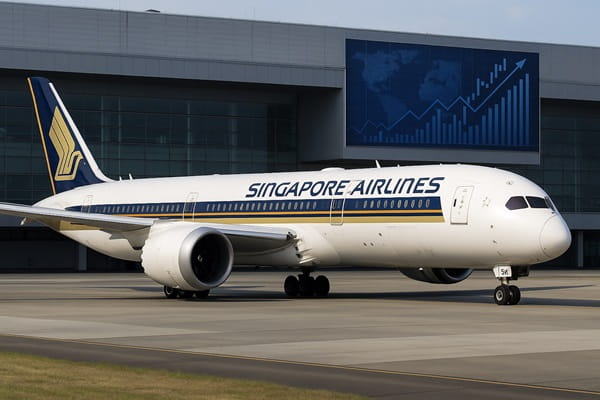
Singapore Airlines has delivered a first-half scorecard that, at first glance, looks like two different airlines stitched together. The operating side is disciplined, stable and performing much as analysts expected. But the net result? That took a hit big enough to make the market sit up and take notice.
The reason is no mystery: Air India’s losses, now flowing through SIA’s books for the first time under equity accounting, landed with force. And while that’s never pleasant, it also wasn’t entirely unexpected. Anyone who’s followed the Indian flag carrier’s long, uneven transformation under Tata Sons knew the early years would be expensive.
Still, numbers matter, and these numbers tell a story of a flagship carrier holding firm while its newest associate tests the strength of its balance sheet.
Operating momentum holds steady at $803 million.
The headline that actually reflects SIA’s day-to-day business isn’t the net profit at all, it’s the $803 million operating profit, just a whisker above last year’s figure, despite higher non-fuel costs and softer yields. Not many full-service carriers can boast that sort of composure while inflation eats into everything from catering to crewing.
Passenger demand remains robust. SIA and Scoot carried 20.8 million passengers, up 8%, pushing load factors to a sturdy 87.7% — the sort of utilisation most carriers chase for years. Revenue edged up to a record $9.675 billion, helped by cheaper fuel prices and consistently strong regional travel demand.
Yields dipped 2.9%, which will irritate executives but surprise no one. Competition across Asia continues to heat up, and passengers are increasingly savvy about where real value lies.
Cargo was similarly soft, with revenue down 2.8%, though cargo has been jumpy ever since global supply chains went back to improvising themselves every three months.
Operating performance, then, is firm. The wheels are turning cleanly, which is precisely why the net profit drop stands out so sharply.
Net profit plunges 67.8% as Air India’s losses mount.
The Group’s net profit fell sharply to $239 million, a 67.8% drop that reflects two main pressures:
-
Lower interest income, thanks to smaller cash holdings and global rate cuts.
-
A $417 million deterioration in the share of results from associated companies, chiefly Air India.
The airline began formally accounting for Air India’s financial performance from December 2024, following Vistara’s integration. It’s a logical strategic step. India is one of the world’s fastest-growing aviation markets, and SIA’s foothold there is central to its multi-hub vision.
But Air India is also deep into a long, expensive overhaul. No one rehabilitates a legacy airline of its size without the balance sheet looking bruised in the early stages.
SIA knows this. Tata knows this. The market knows this.
Still, accounting impacts have a habit of drowning out broader achievements, and this first-half result is no exception.
Second quarter better than it looks at first glance
Strip out the Air India drag, and SIA’s second quarter actually reads quite positively.
Operating profit jumped 22.5% to $398 million, supported by a second consecutive quarterly revenue record of $4.885 billion. Passenger traffic rose 5.1%, tempered by a 3% decline in yields, a familiar squeeze across the Asia-Pacific region.
Cargo, again, sagged modestly.
Net profit for the quarter fell 82% to $52 million, entirely due to the same accounting and interest impacts.
In other words, the core business is holding its line. The accounting optics are messy. But the fundamentals are not.
Balance sheet demonstrates discipline – debt falls sharply
While earnings wobbled, the balance sheet moved in the opposite direction and decisively so.
Group shareholders’ equity sits at around $15.5 billion, largely steady. Total debt fell by $2 billion, lowering the debt-equity ratio to 0.70, a meaningful improvement that speaks to controlled leverage and operational confidence.
Cash and bank balances dropped to $6.4 billion, reflecting dividend payments and bond redemptions, predictable drains with $1.6 billion in operating cash flow partially offsetting the outflow. The Group also holds $2.1 billion in longer-term fixed deposits and maintains $3.3 billion in undrawn credit lines.
For an industry known for thin margins and high capital costs, that sort of liquidity is enviable.
Fleet and network expand ahead of winter demand.
The Group’s fleet now stands at 208 aircraft, averaging 7 years, 8 months. Younger fleets burn less fuel, attract fewer reliability issues, and keep environmental critics at a manageable distance.
SIA added three Boeing 737-8s during the quarter, while Scoot continued to build its presence with Airbus A320neos, a 787-8, and an Embraer E190-E2.
The network will expand further during the Northern Winter 2025 season, with additional services to Auckland, Busan, Kathmandu, Kochi, Phuket, Tokyo, and several seasonal routes. Scoot, in particular, is in expansion mode, opening or boosting services to Nha Trang, Kota Bharu, Chiang Rai, Palembang, Medan, and more.
Combined, SIA and Scoot now operate a passenger network covering 129 destinations and a cargo network reaching 133, touching 37–38 countries depending on whether you count certain territories with their own timetables.
Partnerships across Southeast Asia strengthen SIA’s regional footing
Two partnerships stood out during the half, both reinforcing SIA’s long-running approach of collaborating where it counts, rather than trying to dominate every market alone.
In August, the airline deepened ties with Garuda Indonesia, expanding codeshares and introducing reciprocal lounge access, a small gesture with a significant impact on frequent flyers.
Then in September, SIA inked a new codeshare with Vietnam Airlines, covering key Vietnamese cities with room to expand. It’s a pragmatic strategy: Southeast Asia’s aviation market is too fragmented for any single carrier to win every route outright.
This is the kind of cooperation that quietly and steadily reshapes traffic flows.
Brand, loyalty and customer experience continue evolving
SIA’s new in-flight safety video, created with the Singapore Tourism Board, is more than a fresh coat of paint. It’s the latest in a long-running push to keep the airline’s brand culturally anchored, visually distinct and globally recognisable.
The Time To Fly travel fair returned with 380,000 discounted tickets, reinforcing the Group’s commitment to premium travel at accessible price points.
KrisFlyer also underwent meaningful changes, including lower-mileage redemptions on Scoot and refreshed milestone rewards. Loyalty, once a quiet corner of airline economics, is now a battleground, and SIA is clearly not letting it slide.
Dividends reflect confidence rather than complacency.
The Group announced an annual special dividend of 10 cents per share, payable over three financial years, totalling roughly $900 million. The first instalment is a 3-cent special dividend alongside a 5-cent interim dividend, both payable on 23 December 2025.
This is not the behaviour of a company uncertain about its prospects. It is, instead, a signal: the core business is strong enough to return capital while weathering the early impact of Air India’s turnaround.
Outlook: steady skies, but always with a warning light flashing
SIA heads into the third quarter with travel demand still resilient, particularly across the year-end peak. Cargo remains trickier, exposed to shifting trade dynamics and redeployed capacity from the US.
Geopolitics, inflation, supply chain gaps and oil price volatility continue to ensure no airline sleeps easily.
But SIA, with its liquidity, young fleet, stable operating base and disciplined growth strategy, remains one of the region’s more structurally resilient carriers.
And Air India? That’s the long game. It will take time and money. But in this business, the best returns often come from the markets others underestimate.
By Susan Ng – (c) 2025
Read time: 6 minutes
About the Writer
 With the polish of an international hotel professional and the heart of a born storyteller, Susan Ng has spent years behind reception desks, in banquet halls, and among linen carts, learning what genuine hospitality feels like, not just looks like. From the first greeting to the last goodnight, she understands that excellence lives in the small, unshowy gestures that linger long after checkout.
Away from the bustle, Susan’s curiosity found another front desk: the blank page. Her candid, thoughtful, sometimes wry blog pieces drew a quiet but loyal readership who sensed the truth behind her words. Today she’s turning that same eye for grace and imperfection toward the written world, offering stories rich in empathy, insight and lived detail. Every time, expect warm, genuine and polished writing like the perfect check-in.
=================================











