

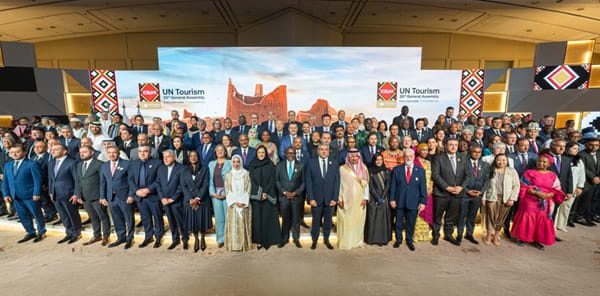
In a world that seems to reinvent itself every few months, Saudi Arabia has taken the old-fashioned long view and quite a long one at that. The 26th session of the UN Tourism General Assembly closed in Riyadh with the adoption of the Riyadh Declaration on the Future of Tourism, a sweeping 50-year plan designed to steer global tourism well into the middle of the century.
It’s a bold move, the kind of sweeping, strategic vision we used to see in the days when nations planned in decades rather than financial quarters. And in a sector still dusting itself off after a few rough years, the appetite for stability and a clear map is strong.
A Declaration with Its Eyes on 2075
The Riyadh Declaration positions the Kingdom as both a convenor and an architect of global tourism cooperation, elevating its status as a centre of industry-shaping decisions. More importantly, and this is where the mood in Riyadh felt particularly future-minded, the declaration is anchored around sustainability, AI-driven innovation, digital transformation and more inclusive economic opportunities.
Far from a ceremonial communiqué to be filed away and forgotten, the Declaration is designed as a genuine operational roadmap. Its priorities include building sector resilience, growing community-led tourism, and ensuring economic development doesn’t bulldoze cultural or environmental heritage along the way.
One senior delegate described it as “a framework built with a surprisingly practical streak,” and that sentiment echoed throughout the halls.
Saudi Arabia’s Expanding Diplomatic Footprint
His Excellency Ahmed Al Khateeb, Minister of Tourism, captured the tone of the gathering with refreshing firmness, declaring:
“From Riyadh, we move from declarations to delivery. The agreements signed here and the platforms we are launching will mobilize investment, upskill our people, digitize our SMEs, and protect culture and nature. As home to UN Tourism’s Regional Office for the Middle East, the Kingdom will continue to convene partners and deliver measurable outcomes, so tourism remains a bridge between nations and a driver of shared prosperity.”
That blend of confidence and pragmatism reflects Saudi Arabia’s broader strategy: heavy investment, assertive diplomacy, and a bid to become the world’s most influential tourism convener.
Al Khateeb was equally blunt about the political message:
“The declaration’s adoption signals renewed determination among the international community to unlock the full economic and social value of tourism as we pursue the SDGs. It is also a vote of confidence in Saudi Arabia’s position as a facilitator of dialogue and a new hub for collaboration.”
The subtext was clear: Riyadh intends to become not just a destination, but a headquarters for the future of the global travel economy.
A Historic First for UN Tourism Leadership
While the Declaration took centre stage, delegates also endorsed a milestone appointment. Shaikha Nasser Al Nowais will become the next Secretary-General of UN Tourism in early 2026, the first woman and the first GCC national to hold the role.
Her appointment adds symbolic weight to the session’s recurring themes of inclusion and modernisation. And in a region undergoing rapid transformation, her leadership promises to introduce a more diverse perspective to an industry in urgent need of fresh thinking.
TOURISE: A New Engine for Public-Private Cooperation
Adding further substance to the week’s announcements was the unveiling of TOURISE, a new Saudi-led platform intended to knit the public and private sectors closer than ever. Designed to accelerate digital transformation, sustainability initiatives, workforce development and cross-border investment, TOURISE aims to provide the kind of structured collaboration the industry has often lacked.
In many ways, TOURISE reflects the Declaration’s spirit: practical, investment-driven, and focused on equipping the tourism sector for whatever the next half-century throws our way, economic shocks, climate disruptions, or technological revolutions.
A Sector Looking for Certainty – and Finding It in Riyadh
If there was a prevailing sentiment as delegates filed out of the General Assembly, it was relief mixed with renewed ambition. Tourism has spent the last five years oscillating between crisis management and cautious recovery. A 50-year plan, one that is globally endorsed, digitally minded, and rooted in sustainability, feels almost revolutionary.
Whether Riyadh’s roadmap carries the sector all the way to 2075 remains to be seen, but for now, the Kingdom has positioned itself as a decisive voice in a world hungry for direction. And in tourism, an industry built on movement, clarity may be the most valuable currency of all.
By Jason Smith – (c) 2025
Read Time: 4 minutes
About the Writer
 Jason Smith has the kind of story you can’t fake, built on long flights, new cities, and that unmistakable hum of hotel life that gets under your skin and never quite leaves. Half American, half Asian, he grew up surrounded by the steady rhythm of the tourism trade in the U.S., where his family helped others see the world long before he did.
Eager to carve out his own path, Jason packed his bags for Bangkok and the Asian Institute of Hospitality & Management, where he majored in Hotel Management and found a career and a calling. From there came years on the road, Singapore, Malaysia, Vietnam, each stop adding another thread to his craft.
He made his mark in Thailand, eventually becoming Director of Sales for one of the country’s leading hotel chains. Then came COVID-19: borders closed, flights grounded, and a new chapter began.
Back home in America, Jason turned his knack for connection into words, joining Global Travel Media to tell the stories behind the check-ins written with the same warmth and honesty that have always defined him.











