

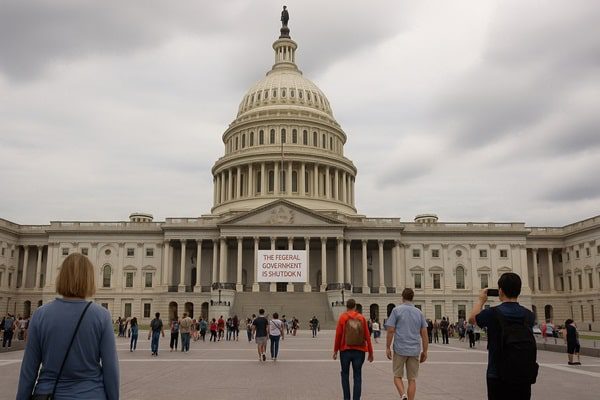
It’s a strange sort of superpower that can send people to the Moon but can’t keep its own museums open. Yet here we are again: the United States has locked its doors, switched off the lights and left the “Welcome to America” sign flickering in the dark.
At 12:01 a.m. EDT on 1 October 2025, the U.S. government officially ran out of money. By the evening of 4 November, it had broken its own record for political paralysis. At 8:27 p.m. EST, the Senate voted 54-44 against moving forward. One senator muttered that they were “working through the night,” though the only thing that seemed to move was the clock.
The sound of closing doors
For tourists, that click of the lock in Washington echoes all the way to Sydney and Seoul. The shutdown has halted visa processing, idled park rangers, and sent airport queues snaking out past the food courts. In Los Angeles, weary Australians eye the departure boards with the look of people trapped in a remake of Groundhog Day Without Pay.
The Federal Aviation Administration, short-staffed and short-tempered, has quietly warned airlines to trim flight schedules by 10 percent at major hubs. Not exactly the “land of the free” when you can’t even freely take off.
Aussies abroad – patience tested.
Australians are famously forgiving travellers. We’ll queue, we’ll wait, we’ll even smile politely while the Americans fingerprint us. But the patience is thinning. “We saved two years for this,” sighed Fiona from Sydney, stranded in San Francisco after her Grand Canyon leg was scrubbed. “Turns out Congress cancelled our holiday.”
Back home, travel agents are steering customers toward Asia and the Pacific. “It’s not anti-American,” one agent said. “It’s just that Bali doesn’t shut itself down every six months.”
Asia’s shrug
In Singapore, posters for U.S. tours are coming down faster than Christmas decorations in January. “Clients want certainty,” explains Ken Lim, a veteran tour operator. “They ask: Will the parks be open? Will flights be normal? I say well, depends if Congress agrees on breakfast.”
Across Asia, the U.S. is no longer the default dream trip; it’s a gamble. Tokyo newlyweds who once honeymooned in Hawaii are booking Hokkaido instead. The American brand, once synonymous with reliability, is now a byword for red tape and rolling uncertainty.
Europe’s wry detachment
Over in Europe, the schadenfreude is practically a tourist attraction. “Every time America catches a chill,” chuckled a Paris travel agent, “Europe sells another weekend in Provence.” London papers run daily tallies of the shutdown’s duration, as if counting down to a royal wedding.
But behind the jokes lies a fundamental shift. With the dollar strong and U.S. bureaucracy wobbling, the numbers are moving: international bookings to America down seven percent, intra-European travel up. A Brit summed it up neatly: “For what a week in Florida costs, I can get two in Crete and someone still says ‘cheers’ when I pay.”
Counting the cost
The U.S. Travel Association estimates the tourism industry is losing US$1 billion a week. That’s not abstract, it’s baristas in Boston, guides in Utah, Uber drivers in Miami. The ripple spreads fast. When America sneezes, global tourism reaches for Panadol.
The tragedy is that much of this was avoidable. Airports, national parks, and museums are the soft-power symbols that sell “Brand America” better than any campaign ever could. And yet, Washington keeps proving that even the world’s wealthiest nation can turn its hospitality into collateral damage.
Australia’s silver lining
If there’s a quiet winner here, it’s us. Tourism Australia reports a bump in domestic and trans-Tasman bookings since early October. “People are nervous about long-haul chaos,” one executive admitted, “so they’re staying closer to home.”
That might be cold comfort to the airlines, but it’s a boon for Cairns hotels, Margaret River wineries and New Zealand ski lodges. The Pacific, it seems, is benefiting from America’s political hangover.
The Senate’s midnight theatre
Back in Washington, senators spent last night in yet another “emergency” session, if “emergency” means the same speeches rearranged like deckchairs on a budgetary Titanic. At 10:15 p.m. EST, Majority Leader John Thune told reporters he was “hopeful of bipartisan progress.” By 11 p.m., the chamber lights dimmed, and America’s travel plans dimmed with them.
A weary world watches
For international travellers, the equation is simple: reliability equals desirability. Once, the U.S. could claim both. Now it can’t. A shutdown might be an American domestic drama, but its stage is global.
Australians know that travel, at its best, is about connection. You book a ticket, not a political statement. Yet here we are, watching the world’s biggest tourism magnet shake itself to pieces over budget lines.
One can’t help thinking of that famous Las Vegas slogan, What Happens in Vegas Stays in Vegas, and wishing it applied to Congress.
Final word
The United States will reopen, eventually. It always does. But every time it closes, a little more trust leaks out of the brand. The tourists will return, they always do, but some won’t come back as readily. They’ll have discovered Kyoto, Lisbon, Queenstown, and the Kimberley. Places that don’t shut down on principle.
For now, Lady Liberty still holds her torch aloft, but if the lights keep flickering in Washington, she might start charging admission by candlelight.
By Jason Smith, reporting from Los Angeles – (c) 2025
Read time: 6 minutes.
About the Writer
 Jason Smith has the kind of story you can’t fake, built on long flights, new cities, and that unmistakable hum of hotel life that gets under your skin and never quite leaves. Half American, half Asian, he grew up surrounded by the steady rhythm of the tourism trade in the U.S., where his family helped others see the world long before he did.
Eager to carve out his own path, Jason packed his bags for Bangkok and the Asian Institute of Hospitality & Management, where he majored in Hotel Management and found a career and a calling. From there came years on the road, Singapore, Malaysia, Vietnam, each stop adding another thread to his craft.
He made his mark in Thailand, eventually becoming Director of Sales for one of the country’s leading hotel chains. Then came COVID-19: borders closed, flights grounded, and a new chapter began.
Back home in America, Jason turned his knack for connection into words, joining Global Travel Media to tell the stories behind the check-ins written with the same warmth and honesty that have always defined him.











