
When an airline’s CEO starts a quarterly briefing by referencing “labour disruption,” investors usually tighten their seatbelts. Yet Air Canada’s third-quarter update proved that a few mid-flight bumps haven’t thrown the flag carrier off its long-haul trajectory.
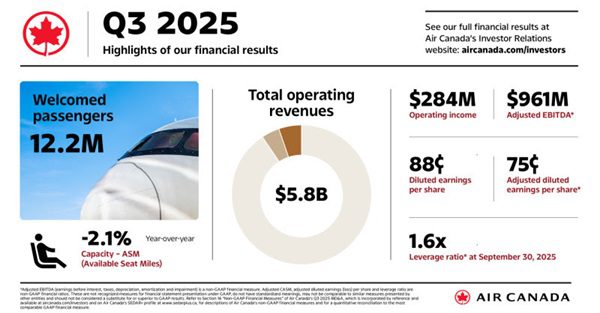
Despite a 5 per cent drop in revenue to C$5.77 billion, the Montreal-based airline delivered a tidy operating income of C$284 million. It adjusted EBITDA of C$961 million, a performance that, while softer than last year, still shows resilience in a sector where headwinds are as common as tailwinds.
Storms at altitude, calm in the cockpit
Chief Executive Michael Rousseau struck an apologetic yet upbeat tone:
“We delivered a solid third-quarter performance after adjusting for the labour disruption,” he said. “We deeply regret that the disruption significantly affected our customers… The entire company worked extremely hard to assist those whose travel was disrupted and to quickly return our operations to normal.”
Rousseau’s note of contrition quickly gave way to confidence. Operationally, the airline exceeded its own targets on punctuality and customer satisfaction, outperforming last year’s benchmarks. For a carrier that’s spent the better part of a decade shaking off the baggage of pandemic-era chaos, that’s no small feat.
Atlantic tailwinds, trans-border steadiness
The quarter’s strength came from the Atlantic market, Europe continues to lure Canadian travellers, and the premium-cabin segment, where the airline’s strategy of upgrading its business-class experience is paying dividends. Meanwhile, trans-border routes to the United States held steady, mirroring early-year patterns.
Bookings into the fourth quarter and early 2026 show what Rousseau described as “good momentum”, with positive early indicators suggesting that pent-up demand remains robust. In other words, Canadians are still swapping snow boots for sun hats.
Balancing the books at cruising altitude
For all its operational grit, Air Canada remains a numbers game. The airline’s net income came in at C$264 million, or C$0.88 per diluted share, while adjusted net income stood at C$223 million. The free cash flow tally of C$211 million underscores the airline’s ability to generate liquidity even as it modernises its fleet.
Operating margins narrowed to 4.9 per cent, a comedown from last year’s lofty 17 per cent, but Rousseau insists that the trajectory remains “in line with expectations” once the one-off labour costs are stripped out.
The airline is also keeping a disciplined eye on costs. Its adjusted cost per available seat mile (CASM) rose to 13.99 cents, reflecting inflation, labour settlements and higher maintenance charges. But with new, fuel-efficient aircraft rolling off the production line and a tighter network focus, management expects a gradual easing through 2026.
Fleet renewal and a fresh Rouge
Rousseau confirmed that the next twelve months will see a major fleet transformation, with new-generation aircraft replacing older jets. A revitalised Air Canada Rouge, the leisure-focused arm, is also due for relaunch — a timely move given renewed appetite for sun destinations.
“Our focus over the next twelve months is on preparing the airline to grow and expand margins as we transform our fleet with best-in-class aircraft and a revitalised Rouge offering,” Rousseau said. “We will continue improving our cost structure through productivity gains and operational efficiencies.”
It’s a nod to the enduring industry truism that newer aircraft don’t just look sleek, they sip less fuel and charm analysts.
Shareholders invited back on board.
In a sign of restored confidence, Air Canada announced that the Toronto Stock Exchange has green-lit a normal course issuer bid (NCIB), authorising the repurchase of up to 29.6 million shares, around 10 per cent of its public float, between November 2025 and November 2026.
It’s a move designed to counteract shareholder dilution from pandemic-era financing, and to telegraph faith in the airline’s long-term fundamentals. Under its previous NCIB, Air Canada repurchased the full authorised 35.8 million shares at an average of C$22.34.
Such buybacks are often the corporate equivalent of a pilot’s reassuring announcement mid-flight: “We’ve got this under control.”
Eyes on the horizon: 2028 and beyond
While the airline’s 2025 guidance remains intact, mainly with adjusted EBITDA between C$2.95 billion and C$3.05 billion, management is already peering well past the immediate horizon.
The 2028 targets and 2030 aspirations unveiled late last year call for operating revenue of about C$30 billion, adjusted EBITDA margins of 17 per cent or more, and a free cash flow margin of 5 per cent. By 2030, Air Canada hopes to sustain an adjusted EBITDA margin between 18 and 20 per cent and deliver a return on invested capital of at least 12 per cent.
Those numbers might sound as ambitious as promising a tailwind over the Rockies, but the carrier’s progress since the pandemic suggests they’re not pure sky-writing.
Fuel costs and currency headwinds
Still, the environment remains unpredictable. Air Canada’s updated assumptions peg the Canadian dollar at C$1.40 to the U.S. dollar and jet fuel averaging C$0.91 per litre. Even a modest uptick could erode margins.
That said, the airline’s leverage ratio, net debt to trailing 12-month adjusted EBITDA, sits at a comfortable 1.6, offering breathing room if markets turn turbulent. After all, when the fuel gauge and the foreign-exchange meter both blink amber, balance-sheet strength is the best parachute.
Aviation’s delicate dance
Air Canada’s quarter neatly encapsulates the modern airline dilemma: deliver profit while managing everything from labour relations to geopolitical jitters and still convince travellers that air travel can be both seamless and sustainable.
Rousseau, ever the pragmatist, summed it up with corporate restraint but quiet optimism:
“The hard work ahead in 2026 will position us very well for the second half of our strategic plan and deliver significant long-term value to all stakeholders.”
Translated from CFO-speak: keep your tray tables stowed, but expect smoother skies ahead.
Analyst view: not all clouds are dark
Analysts in Toronto note that while the third-quarter dip was expected, the underlying metrics, booking momentum, cash generation, and fleet renewal, suggest Air Canada has regained altitude. The re-authorised share-buyback program underscores management’s confidence in the carrier’s intrinsic value.
Even with the 5 per cent revenue decline, Air Canada’s fundamentals compare favourably with those of its peers in North America and Europe. The airline’s pivot toward premium products and long-haul connectivity positions it well to ride the global rebound in corporate and leisure travel.
The final approach
For an airline once grounded by the pandemic and buffeted by fuel volatility, the message from Montreal is unmistakably forward-looking. With modern aircraft on order, a rejuvenated leisure brand, and a balance sheet showing renewed strength, Air Canada is plotting a steady climb toward its 2028 targets.
If Rousseau’s optimism proves well-placed, passengers and shareholders alike might soon find themselves cruising at a far more comfortable altitude.
By Jason Smith – (c) 2025
Read time: 6 minutes.