

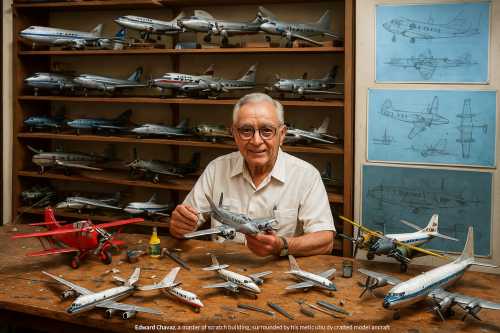
For over a century, model aircraft have enabled aviation professionals and enthusiasts to visualize the history and achievements of human flight on a miniature scale. Many skilled modelers build from commercially available kits; however, crafting a model entirely from scratch requires an advanced level of artistry and dedication. In the age of mass production, a meticulously handmade model stands apart as a singular work of wonder.
Edward Chavez (1917–2004) was a recognized master of scratch building within the model-making community. Fascinated by aviation from an early age in San Antonio, Texas, Chavez enlisted in the United States Army Air Corps in 1941, and served during World War II. After the war, he joined the U.S. Postal Service and, while in the military reserve, was commissioned to construct aircraft recognition models. He later served as a captain in the Korean War and was awarded both the Distinguished Flying Cross and the Bronze Star. His model commissions expanded from private aircraft owners to professional work for the Piper Aircraft Company.
In 1961, the Nut Tree Restaurant commissioned Chavez to build display models of renowned aircraft. Edwin I. Power, Jr. (1922–2017) — a pilot and one of the restaurant’s owners who helped develop the adjacent Nut Tree Airport — had seen Chavez’s work at the Smithsonian Institution’s National Air and Space Museum in Washington, D.C. Beginning with the Aero Commander 500 in 1962, Chavez produced numerous models for the restaurant over twenty-seven years, occasionally collaborating with his friend Robert Fogg.











