

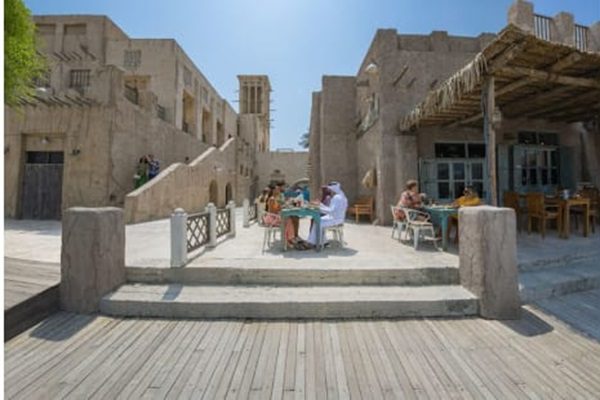
Not every day, a guidebook famous for back-packers and well-thumbed pages shines its light on a city more famous for gold-leaf cappuccinos and supercars. But Lonely Planet, the oracle of dusty-boot travellers everywhere, has declared Old Dubai’s cultural food tours among the Best in Travel experiences for 2026.
And there’s something wonderfully poetic about that.
Dubai, so often caricatured as a place where everything is new, has just been celebrated for something decidedly old: a string of unpretentious eateries, spice-scented alleyways, and creekside cafés where time moves as slowly as the tea is poured.
A City Remembering Its Flavour
For most visitors, Dubai begins and ends in its skyline, an orchestra of glass, steel and ambition. Yet wander east toward the Dubai Creek, and you’ll find a city that remembers its flavour.
The emirate began in Bur Dubai and Deira’s twin districts. Before oil, malls, and the Burj Khalifa reached the stratosphere, traders, Indian, Iranian, and Yemeni, arrived with spices, textiles, and stories.
If the modern city is a mirage of the future, Old Dubai is its memory, and it’s edible.
Lonely Planet’s Nod to Nostalgia
Lonely Planet’s Best in Travel list, that annual roll-call of wanderlust, chose Old Dubai not for its glitter but for its grit. Tom Hall, Vice President of Lonely Planet, put it:
“A cultural food tour of Old Dubai reveals what our writer describes as a rich tapestry of flavours shaping the diverse cuisine scene that defines the city today.”
Translation? If you want to understand Dubai, skip the high tea at the Burj and follow the scent of cumin down a narrow lane.
Even His Excellency Issam Kazim, the affable head of the Dubai Corporation for Tourism and Commerce Marketing, couldn’t hide his pride:
“This recognition is a testament to the city’s rich heritage and vibrant culinary scene. As one of the world’s most trusted travel guides, Lonely Planet’s acknowledgment aligns with our objective of making Dubai the world’s best city to visit, live and work in.”
It’s the kind of quote that sounds rehearsed in corporate hands, but here, it rings true. If you’ve ever eaten grilled hammour by the creek at sunset, you’ll know Dubai’s best side is the one still seasoned with tradition.
Walking the Creek
You start in Al Fahidi Historical Neighbourhood, where the sand-coloured wind towers lean protectively over stone courtyards and lantern-lit lanes. The Sheikh Mohammed bin Rashid Al Maktoum Centre for Cultural Understanding (mercifully shortened to SMCCU) stands nearby — part museum, part dining room, part cultural therapy session for curious foreigners.
Lunch here comes with a conversation. Emirati hosts share biryani and anecdotes equally, explaining customs that predate oil wealth: generosity, family, and the sacred art of overfeeding your guests.
Across the courtyard, the Al Khayma Heritage Restaurant glows in the golden hour. A lamb machboos arrives — fragrant, saffron-tinted, and large enough to require strategy. The waiter smiles knowingly; this isn’t fast food, it’s family food. Al Khayma is part restaurant, part living exhibit, complete with traditional décor and a Michelin Bib Gourmand nod.
Around the corner, Arabian Tea House invites you to slow down. Opened in 1997, it feels like stepping into an Emirati grandmother’s garden, with white wicker chairs, mint tea, and the hum of conversation. The biryani deyay (chicken with Gulf spices and yoghurt) tastes like Dubai before it went digital.
Peter Needham, notebook open, might scribble: “A place where even the ceiling fans seem to gossip.”
Bur Dubai: Heritage with Hunger
Bur Dubai, for all its heritage, hums with the business of the present. The Meena Bazaar bursts with saris and spices; every third shopkeeper knows your shoe size before you do. Nihal Restaurant, a humble corner joint serving koki paratha, flaky, onion-dotted, unapologetically carb-heavy, somewhere between the tailors and the trinkets.
Then there’s Al Ustad Special Kabab, the sort of place that should have a historical plaque. Its walls are plastered with photos of grinning patrons from decades past, proof that the food here has outlasted hairstyles and hotel chains alike. The kabab khas, marinated in yoghurt and perfectly grilled, is a carnivore’s lullaby.
Just across town, Bhavna Vegetarian Delux celebrates 50 years of Gujarati home cooking. Pani puri bursts like edible confetti, a dish that demands laughter and a second helping.
The camel burger commands attention at Local House Restaurant, another Dubai institution. It’s one of those things you order with curiosity and finish with conviction. And yes, the camel ice cream for dessert is real and surprisingly elegant.
For coffee lovers, Mazmi Coffee & More sits on the creek like a poet’s balcony. The espresso is strong, and the pistachio ice cream is even stronger. On quieter afternoons, the café’s owners chat about old Dubai as if it were a relative they still visit every weekend.
Crossing the Creek: Deira’s Delicious Disorder
Crossing the water by abra, those traditional wooden ferries that cost a single dirham, is to perform a small act of time travel. Deira, on the northern bank, is busier, brasher, and hungrier.
It’s where the air smells of shawarma smoke and ambition.
Al Bait Al Qadeem, near the Gold Souk, offers a plate of grilled shawarma that’s less takeaway, more theatre. A few streets away, Aroos Damascus serves Syrian comfort food to a packed house. At the same time, Al-Karmel Somali Restaurant introduces diners to suqaar sautéed lamb with onions and peppers that could convert the most cautious eater.
Anthony Bourdain fans pilgrimage to Bait Al Mandi, featured in No Reservations. Its mutton mandi is the kind of dish that requires silence and possibly a nap.
And when sugar calls, Al Samadi Sweets answers with ma’amoul date-filled pastries so rich they might qualify as currency.
In between, the Spice Souk and Waterfront Market remind you that food here begins at dawn, not dinner. Fishermen bargain over snapper while tourists haggle for saffron, two rituals separated by accent, not intent.
Dubai’s Culinary Democracy
For a city built on ambition, Dubai is astonishingly democratic regarding eating. Michelin-starred restaurants may dot the Marina, but the heart of its cuisine beats loudly in backstreets.
“Old Dubai,” says one guide, “is where the city eats when it’s off duty.”
It’s also where the boundaries blur. Iranian kebabs meet Indian masalas; Somali stews share menu space with Emirati grills. It’s culinary diplomacy at street level and it works remarkably well.
At Kabab Erbil, the masgouf (Iraqi river fish grilled with tamarind) arrives smoking, tender, and possibly capable of changing your weekend plans at Sadaf Restaurant. Persian kebabs and rosewater desserts whisper of Tehran’s boulevards. Meanwhile, Sreeraj Lassi, a fixture since 1973, still serves its signature matka lassi in clay pots — cool, tangy, and blessedly unpretentious.
The humble Pakora Lane in Souk Al Kabeer, two small Kerala eateries sharing one cramped alley, is a legend. Fried snacks, tea, and gossip; no Michelin star required.
The Charm of the Everyday
What makes Old Dubai irresistible isn’t luxury or novelty, it’s continuity.
The man frying falafel at Falafel Ala Kaifak has been there longer than many hotels have existed. The woman at the Jafer Biman Ali Cafeteria counter, a 65-year-old fixture in the Spice Souk, remembers when tourists were rare and falooda, a colourful ice-cream drink, was the ultimate indulgence.
These places endure not through branding, but belonging.
In a world where every new restaurant announces itself with hashtags and PR fanfare, Old Dubai whispers — and still wins the crowd.
A Culinary Crossroads Acknowledged
For Dubai’s tourism board, Lonely Planet’s nod isn’t just a compliment; it’s vindication. For years, the city has worked to showcase its cultural core beyond skyscrapers.
Issam Kazim puts it neatly:
“As we continue to grow our global appeal, especially to those seeking authentic cultural offerings, this is a segment we are truly committed to further developing.”
Translation: the world’s finally catching up to what Dubai’s old guard knew, the future is brighter when the past is still cooking.
And there’s substance behind the sentiment. The Dubai Historic District project aims to preserve and enhance the areas along the creek, linking Bur Dubai and Deira through heritage trails, restored architecture, and cultural programming. Food, naturally, is the common language.
Beyond the Plate
For all its culinary glory, what lingers about Old Dubai isn’t the spice but the sincerity. Here, hospitality isn’t a strategy; it’s instinct. A restaurateur won’t ask for a review; he’ll ask if you’ve eaten enough.
Lonely Planet’s inclusion of the experience as one of just 50 global picks (25 destinations, 25 experiences) feels like an overdue thank-you.
It’s a reminder that authenticity doesn’t always need to be shouted. Sometimes, it just needs to simmer long enough to be noticed.
Evening at the Creek
By evening, the creek glows — a mirror for the minarets, a theatre for the dhows. The call to prayer drifts over the water, and a breeze carries the scent of grilled fish, cardamom, and nostalgia.
A waiter brings tea, which you drink slowly, because leaving would break the spell. Across the water, another ferry loads up, its passengers a mix of cooks, traders, and tourists all searching for something, or perhaps simply dinner.
Old Dubai doesn’t compete with the city beyond; it completes it.
And maybe that’s the point. In a world hurtling towards the next big thing, it’s comforting to know there’s still a place where flavour takes its time.
If You Go
Getting there:
Old Dubai is a 20-minute drive from Downtown Dubai. The abra ferry across Dubai Creek costs AED 1 (about 40 cents).
When to go:
Evenings are ideal from November to March when the air cools and the souks come alive.
Don’t miss:
A guided tour with the Sheikh Mohammed Centre for Cultural Understanding — or better still, wander alone with an appetite and an open mind.
More information: www.visitdubai.com | www.lonelyplanet.com.
By Sandra Jones – (c) 2025
About the Author
 Sandra has spent much of her working life untangling the world for others, one itinerary, one dream, one frazzled traveller at a time. With years spent in some of Australia’s best-known travel agencies, she’s the calm voice on the line when flights go missing, luggage takes its own holiday, or someone decides to “see Europe properly” in nine days.
A qualified travel consultant with a knack for making sense of chaos, Sandra fine-tuned her skills through a specialised advisory course, the sort that teaches both knowledge and patience in equal measure. But the storyteller in her was never far away. A later foray into writing gave her the perfect excuse to blend that industry wisdom with her gift for words.
Now, through Global Travel Media, Sandra shares the small truths of travel, its frustrations, laughter, and quiet moments that make every journey worth the fuss.











