

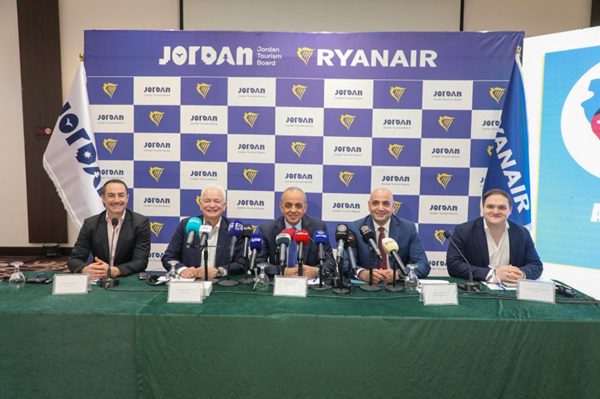
There are airline announcements, then Ryanair announcements, usually louder, brasher, and just a touch more Irish in their confidence. This week, Europe’s most unrepentant low-cost carrier has turned its gaze towards the Middle East, rolling out a record winter schedule for Jordan that would make most legacy airlines look idle.
Ryanair’s plan? A hefty 300,000 seats, 18 routes, and direct connections to 12 European countries, including Austria, Belgium, France, Germany, Italy, and Spain, all funnelled through Amman. This is a bold, calculated leap east for an airline that once treated the Mediterranean as its outer limit.
A comeback with purpose
After a few quiet years in the Jordanian market, Ryanair is returning at full throttle. “We’re thrilled to announce the return to full operations to Jordan,” said Chief Executive Eddie Wilson, who rarely understates anything. “With 84 weekly flights across 18 routes, Ryanair’s investment will ensure Jordan remains a key tourist destination this winter – delivering enhanced connectivity, increased tourism and economic growth with Europe’s lowest fares.”
It’s the sort of line Wilson could recite in his sleep — but behind the bravado lies substance. The schedule marks not just a restoration of flights, but an expansion strategy with political and economic undercurrents.
Jordan’s tourism recovery has been carefully nurtured by a government that understands one truth of modern travel: accessibility drives arrivals. Fares drop, passengers follow. Ryanair, of course, has built an empire on that equation.
From Amman to Aqaba – and now, Marka
Beyond Amman’s Queen Alia International Airport, Ryanair is eyeing Marka Airport, a smaller, more centrally located terminal in the capital. This move could redefine domestic and regional access. Aqaba, Jordan’s sun-kissed Red Sea resort, remains firmly in the picture, with the airline pledging year-round service.
Ryanair’s ambitions are not modest. The airline has unveiled an investment proposal designed to triple its footprint, a staggering 3 million seats annually and 50 direct European connections. In Ryanair-speak, that’s not just a goal; it’s a declaration of intent.
A partnership built on pragmatism
If Wilson’s enthusiasm borders on theatrical, his Jordanian counterparts are equally polished.
Dr Emad Hijazeen, Minister of Tourism and Antiquities, was effusive but measured:
“Today’s announcement marks a truly exceptional milestone for Jordan’s aviation and tourism sectors,” he said. “It reinforces Jordan’s position as a key tourism and investment hub in the region, and plays a vital role in supporting our national economy and creating new opportunities across the tourism value chain.”
That’s the diplomatic version: We’re thrilled to have you back.
Since Ryanair’s first Jordanian touchdown in 2018, the relationship has matured into what both sides now call a “strategic partnership.” In travel diplomacy, that phrase usually means something more than polite handshakes; it’s code for real money changing hands and steady traffic growth.
Dr Abdul Razzaq Arabiyat, Managing Director of the Jordan Tourism Board, went further:
“Since the start of our partnership in 2018, Ryanair has been an essential strategic tool in promoting Jordan as a competitive and accessible destination for European travellers.”
He’s not exaggerating. Ryanair has delivered over a million European visitors since 2018, not all backpackers. Many were middle-market travellers, newly emboldened by cheap fares to explore Petra, the Dead Sea, or Wadi Rum.
Old travel truths, new routes
There’s something deliciously traditional about this story. Airlines can talk endlessly about sustainability, digital innovation, and AI-powered experiences, but at its heart, global tourism still hinges on two old-fashioned virtues: price and access.
Ryanair knows this better than anyone. Offer a €29 fare from Frankfurt or Milan, and you’ll fill planes with the curious, the thrifty, and the adventurous. Those travellers become Jordan’s best ambassadors when they post their Petra selfies and beach shots across Europe.
It’s a simple model, almost quaint in its predictability, and works.
Economic lift-off
Tourism already contributes around 15 per cent to Jordan’s GDP. The hope is that Ryanair’s expansion will increase that figure, spreading benefits to local hotels, restaurants, guides, and transport operators. For a country where every arrival matters, a few hundred thousand visitors this winter could translate into millions of dollars in local spend.
Wilson is keen to stress that this is a “pro-growth partnership” with the Hashemite Kingdom. “We look forward to working with Jordan to introduce millions of passengers from across Europe to the Kingdom’s rich culture and unique history,” he said, a sentiment delivered with just the right amount of Irish charm to keep both tourism officials and accountants smiling.
Cautious optimism in Amman
Still, Jordan isn’t taking anything for granted. The region’s geopolitics are never far from the flightpath, and rapid expansion comes with logistical strains from airport capacity to ground services. But for now, there’s a sense of cautious optimism.
Queen Alia International Airport has been operating well below its potential, and Ryanair’s renewed commitment offers a welcome jolt of activity. The reintroduction of Marka as a potential hub could also ease congestion and add domestic flexibility, a rare advantage in a region dominated by massive state carriers.
Low-cost carrier, high-stakes ambition
Ryanair’s move is more than another European budget airline dipping its wing in the Middle East. It’s part of a broader realignment: as traditional Gulf carriers look westward, Ryanair is testing the east.
It’s a reminder that even in the algorithm age, the fundamentals of aviation success remain human. People still want to see the world and go where they can afford to fly.
Jordan, with its balance of ancient history and modern accessibility, is suddenly very well placed to capitalise on that.
A final word from Jason’s corner of the newsroom
There’s something quietly satisfying about watching Ryanair, the scrappy upstart of European aviation, take its low-fare swagger to the sandstone splendour of the Middle East. It’s audacious, a little improbable, and very Ryanair.
One suspects that if Eddie Wilson could bottle confidence, he’d sell it duty-free. But in fairness, the airline’s record speaks for itself: it promises low fares, it delivers them, and along the way, it forces entire industries to adapt.
To its credit, Jordan is playing the long game, positioning itself as the Middle East’s accessible, culture-rich, politically stable alternative. If Ryanair’s 300,000-seat winter lift-off works, that game just changed.
And that, as the old newsroom adage goes, is a story worth flying for.
By Jason Smith – (c) 2025
About the Author
 Jason Smith has the kind of story you can’t fake, built on long flights, new cities, and that unmistakable hum of hotel life that gets under your skin and never quite leaves. Half American, half Asian, he grew up surrounded by the steady rhythm of the tourism trade in the U.S., where his family helped others see the world long before he did.
Eager to carve out his own path, Jason packed his bags for Bangkok and the Asian Institute of Hospitality & Management, where he majored in Hotel Management and found a career and a calling. From there came years on the road, Singapore, Malaysia, Vietnam, each stop adding another thread to his craft.
He made his mark in Thailand, eventually becoming Director of Sales for one of the country’s leading hotel chains. Then came COVID-19: borders closed, flights grounded, and a new chapter began.
Back home in America, Jason turned his knack for connection into words, joining Global Travel Media to tell the stories behind the check-ins written with the same warmth and honesty that have always defined him.











