

Watching an old civilisation remember itself is one of the more curious pleasures of journalism. In Saudi Arabia, that remembering has taken a tangible shape, brick, stone, glass, and the quiet hum of air conditioning. The Kingdom that once measured distance in dunes is now building destinations, and doing so with surprising grace.
Not long ago, flying to Saudi Arabia for leisure would have raised a polite eyebrow in any Qantas lounge. Yet here we are: travellers arriving not merely for pilgrimage, but for pleasure for art, for architecture, and yes, for the sort of hospitality that still believes a good welcome begins with sincerity, not spectacle.
AlUla – History in Soft Focus
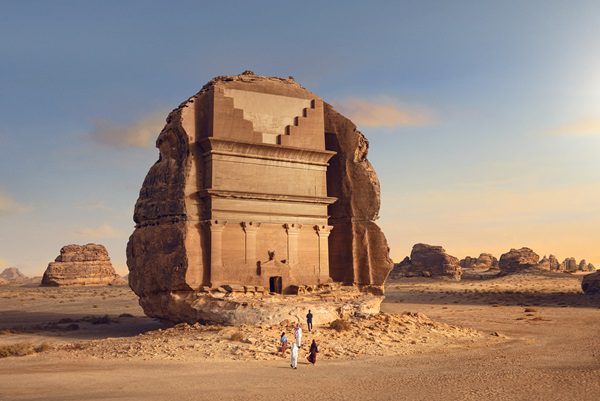
The desert north of Medina has always held its secrets in sandstone. In AlUla, the wind still sighs through canyons older than memory, but now a handful of lamps glimmer behind mudbrick walls. They belong to Dar Tantora The House Hotel, a restoration so faithful it almost feels bashful.
Its thirty rooms were once family homes. The ceilings are low, the lamps burn softly, and the air smells faintly of dust and bread. At dawn, you might hear the laughter of guests learning to bake khubz in clay ovens, or a storyteller rehearsing an old fable in a courtyard perfumed with sage.
Here, heritage is not curated; it’s lived. And when evening comes, the desert glows the colour of burnt honey while the constellations reassert their authority. For a nation intent on reinvention, AlUla provides an anchor: proof that renewal need not mean erasure.
Jeddah – The Sea Still Sings
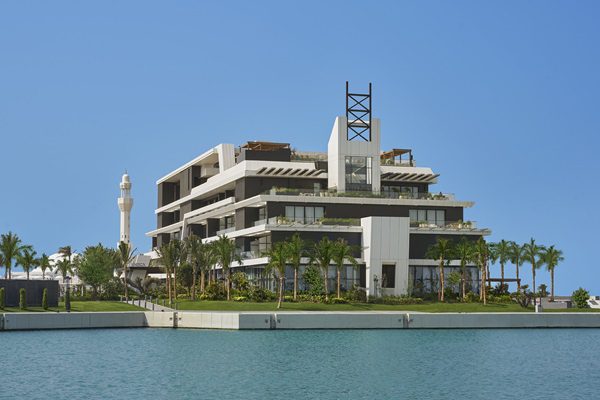
The Jeddah EDITION – Jeddah Corniche, Facade
Every transformation needs a port, and Jeddah has been one for a thousand years. Pilgrims once disembarked here with dust on their sandals; now travellers arrive at The Jeddah EDITION, where marble meets the murmur of the Red Sea. The rooftop pool, impeccably poised above the Corniche, has become the city’s new compass point, though the authentic charm lies in the contradictions below.
The coral-stone houses of Al Balad, their wooden balconies shading alleys no wider than memory, stand defiantly beside designer boutiques. Step inside one and you can smell the centuries’ spice, salt, and the occasional whiff of ambition.
Each evening, the King Fahd Fountain performs its nightly sermon, a column of water arcing 312 metres into the sky to remind the city that aspiration was always its true religion. It’s hard not to smile: Jeddah has rediscovered its rhythm somewhere between the merchants and the modernists.
The Red Sea – Luxury with a Conscience
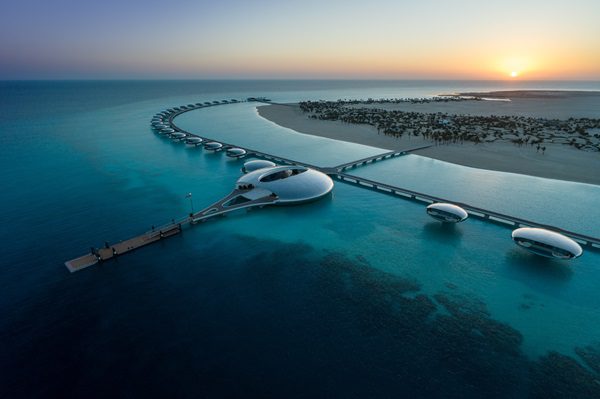
Shebara, Aerial View
Farther down the coast, where coral gardens bloom beneath turquoise shallows, Saudi’s newest frontier is taking shape. The Red Sea Project may sound like a developer’s daydream, yet it has yielded two properties that could change the conversation about luxury itself.
On Sheybarah Island, the Shebara Resort looks like almost otherworldly polished steel pods that glint like scattered pearls. At dawn, they catch the sunrise; by night, they mirror constellations. The design is daring, but the philosophy is humble: renewable energy, minimal footprint, and an insistence that beauty should never cost the earth.
A short boat ride away lies Nujuma, a Ritz-Carlton Reserve as discreet as indulgent. There are no grand gestures here, just sea turtles nosing through shallows, mangroves whispering in the tide, and staff who appear with cool towels and vanish with equal grace. If paradise exists, it has learned restraint.
One suspects the late Lawrence of Arabia would have approved.
Diriyah – Where the Kingdom Began
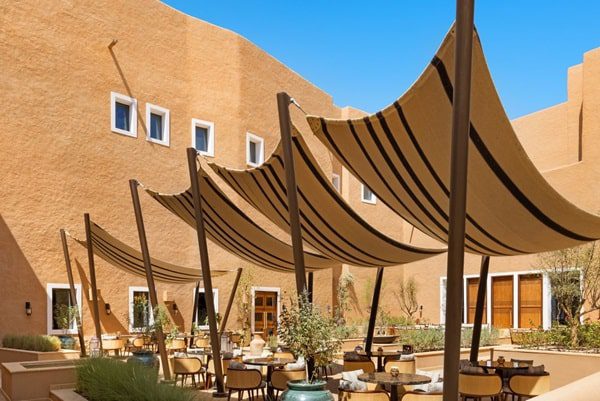
Bab Samhan, a Luxury Collection Hotel – Diriyah, Hotel Exterior
Every modern vision needs an origin story, and Saudi Arabia’s sits beside the Wadi Hanifah. Diriyah, founded in the 15th century, once served as the cradle of the Saudi state. Today, its mudbrick walls cradle something different: a new sense of continuity.
Within them stands Bab Samhan, a Luxury Collection Hotel that feels like it has grown rather than been built. Palm fronds cast dappled shade over courtyards where guests linger over gahwa coffee while oud drifts through the air. At dusk, musicians sing old folk songs that echo across the riverbank.
Here, progress takes its cues from patience. Diriyah’s At-Turaif District, listed by UNESCO in 2010, hums with museums, markets and the cheerful clatter of evening families. The past is not behind glass; it’s walking in the laneways.
Riyadh – The Desert Gets a Skyline
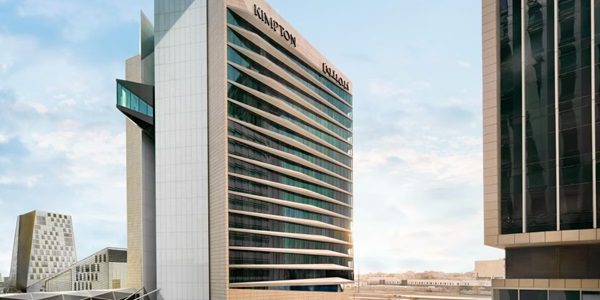
Kimpton KAFD – King Abdullah Financial District, Facade
Drive thirty minutes, and the desert yields to geometry. The King Abdullah Financial District is Riyadh’s vertical wager on the future — a city within a city of glass canyons and eco-friendly towers. Amid it all rises the Kimpton KAFD, the first of its kind in the Middle East.
Kimpton has always traded in personality over protocol; its Riyadh edition is no exception. There are bicycles in the lobby, local art on the walls, and a staff member who greets you as though they’ve been expecting you for years. It’s a hotel as a conversation rather than a corporation, and suits the capital’s newfound confidence.
The surprise, though, is how naturally Riyadh wears its progress. The call to prayer still threads through traffic; the scent of cardamom still hangs in the air. The future, it seems, has learned to share the room.
Madinah – Grace and Quiet
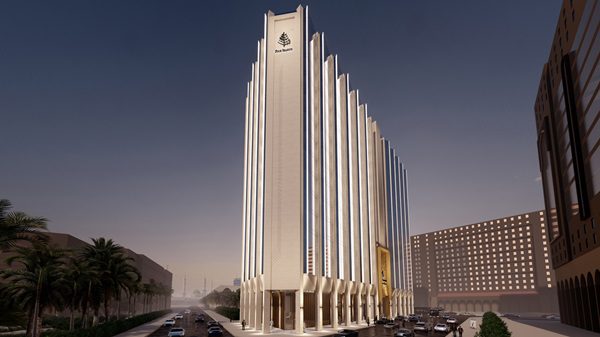
Four Seasons Hotel Madinah – Madinah
Not all journeys are about noise. Faith is still in Madinah and will soon have a new address: the Four Seasons Hotel Madinah. It promises refinement without ostentation, where pilgrims can rest without losing the humility of purpose that brought them.
From its terraces, the city unfolds in muted tones. The Prophet’s Mosque gleams at the horizon, markets are alive with murmured barter, and gardens are fragrant with dates and jasmine. The balance between reverence and rest feels right. Madinah remains eloquent in its silence in a world that too often confuses noise with significance.
The Traveller’s Return
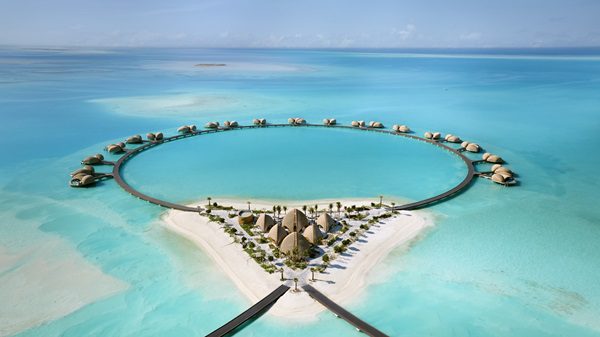
Nujuma, Arial Exterior
For decades, Saudi Arabia was a closed book, its margins glimpsed only through pilgrimage or petroleum. Now, those pages are turning. Travellers arrive with curiosity rather than caution, and many leave with surprise bordering on affection.
The Visit Saudi website ( visitsaudi.com ) lists the practicalities: e-visas for holders of UK, US, or Schengen permits, smooth arrivals, and an emerging network of guides and festivals. However, it cannot list the intangible: standing beneath a desert sky, the quiet sense that you are watching a culture find its balance again.
For all its steel and spectacle, the Kingdom’s new luxury has something old at its heart: hospitality as conversation, architecture as memory, progress with manners.
As the plane banks over the Red Sea, the lights of Jeddah glitter like a string of lanterns. Somewhere beyond them, in AlUla or Diriyah, a lamp still burns in a courtyard where history and hope share the same flame. And you can’t help thinking, as any traveller would: perhaps the old Arabia was never lost, just waiting to be rediscovered.
By Michelle Warner
BIO:
 Michelle Warner is a storyteller with jet fuel in her veins — the sort of woman who could turn a long-haul delay into a lesson in patience and prose. She began her career in media publications, learning the craft of sharp sentences and honest storytelling, before trading deadlines for departures as a flight attendant with several major airlines. Years spent at thirty thousand feet gave her a keen eye for human nature and a deep affection for the grace and grit of travellers everywhere.
Now happily grounded, Michelle has returned to her first love, writing, with the same composure she once brought to a turbulent cabin. Her work combines an editor’s precision with a traveller’s curiosity, weaving vivid scenes and subtle humour into stories that honour the golden age of travel writing. Every line is a small act of civility, polished, poised, and unmistakably human.











