
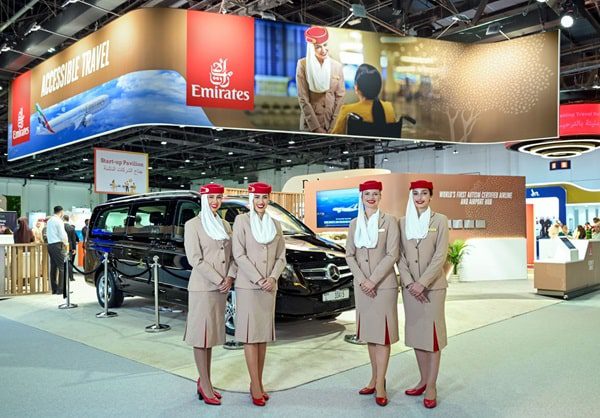
In an era when we demand that travel be more than seamless, it must be just. Emirates has delivered a stirring declaration of intent. At the 7th AccessAbilities Expo in Dubai, the airline unveiled a sweeping suite of services, enhancements, and future-focused innovations designed to empower travellers with accessibility needs. The message: fly with dignity, fly with confidence, fly with Emirates.
What was once a whisper of hope in accessible travel has become, under Emirates’ hand, a full-throated blueprint for what an inclusive airline must look like. This isn’t tokenism, it’s transformation.
A Hub for Everyone: Accessible & Inclusive Travel Hub
Every journey starts online. Emirates has launched its Accessible & Inclusive Travel Hub on emirates.com, a centralised, fully accessible guide built for those with varying needs.
It’s not just a web page, it’s a promise. Designed over a year ago, the hub features token-based architecture to allow seamless updates and simplified customisation. The colour palette? Tested to meet high contrast standards. Navigation? Friendly to screen readers, voice control, and keyboard users.
Travellers can navigate by disability type (Mobility, Visual Impairment, Hearing Impairment, hidden disabilities), stage of journey (before flight, at Dubai, Onboard, Connecting, Arrival), or specific need (e.g., “Book Special Assistance,” “Autism-friendly guide,” “DXB Map & Sensory Guide,” “Be My Eyes support,” “FREMEC medical card,” and more).
Sections include explicit breakdowns:
-
Travelling with Wheelchairs & Mobility Aids
-
Medical Travel & Frequent Traveller Medical Card (FREMEC)
-
Family Travel (Children, Pregnancy, Unaccompanied Minors)
The design ethos is to grow and evolve — recognising that accessibility needs shift with time and innovation. It was developed in consultation with users across the spectrum of disabilities, ensuring authenticity and real usability.
Onboard Comfort: Sensory Tools, Fidget Toys & Mattress Hood

Emirates’ new hooded mattress in Business Class
From 1 November 2025, Emirates will roll out a new set of onboard enhancements catering directly to sensory and physical needs:
-
Sensory Products & Fidget Toys: A tactile aircraft stress reliever, two varieties of fidget cubes, a branded “rubber popper” made available to neurodiverse passengers, anxious flyers or anyone needing a calm moment mid-flight.
-
Business Class “Mattress Hood”: A seemingly simple innovation with significant impact. The mattress is now secure to the seat (like a fitted sheet), eliminating the need to remove it before landing. For passengers with severe mobility constraints, it means fewer in-flight disruptions and smoother rest.
These changes are born from insight: sometimes dignity lies in the small, quiet innovations.
Entertainment & Media: Accessibility at Your Fingertips
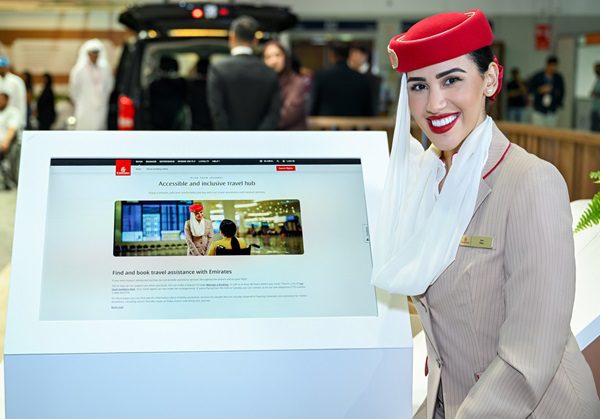
New ‘Accessible & Inclusive Travel Hub’ on Emirates.com
Emirates continues to push boundaries in in-flight entertainment:
-
Closed Captions on over 600 movies
-
Audio Description on 200+ titles
-
Headphones compatible with hearing aid T-settings
-
12 channels of Wellbeing TV, 31 channels of Happiness & Wellbeing podcasts, meditations, soothing sounds
But the pièce de résistance: on its new A350-900 aircraft, the ICE system user interface has been co-designed with advocacy groups to serve those with visual impairment. Expect audio-cue navigation, voice feedback, touch/swipe support, and clear access to the rich library of audio description content.
Ground at Dubai: Barrier-Free Design & Biometrics
Dubai’s Terminal 3 Emirates’ hub now features:
-
A bright, barrier-free corridor with adaptive cameras that don’t obstruct wheelchair users
-
Self-service kiosks with text-to-speech, tactile and braille support, adjustable height, headphone jacks, all built for usability by passengers with mobility or vision challenges
Simply put: the space doesn’t demand you conform. It conforms to you.
The Chauffeur Ride, Reimagined
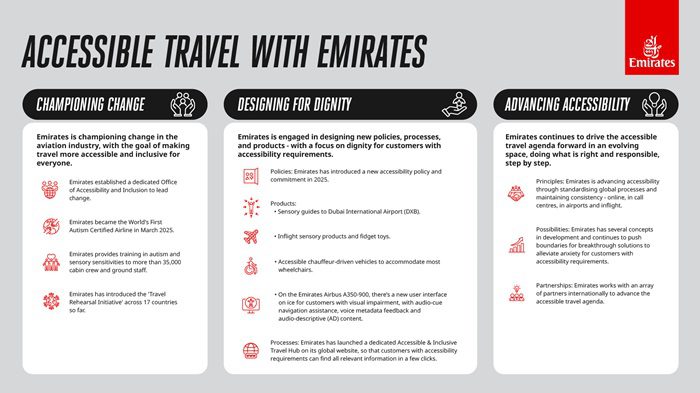
To complement the in-flight and airport experience, Emirates is prototyping a wheelchair-accessible Mercedes V250 van with a powered lift and ramp. Safety harnesses and restraint systems are built in. Drivers are being trained in mobility assistance with dignity. Initially deployed for First and Business Class in Dubai, the plan is to roll out a fleet of 10 by early 2026.
This isn’t novelty, it’s a full-circle commitment: from home to curb to cabin.
Innovation Laboratory: What’s Next
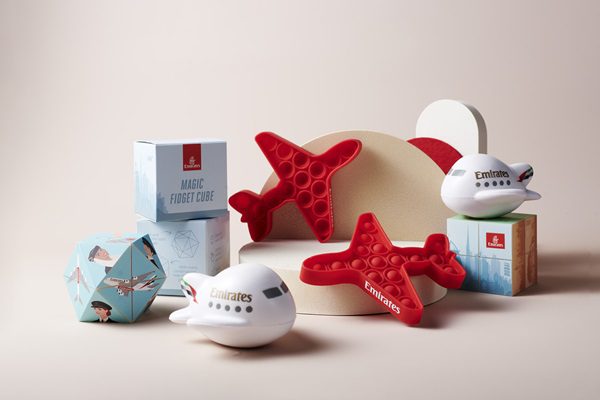
Emirates’ new sensory products and fidget toys for children and adults
The future, under the Emirates’ watch, is promising:
-
A cabin prototype that empowers independent travel for blind / low-vision travellers via discreet QR codes that provide audio descriptions, haptics and orientation cues (seat rows, amenities, menus)
-
A “Wheelchair Cube” concept that securely restrains mobility aids during transit, affording users peace of mind
-
Sign Language Robot in development, responding to deaf or hearing-impaired travellers with maps, directions and AI-signed responses
-
A VR airport tour/travel rehearsal that lowers anxiety by letting users “walk” Terminal 3 virtually before the real journey
These aren’t ideas on paper; they were demoed at the Expo, inviting real-time user feedback.
Championing Change: Policy, Training & Certification
Emirates isn’t dabbling. It’s declaring:
-
A dedicated Office of Accessibility & Inclusion
-
The airline has become the world’s first Autism Certified Airline (soon to be formally awarded
-
Over 35,000 staff trained in supporting neurodiverse travellers
-
“Travel Rehearsal” interventions in 17 countries currently
-
Check-in facilities in Dubai are designated as Certified Autism Centers™ via IBCCES
Language matters: Emirates refers to persons with disabilities as “People of Determination” — an identity of strength rather than limitation.
Why This Matters (And Why Now)
For decades, airlines have made accessibility an afterthought. Add a ramp, maybe a disability helpdesk, and call it done. Emirates is doing the reverse, placing accessibility at the centre of its vision.
This is not philanthropy. It is innovative, strategic, brand-defining leadership. Because travellers are more conscious, regulations are tightening globally, and inclusion is no longer optional, it’s inevitable.
By weaving accessibility into every touchpoint, web, and ground, Air Emirates is staking its claim as a premium airline and a beloved institution for all travellers.
Challenges Ahead & the Road to Execution
Of course, vision is one thing, delivery is another:
-
Consistency globally: Will these new systems and vehicles roll out across all hubs, not just Dubai?
-
Staff culture beyond training: Real empathy surpasses modules; lived respect is harder to teach
-
Technological robustness: QR systems, robotic sign language and haptic feedback must be reliable, intuitive, and bulletproof
-
Cost, regulation and retrofit: Old aircraft, varying airport infrastructures, and regulatory hurdles must be navigated.
Still, Emirates has already shown the capacity to move fast when it chooses. This is not incremental tinkering; it’s a leap.
What It Says About the Age
We’re witnessing an aviation moment: the shift from “accessible as compliance” to “accessible by design.”
This is vindication for travellers who have long had to prove their worth and justify their existence in the skies. For the airline industry, it’s a marker: evolve or be left behind.
Emirates’ choices here are no modest upgrades. They challenge every airline: are you serving all travellers or just the ones you find easy?
Final Word
Emirates has bet its legacy on inclusion. It knows what’s at stake: dignity, independence, and the right to expect travel without compromise. And it’s not resting on promises, it’s delivering milestones.
This is a story of tough standards, brave innovation, and a willingness to embrace the needs of everyone, not just the many, but the few who have long been excluded.
In the spirit of Australian pragmatism: it’s not perfect yet. But it’s something better than what we’ve had. And if Emirates sustains momentum, it could rewrite air travel’s moral contract.
Here’s hoping others follow because travel should carry everyone, not just those who fit the mold.