

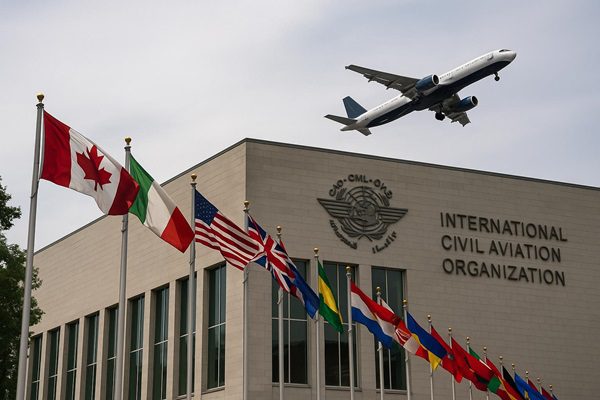
When the aviation world gathers in Montréal this September for the 42nd Assembly of the International Civil Aviation Organisation (ICAO), it won’t simply be another polite round of speeches and photo opportunities. With the planet’s skies increasingly crowded, airlines bruised by taxes, regulators distracted by consumer politics, and the green clock ticking, the Assembly is shaping up as one of the most critical since ICAO’s founding in 1944.
The International Air Transport Association (IATA) is wasting no time making its case. The association has lodged 14 detailed working papers, a veritable survival kit for global aviation, covering everything from sustainable fuels to passenger rights, tax treaties, accident investigations, and even the age at which a pilot should hang up the uniform.
At the centre of the debate? Whether governments will finally move beyond noble declarations and put real weight behind the global standards that keep airlines in the air and keep passengers safe, connected, and, dare one say, reasonably comfortable.
Willie Walsh: Aviation’s Unapologetic Standard-Bearer
No one accuses IATA’s Director General, Willie Walsh, of mincing his words. A veteran of British Airways and a man well-versed in the fine art of dealing with irate governments, Walsh went into the Assembly with a blunt message:
“IATA will be participating in the ICAO Assembly with safety, sustainability and efficiency at the top of our priority list. It is critical that we secure stronger support for SAF production and CORSIA as key enablers of aviation’s commitment to achieve net zero emissions by 2050. Equally, we need agreement to follow the principles and provisions of the Chicago Convention to avoid patchworks of debilitating tax measures and passenger rights regulations. And we must shore-up safety with timely accident reports, mitigations for GNSS interference and preservation of critical radio-frequency spectrum.”
In other words: less political grandstanding, more getting on with the job.
SAF: A Market Still on Paper Wings
One of IATA’s loudest calls is for governments to stop treating Sustainable Aviation Fuel (SAF) like a fashionable side salad and instead start making it the main course.
SAF is the only real short-to-medium-term solution for reducing aviation’s carbon footprint. But while airlines are willing to buy, producers remain lukewarm. The problem is simple economics: it’s more expensive to produce than fossil jet fuel, and governments haven’t yet rolled out incentives at scale.
IATA is urging states to:
-
Back IATA’s SAF market efforts so supply and demand can finally meet.
-
Offer economic carrots to producers rather than wielding tax sticks at airlines.
-
Tackle policy gaps early to avoid yet another round of price spikes.
Walsh’s message is clear: aviation’s 2050 net-zero promise will be grounded before take-off without SAF.
CORSIA: A Scheme Undermined by Politicians
The Carbon Offsetting and Reduction Scheme for International Aviation (CORSIA) was hailed as a breakthrough when adopted at ICAO’s 39th Assembly in 2016. It was meant to be the single economic instrument for managing aviation’s global carbon emissions.
Theoretically, it should generate US$17 billion in climate finance by 2035. In practice, however, politicians cannot resist tinkering. National and regional governments have piled on their own aviation taxes, undermining CORSIA’s credibility. And while only Guyana has issued CORSIA-compliant carbon units so far, airlines are left wondering if the grand scheme will ever be taken seriously.
IATA’s plea is to reaffirm CORSIA as the only global measure and make eligible units available so airlines can comply. Anything less, Walsh warns, risks replacing clarity with chaos.
Taxation Turbulence: Article 8 Misfires
If there’s one thing airlines fear more than fuel hikes, it’s double taxation. Yet a revision to Article 8 of the UN’s Model Tax Treaty threatens that by allowing countries to tax airline revenue at the source, on top of existing residence-based taxation.
Walsh describes the idea as “administrative lunacy”. IATA is pressing states to ignore the revision, stick to the tried-and-true residence system, and spare airlines another round of bureaucratic pain.
Consumer Protection or Consumer Confusion?
Nobody disputes that passengers deserve protection. However, IATA argues that recent government experiments in consumer rights regulation have created a messy patchwork, often deviating from ICAO’s carefully negotiated Core Principles.
The result? Confused travellers, conflicting obligations, and airlines are lumped with the blame when things go wrong. IATA wants states to:
-
Realign laws with ICAO’s Core Principles.
-
Agree on global definitions for “extraordinary circumstances”.
-
Share responsibility for disruptions, rather than leaving airlines to foot every bill.
As Walsh dryly noted, “Airlines can’t control volcanoes, pandemics, or political meltdowns yet regulations increasingly pretend we can.”
Radio Spectrum: Telecoms vs. Take-off
Aviation’s dependence on critical radio frequencies is hardly news. Yet as telecom giants push for ever more spectrum to feed their 5G (and soon 6G) empires, safety is being squeezed.
The 4.2–4.4 GHz band, vital for radio altimeters, has already been compromised in parts of the US, Canada, and Australia, forcing airlines into expensive retrofits and regulators into emergency fixes.
IATA demands a global ceasefire in the spectrum wars: protect aviation frequencies, coordinate between telecoms and aviation regulators, and agree on realistic timelines before safety is traded for speed.
Safety Reports: A Silence That Costs Lives
Aviation’s safety record is enviable, but only because the industry insists on learning from every incident. Yet ICAO Annex 13’s rule requiring accident reports within a year is flouted, as only 57% of accidents between 2018 and 2023 produced a final public report.
Walsh warns that this is “a scandal of silence.” IATA wants states to file timely reports and build investigative capacity so that future tragedies can be prevented rather than repeated.
GNSS Interference: War in the Air
Airlines now rely on Global Navigation Satellite Systems (GNSS) for everything from navigation to landing approaches. Unfortunately, GNSS jamming and spoofing are rising, especially near conflict zones.
While backup systems exist, Walsh is adamant: “It’s like driving with one eye shut. You might manage, but why risk it?”
IATA’s recommendations include better coordination between military and civil aviation authorities, investment in interference-proof avionics, and mandatory contingency training for pilots and air traffic controllers.
Aircraft Mandates: The Slow March of Safety
Even when regulators agree on new safety standards, getting them into cockpits takes years. Supply chain delays and certification bottlenecks stretch the Adopted–Effective–Applicable cycle. Airlines are often left scrambling to retrofit fleets, while regulators grant exemptions that erode harmonisation.
IATA wants a new mechanism for realistic compliance timelines, with flexibility built in when global crises strike. The logic is straightforward: if airlines bear the liability, they should have a say in the deadlines.
Pilots: Retiring Gracefully, Not Prematurely
Another hot potato is the age limit for international airline pilots. ICAO’s current ceiling is 65. IATA argues this is too conservative given today’s healthier, longer-living professionals.
Its proposal: lift the limit to 67, but keep safeguards such as the rule that one pilot must be under 65, frequent medical checks after 60, and a standardised medical oversight system across countries.
The aim is simple: balance safety with the reality that many seasoned pilots are fit to fly for longer. As Walsh quipped, “If a surgeon can wield a scalpel at 67, surely a pilot can still handle a yoke.”
Why This Assembly Matters
For ICAO, this Assembly is more than another bureaucratic cycle. It’s a chance to show that global aviation governance can still deliver unified, practical action in an age of political fragmentation.
IATA’s working papers remind governments of a simple truth: the Chicago Convention was designed to avoid a patchwork of conflicting national rules. If that spirit collapses under political grandstanding, aviation risks descending into a costly, inefficient free-for-all.
As Walsh summed it up:
“The criticality of global standards to global aviation cannot be underestimated. Everybody wants flying to be safe, efficient and more sustainable. We have a common agenda. The coming weeks in Montréal are essential to set the agenda, but even more important is the following three years of work to achieve what is agreed.”
Conclusion: A Sky-High Test of Resolve
The 42nd ICAO Assembly won’t solve every challenge in aviation overnight. But it is a rare chance to set the compass for the next three years.
Suppose governments truly want aviation to remain the safest, most efficient, and most globally connected industry in history. In that case, they must resist the temptation of national quick fixes and embrace the hard work of global standard-setting.
In Montréal, the world’s ministers and regulators have an opportunity to prove that aviation is not just a political pawn but a shared public good. Whether they rise to the occasion remains to be seen.
For now, airlines and passengers only hope politics doesn’t clip aviation’s wings.
By Susan Ng











