

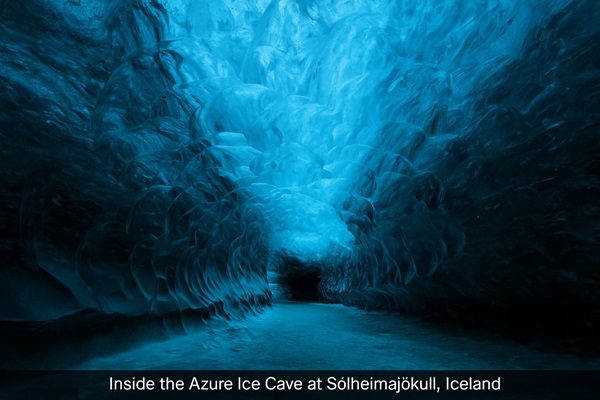
You’d think Iceland would have run out of surprises by now. After all, how many volcanoes, waterfalls, geysers and glaciers can one small island pack in before visitors begin to yawn politely and head back to Paris? Yet, here we are in 2025, with the country again pulling a rabbit out of its frosty hat, the Azure Ice Cave at Sólheimajökull.
And what a rabbit it is. Imagine stepping inside a cavern whose walls glow in shimmering blues and aquamarines so vivid that you half expect to find King Neptune lounging on a deckchair. Mind you, this is no static museum piece but a fickle, fleeting phenomenon. Here one winter, gone the next, it’s nature showing off and slamming the door shut before you’ve finished gawking.
Glaciers That Refuse to Behave
Sólheimajökull is one of Iceland’s most accessible glaciers, about 2.5 hours from Reykjavík. “Accessible” is a relative term, of course. You still need to strap crampons to your boots, don a helmet and harness, and march across an icy expanse, wielding an ice axe that makes you feel like an extra in Game of Thrones.
The glacier itself is a drama queen of the highest order. It bristles with ridges and yawning crevasses, streaked with volcanic ash that looks like some careless giant tipped his morning espresso over it. And just when guides think they know its moods, it coughs up an ice cave of such beauty it silences even the most talkative tour group.
This year, the highlight is the Azure Ice Cave. Its walls are so smooth and luminous that they appear backlit by some celestial stagehand. According to Francesco Li Vigni, Glacier Operations Manager at Arctic Adventures, this particular cave has been teasing guides for years.
“We’ve been observing this cave for years, though it is rarely accessible. We had a brief chance to enter it in 2019, and now we are once again gifted with the opportunity to visit it,” Li Vigni said.
“Gifted” is the word. These ice cathedrals are as transient as a politician’s promise — here today, gone tomorrow, and often returning in an entirely new form.
The Hike, the Gear, the Bragging Rights
The guided hike covers about four kilometres round trip, which sounds manageable until you realise it’s over frozen terrain with the unnerving habit of creaking beneath your boots. Tours begin at the Sólheimajökull car park (proof that even miracles need parking facilities) before participants march across the glacier in small groups.
Small groups matter. Nothing kills the magic of a glowing cave faster than a busload of tourists trying to out-selfie each other. Thankfully, Arctic Adventures limits numbers, ensuring guides can keep you safe and regale you with tales of shifting ice and Icelandic lore.
Once inside, there’s time to gape, photograph, and wonder how something so otherworldly can vanish with the first hint of spring. The whole experience lasts about four hours — long enough to feel you’ve earned that post-hike schnapps, not so long you’re considering frostbite as a travel souvenir.
Tourism With a Cold Edge
For Iceland, this isn’t just another photo-op; it’s another feather in the cap of a tourism industry that continues to punch above its weight. Adventure travel remains one of the country’s strongest draws, and experiences like this ice cave are exactly why global visitors keep booking flights to Keflavík rather than Cancun.
According to Visit Iceland, glacier tours consistently rank among the nation’s most popular attractions. And why wouldn’t they? Where else can you stroll inside a structure that looks like it belongs in a fantasy novel and know it might never look quite the same again?
Arctic Adventures, for its part, has seized the marketing gift. The message is simple: come now, or miss it forever. Unlike the Eiffel Tower, the Azure Ice Cave won’t be waiting patiently for your next annual leave application.
A Word From the Wise
Now, a Needham word of caution. Don’t if you’re tempted to wander onto the glacier by yourself. The place is as treacherous as it is beautiful, and more than one overconfident amateur has learned the hard way that glaciers don’t take kindly to human bravado. Stick with the guides, who know the ice as intimately as a barista knows their espresso machine.
Besides, the guides add something Google can’t: stories. Stories of ice that shifts and reforms, of caves that emerge, collapse, and reappear like old friends who’ve had a wardrobe change. These are the threads that turn a hike into an experience.
Final Thoughts
The Azure Ice Cave at Sólheimajökull is a marvel not to be missed. It is as dazzling as any cathedral, as fragile as spun glass, and as temporary as a New Year’s resolution. Iceland reminds us that the world still has surprises, if only we’re willing to lace up our crampons and step onto the ice.
So, if 2025 finds you anywhere near the North Atlantic, do yourself a favour: go now while the cave still exists. Come spring, it may be gone, and unlike most tourist attractions, this one doesn’t issue rain checks.
Bookings can be made through Arctic Adventures.
By Sandra Jones











