

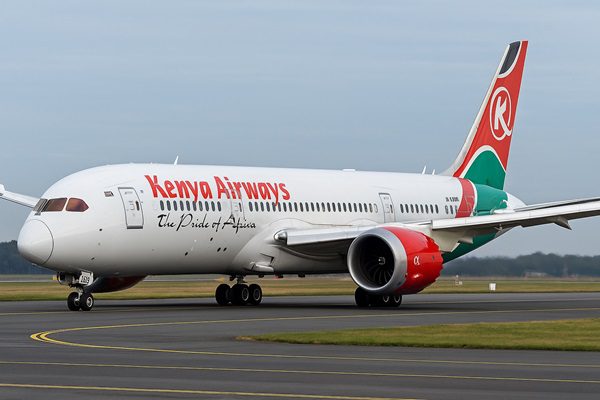
There are bad weeks and months, and then there’s the first half of 2025 for Kenya Airways. Grounding a third of your Dreamliners is enough to give any airline chief executive heart palpitations, particularly when those aircraft are the backbone of your long-haul operations. Yet, remarkably, the flag carrier has chosen not to wallow but to recalibrate, dust itself off, and, dare one say, keep flying the flag for Africa.
The results tabled in Nairobi for the six months to 30 June had the whiff of bad news. Revenue slipped 19 percent (a KShs 17 billion dent), passenger numbers fell 14 per cent, and available seat kilometres dropped by 16 per cent. That’s not so much a bump in the runway as a pothole large enough to swallow a Boeing nose-wheel.
Operating costs eased 10 per cent, but only because the airline scaled back flights. Fleet ownership costs soared 29 per cent thanks to a new Boeing 737 and some eye-watering remeasurements of lease liabilities. Add it all up and you’re looking at an operating loss of KShs 6.2 billion, compared with a KShs 1.3 billion profit last year. Not exactly the kind of numbers you pin proudly on the office wall.
A CEO Holding His Nerve
Still, Kenya Airways’ chief executive, Allan Kilavuka, kept his chin up when unveiling the half-yearly horror show.
“The first half of 2025 was defined by industry-wide challenges that directly impacted our performance, particularly the grounding of three of our aircraft,” he admitted. “While the financial results reflect these headwinds, we have taken decisive actions to stabilise operations and protect the long-term resilience of Kenya Airways.”
That’s executive-speak for “things are crook, but don’t panic”. And to his credit, Kilavuka managed to lace the medicine with a spoonful of optimism.
“Even in the face of these challenges, passenger demand for international routes remains robust, underscoring the strength of our brand and the critical role Kenya Airways plays in connecting Africa to the world,” he said. Translation: the passengers still want to fly with us, if only we can get the planes airborne.
Dreamliners Back Where They Belong
Nothing quite says “recovery” for any carrier like the sight of a gleaming wide-body being wheeled back into service. One of the grounded Boeing 787-8 Dreamliners rejoined the fleet in July, and the other two are due to follow later in the year. For passengers and staff alike, that’s good news that can banish the gloom of financial spreadsheets.
Fleet restoration is only part of the recovery script, however. Kenya Airways is also doubling down on cost discipline, which is no easy feat when fuel prices and inflation behave like toddlers on a sugar high. And then there’s the capital raising program, designed to bring in the liquidity needed to keep the airline competitive against rivals such as Ethiopian Airlines and RwandAir.
Wider Industry Winds
It’s worth noting that Kenya Airways is not suffering alone. Supply chain logjams, engine availability crises, and the lingering aftershocks of the pandemic are global in scope. The International Air Transport Association (IATA) projects passenger traffic will grow by 5.8 per cent in 2025, but cargo is expected to grow at just 0.7 percent.
So, if you’re running an airline, you’re facing turbulence in Nairobi, Sydney, or New York.
The Stakes for Africa
Kenya Airways’ fate isn’t just a line item in a balance sheet. For East Africa, it’s an artery of trade and tourism. Whether flying investment bankers to London, honeymooners to Paris, or safari-bound adventurers to the Maasai Mara, the airline connects a continent that desperately needs reliable links to the broader world.
Kilavuka, for his part, knows the symbolism matters as much as the bottom line. “Our focus remains clear: restoring full fleet capacity, advancing cost optimisation, and completing our capital raising program to strengthen our balance sheet. These measures will ensure we emerge stronger, leaner, and better positioned to deliver long-term value for our shareholders, customers, and partners.”
It’s not Churchillian oratory, but it gets the point across.
Outlook: A Steady Hand at the Yoke
So, where does this leave Kenya Airways? In recovery mode, indeed, but a recovery with teeth. One Dreamliner back in action, two more to follow, and a strategic plan that, if it comes good, will see the airline steady its wings by year’s end.
“Our recovery plan gives us confidence in our ability to navigate near-term challenges while building a more competitive and sustainable airline,” Kilavuka concluded. The message: this bird may be buffeted by headwinds, but it has no intention of crash-landing.
For now, the Pride of Africa keeps its nose up, eyes forward, and engines, when available, turning.
By Michelle Warner











