

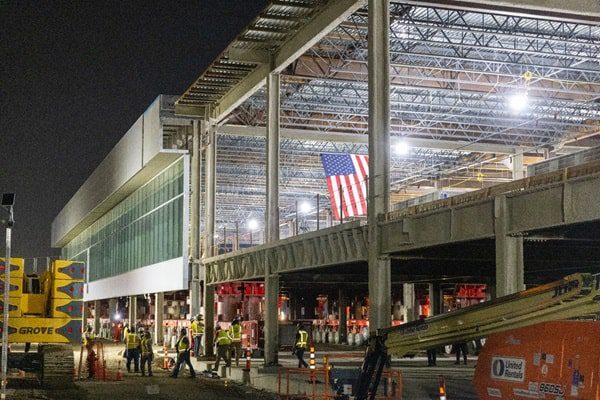
Building an airport terminal isn’t usually the sort of thing you knock out between morning tea and lunch. Still, Mammoet has done just that, albeit with a bit of help from a few thousand tonnes of steel, wheels the size of suburban houses, and the sort of logistical precision that would make a Swiss train timetable blush.
In an engineering masterstroke at Dallas Fort Worth International Airport (DFW), the Dutch heavy-lift specialist installed six gargantuan modules—the opening act of the long-awaited Terminal F. And it all happened in less than a fortnight.
You read that correctly: six hulking terminal modules, the largest ever shuffled across an airport tarmac, were delicately lifted, rolled, and slotted neatly into place like Lego bricks on steroids.
The Modular Marvel
The project marks a milestone in DFW’s expansion, where speed, efficiency, and disruption minimisation are the rules. Instead of building the terminal brick by brick on-site, Mammoet and its partners embraced modular construction, a method gaining serious altitude in aviation circles.
For the uninitiated, modular construction means prefabricating giant structural units at an off-site facility before transporting them to their final resting place. The advantages? Faster build times, safer work conditions, and significantly less passenger disruption. And if there’s one thing air travellers despise more than lost luggage, it’s construction chaos on their way to the gate.
As Reid Whitley, Project Manager at Mammoet, explained with justifiable pride:
“Modular construction techniques allow construction companies to reduce the scope of work at building sites, and for different structural elements to happen in parallel. This can be incredibly beneficial for sites like airports, where space is limited, and lessening disruption for passengers is critical. Mammoet prides itself on being the world leader in heavy lift and transport. This project shows another piece of what is possible with our equipment and teams.”
Engineering on an Epic Scale
To grasp the sheer size of this operation, consider this: the heaviest of the modules tipped the scales at 3,320 tonnes, stretching 85 metres in length. That’s roughly the weight of 550 African elephants or, for the more aviation-minded, the equivalent of six fully loaded Boeing 747s.
The modules were fabricated nearby on airport property before being carefully hoisted onto Self-Propelled Modular Transporters (SPMTs). These motorised platforms, bristling with hydraulic power, inched their way across the tarmac, each module balanced on an intricate lattice of steel supports.
Once at their destination, the modules were hoisted and slotted into position with the kind of finesse usually reserved for neurosurgeons rather than crane operators.
A Terminal for Tomorrow
This is just Phase One of DFW’s Terminal F, which, once complete, will boast 15 new gates and a shiny new Skylink Station. For an airport that already ranks among the world’s busiest, the expansion is less luxury and more necessity.
Mammoet’s involvement doesn’t stop here. The company has already carried out a similar feat at Terminal C, where it helped create nine new gates, and next up is Terminal A, where the heavy-lift giant will again be called into action.
The success of Terminal F’s first phase proves that modular techniques aren’t just a quirky alternative—they’re fast becoming the gold standard for megaprojects in constrained environments like airports.
For DFW, it means keeping millions of passengers moving with fewer headaches and less downtime. For Mammoet, it’s another feather in an already weighty cap. And for the aviation industry, it’s a sign that building big doesn’t have to mean building slow.
The Bigger Picture
Airports worldwide are grappling with capacity crunches and the rising costs of traditional construction. By embracing modular methods, projects typically take years can be delivered in record time, reducing risks and minimising disruption.
Dallas-Fort Worth has shown it can be done on a grand scale. And with Mammoet’s self-proclaimed title as the “world leader in heavy lift and transport,” it seems a safe bet this won’t be the last time we see modules rolling majestically across an airfield.
For those keen to see more about Mammoet’s extraordinary feats in engineering, visit their official site: www.mammoet.com.
By Octavia Koo











