

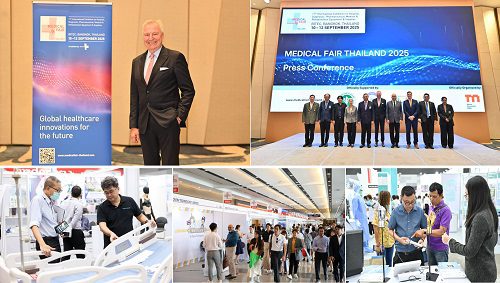
Messe Düsseldorf Asia, in partnership with leading Thai public and private sector partners, is gearing up for the highly anticipated ‘MEDICAL FAIR THAILAND 2025’ – the premier international exhibition for medical innovations, products, and healthcare services – bringing together the key players of the global medical industry. More than 1,000 exhibitors and start-ups from over 40 countries, alongside 20 Thai and international pavilions, will present a comprehensive range of medical equipment and supplies across 20,000 square metres of exhibition space.
The event will provide a complete overview of the healthcare value chain, from hospital equipment, diagnostics, medical devices, and rehabilitation solutions to advanced health digital technologies and high-precision manufacturing. Complementing the exhibition will be in-depth conferences and seminars covering the latest developments in medical technology (MedTech), health technology (HealthTech), and artificial intelligence (AI), aimed at strengthening Thailand’s public health system and supporting the sustainable expansion of Thai medical device and healthcare brands into ASEAN markets. MEDICAL FAIR THAILAND 2025 will take place from 10-12 September 2025 at the Bangkok International Trade & Exhibition Centre (BITEC), Bangna.
Mr Gernot Ringling, Managing Director of Messe Düsseldorf Asia, noted that healthcare demand in Southeast Asia is undergoing a major transformation, with the region’s population projected to exceed 722 million by 2030. This growth, driven by an ageing population and an expanding middle class, is creating strong demand for high-quality, accessible, and specialised healthcare services. According to the United Nations Economic and Social Commission for Asia and the Pacific (UN ESCAP), the proportion of people aged 60 and above in ASEAN countries is expected to reach 22.2% by 2050, placing significant pressure on public health systems and underscoring the urgent need to expand infrastructure, develop elderly care services, and introduce innovative, high-efficiency preventive healthcare solutions.
“Messe Düsseldorf Asia recognises Thailand’s expanding role as a leading hub for medical innovation in ASEAN. MEDICAL FAIR THAILAND 2025 will serve as a key driver for investment collaboration in the MedTech and HealthTech industries, with the potential to attract billions of baht in long-term investment. Our vision is to reinforce Thailand’s position as a regional medical hub, providing a critical platform to connect Thai innovations with partners across the region, generate tangible outcomes, and support the advancement of ASEAN’s healthcare ecosystem. Now in its 11th edition, the trade show continues to expand its platform to meet the evolving needs of the region’s medical industry.” Mr Gernot said.
Event Highlights for MEDICAL FAIR THAILAND 2025 include:
LaunchPad Zone – A dedicated space for exhibitors to debut their latest products and technologies, offering direct access to targeted audiences including distributors, buyers, and healthcare professionals. This platform will foster collaboration, spark business opportunities, and accelerate market entry.
Community Care Zone – Featuring over 100 products, solutions, and technologies for rehabilitation, elderly care, and community health. The focus is on innovations that improve quality of life, support independent living, and enhance rehabilitation outcomes, ranging from advanced mobility aids and assistive devices to integrated care solutions for ageing societies.
Medical Manufacturing Zone – Showcasing manufacturing solutions and processes for medical device production, offering manufacturers and suppliers a key opportunity to demonstrate expertise in precision engineering, advanced medical products, and automation technologies.
WT | Wearable Technologies Conference – Covering innovations in wearable devices and their applications in healthcare, sports, and other industries. Topics range from chronic disease management and early disease detection to telemedicine and remote patient monitoring, with global experts sharing insights and advancements in patient care, performance tracking, and wearable health solutions.
“Messe Düsseldorf Asia continues to track the rapidly evolving MedTech sector in Asia. Recent surveys show that the Asia-Pacific (APAC) region accounts for approximately 30% of global MedTech expenditure, with the market projected to be worth 121–140 billion US dollars by 2025. ASEAN, with a population of over 678 million and a combined GDP of 3.9 trillion US dollars in 2024 (up from 3.8 trillion US dollars in 2023), is gaining increasing economic weight, driven in part by rising healthcare demand, the expansion of the middle class, wider access to health insurance, and the rapid adoption of digital and data-driven healthcare models.” Mr Gernot added.
MEDICAL FAIR THAILAND 2025 will be held from 10-12 September 2025 at BITEC, Bangna. For more information and pre-registration, visit www.medicalfair-thailand.com
Mr Adul Khaminkhiao, Director, Medical Engineering Division (MEDI), Department of Health Service Support, Ministry of Public Health, remarked that the world is currently undergoing a profound period of transformation, particularly in the field of healthcare. Thailand has set a clear goal to establish itself as a global Medical Hub, driven by two powerful forces.
The first is innovation – advancing relentlessly through medical technology (MedTech), artificial intelligence (AI), and telemedicine, which are poised to revolutionise the way healthcare is delivered. The second, an indispensable foundation, is safety and standards – for even the most cutting-edge innovations mean little without public trust.
A key driver in achieving this ambition is the HS4 standard (Health Standard Service Support System), a crucial mechanism for enhancing the competitiveness of Thailand’s public health system on the global stage. The initiative focuses on upgrading the capabilities of public healthcare facilities nationwide to meet the HS4 standard, in line with the Health Facility Act B.E. 2541 (1998) and B.E. 2559 (2016). This ensures that all citizens have access to safe, high-quality healthcare services, instilling confidence among both domestic and international patients and reinforcing Thailand’s position as a global healthcare hub.
The HS4 standard covers core areas such as healthcare management, service delivery, building and facility standards, environmental considerations, and safety – including the safety and quality of medical equipment and devices.
“In today’s healthcare landscape, innovation that meets international standards is essential to ensure maximum quality, efficiency, and patient safety. Integrating such technologies into the healthcare system must go hand-in-hand with designing holistic, patient-centred care that spans prevention, diagnosis, treatment, and rehabilitation. MedTech innovations under HS4 not only enhance treatment precision and reduce risks but also improve the patient experience, making care more comfortable, safe, and participatory. They also enable healthcare professionals to work more efficiently and optimise resources, ultimately improving patient quality of life and ensuring the sustainability of Thailand’s healthcare system. MEDICAL FAIR THAILAND 2025 will be a vital platform for advancing MedTech, HealthTech, and AI, helping translate innovation into real-world hospital applications that support safe and high-quality healthcare.”
The Department of Health Service Support, through the Medical Engineering Division, also co-organised a seminar under the theme “Integrating Innovation and Safety: The Future of Medical Technology under the HS4 Standard and Patient-Centred Care”. The seminar formed part of MEDICAL FAIR THAILAND 2025, the largest medical technology exhibition in the region, held at BITEC Bangna.
The objective was to provide a strategic roadmap for executives of Thai healthcare facilities, aiming to strike the right balance between adopting innovation and maintaining the highest safety standards – a core principle for sustainable growth in the healthcare industry. More than just a seminar, this event served as a platform for building a community of leaders committed to driving Thailand’s healthcare system forward with stability and sustainability.
Participants benefited from valuable insights, inspiration, and practical strategies that could be directly applied to develop hospitals that are not only at the forefront of innovation but also uphold the highest levels of trust in safety. Mr Adul added his further remarks on the importance of this initiative.
Mr Joe Tilaka, Chairman, Medical and Health Device Manufacturers Industry Club (MeDIC), the Federation of Thai Industries, observed that in 2025, demand from health tourists seeking treatment in Thai facilities is on the rise. New hospital projects and expanded facilities to accommodate international patients are underway, and exports of disposable medical devices are growing.
In 2024, Thailand’s medical device exports totalled 133,393 million baht, with imports at 96,937 million baht. The latest report for January to April 2025 shows exports valued at 42,695 million baht and imports at 31,477 million baht.
The Federation of Thai Industries therefore recognises the importance of the medical device industry moving towards a new S-curve target industry, accelerating the development of medical innovation businesses to drive the economy. This will increase GDP from production, employment, and investment, and will also substitute for the import of medical devices.
“The MeDIC is working to build cross-industry partnerships linking digital health providers, research institutes, healthcare service providers, entrepreneurs, and investors to accelerate the growth of Thailand’s medical device and health innovation industries. This aligns with the government’s Medical Hub strategy for 2025-2034. The public sector must play a crucial role in driving the industry forward, from manufacturing and standard-setting to research, innovation, domestic adoption, and business facilitation. MEDICAL FAIR THAILAND 2025 will be a key platform for Thai medical device companies to showcase their capabilities, connect with global partners, and forge new collaborations that elevate Thailand’s medical device and innovation industries to be competitive on the global stage.” Mr Joe said.
Dr Paiboon Eksangsri, President of the Private Hospital Association, stated that in 2025, Thailand’s private hospital sector is expected to see a 7.6% increase in international patient numbers. The country remains a leading destination for health tourism despite facing economic challenges, the rapid transformation of medical innovations, an expanding elderly population, and the emergence of new diseases. These factors will drive private hospitals to adapt strategies and raise patient care standards to fully align with international benchmarks for quality, safety, and service experience, in line with the government’s target of generating 690 billion baht from the health economy in 2025 – equivalent to 3.39% of Thailand’s GDP.
“Thailand’s private hospitals are a key driver of healthcare revenue and reputation. However, global economic pressures are affecting domestic purchasing power and healthcare spending, while people are placing greater emphasis on preventive care to reduce treatment costs. Patients at private hospitals increasingly expect value-driven, high-quality care. Therefore, promoting investment in and the adoption of Thai-branded medical innovations across hospitals nationwide is essential and should be urgently advanced. This will not only improve treatment quality and expand patient access to advanced technologies, but also reduce reliance on costly imported medical innovations, equipment, and devices – helping to set new benchmarks for Thailand’s healthcare system,” Dr Paiboon said.
Mr Chris McCuin, Managing Director South East Asia, KAOUN International Organiser of GITEX Digi-Health & Biotech Thailand, spoke about the collaboration with MEDICAL FAIR THAILAND, “GITEX DIGI HEALTH & BIOTECH Thailand 2025, accelerated by GITEX GLOBAL—the world’s largest tech and startup event, is set to launch on 10–12 September 2025 at BITEC Bangkok, alongside MEDICAL FAIR THAILAND.
Supported by the Ministry of Public Health Thailand, the event will showcase advances in digital health, biotech, AI, telemedicine, and hospital infrastructure. Over three days, attendees can explore cutting-edge solutions, engage in expert conferences, and benefit from curated matchmaking programmes connecting startups, investors, healthcare leaders, and policymakers across ASEAN.
The event will also feature the Supernova Pitch Competition, inspired by Expand North Star in Dubai – the largest startup event in the world; where pioneering health tech startups will pitch their game-changing solutions to influential investors for a chance to win USD 10,000 and unlock new growth opportunities.” Mr Chris concluded.











