

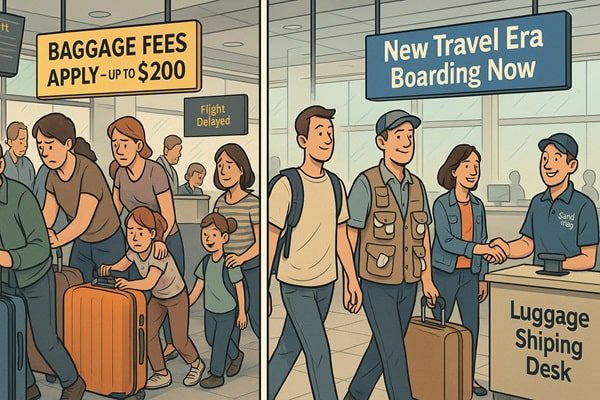
For years, baggage revenue has been a quiet earner for airlines. But as travellers become increasingly fee-weary and value-savvy, new behaviours are emerging, which could have longer-term implications for the travel industry. It’s a growing trend, from frustrated families at check-in counters to digital nomads opting to ship their belongings ahead rather than gamble on surprise airport costs.
Recent Send My Bag research found that nearly half of Aussie travellers believe airlines deliberately profit from confusing luggage policies. It’s not hard to see why. Checked baggage is often excluded from base airfares, and even within the same airline, fees can vary depending on route, season, or booking channel. One in ten Australians told us they’ve paid more for baggage than for their flight in the past year. For more than a third of respondents, excess fees cost them up to $200 – a figure that, for many, represents a substantial portion of their total travel spend.
This isn’t just anecdotal. A report in 2023 revealed that airlines globally collected over US$30 billion (AUD$50 billion) in ancillary fees, with a sizable chunk of that coming from baggage. These are meaningful revenue streams for carriers still recovering from COVID-era losses. But they’re also eroding consumer trust. The backlash can be swift and vocal, as evidenced by the public outrage over Michael O’Leary, CEO of European airline Ryanair, revealing that staff received bonuses for catching oversized cabin bags. For many travellers, it reinforced the perception that airlines are actively profiting from confusion and punishing flyers, rather than prioritising the customer experience.
The result? Many travellers are opting out of the traditional baggage system altogether. People are pushing back, and not just by complaining. Nearly one in three travellers in our research said they’ve resorted to wearing extra layers at the airport to avoid paying to check a bag. And on social media, the resistance is even more visible. TikTok and Reddit are full of so-called “travel hacks”, from wearing fishing vests stuffed with socks and underwear to travelling completely bag-free, a trend dubbed “naked flying.” These aren’t isolated behaviours anymore. They’re indicators of a rising travel mindset that values simplicity, transparency, and flexibility above all else.
This is particularly relevant now, during the peak winter travel period, when thousands of Australians travel in larger numbers, often with heavy, bulky luggage. Whether it’s a golfing holiday in Ireland, a multi-stop trip through Europe, or a student relocating for a semester abroad, baggage often becomes the most stressful and unpredictable part of the experience.
As consumers resist excessive baggage fees, the industry should examine what this behaviour signals. People are prioritising experience over process. They’re open to packing differently, planning smarter, and exploring alternative services that prioritise ease and transparency.
Luggage delivery services, which were once seen as a premium or niche option, are being reappraised as an innovative, convenient alternative for mainstream travellers.
At Send My Bag, we’ve built a global business around this need. We now ship over one million bags a year across 100+ countries. Our customers range from celebrities and professional athletes to business travellers, students, families and backpackers. What they have in common is the desire to take control of their journey, to avoid the chaos of airport queues, bypass the baggage carousel, and reduce the friction that often comes with long-haul or multi-leg itineraries.
The travel and tourism industry would do well to pay attention to this shift. For travel agents, tour operators, group travel coordinators and even accommodation providers, recommending baggage shipping, or at the very least acknowledging it as an option, can be a meaningful differentiator. It provides additional peace of mind for customers, especially those embarking on complex trips or travelling with bulky gear. It can also eliminate a common point of post-sale frustration for businesses: “Where is my bag?”
Ultimately, the rise in baggage fees may continue to boost airline profits in the short term. Still, they’re also accelerating changes in consumer behaviour that will outlast any quarterly earnings report. As with most forms of disruption, this presents both a risk and an opportunity. The brands that win will be the ones that make life easier, not harder, for their customers – those that offer optionality, predictability and a sense of freedom in how we move through the world.
Because when travellers feel unburdened, physically and mentally, everyone benefits.
By Adam Ewart, Founder of Send My Bag











