

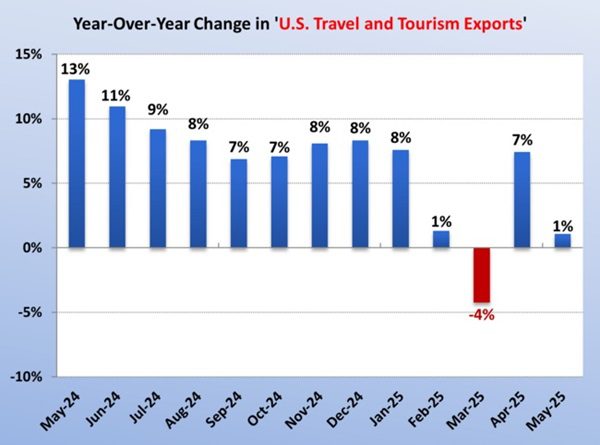
It’s the sort of financial plot twist that would have had Alfred Hitchcock leaning forward in his seat: the United States rakes in a record-shattering $160 billion from international visitors in the first five months of 2025, only to find it’s spent even more sending its citizens overseas.
Yes, despite foreign travellers pumping over $21.2 billion into the U.S. economy in May alone, Americans, ever keen on a croissant in Paris or a selfie in Santorini, managed to outspend their visitors by $21.7 billion in the same month. The result? A $433 million trade deficit. Oh, the irony.
For a nation that prides itself on being a net exporter of burgers, Broadway, and big dreams, it seems we’ve now become net importers of balmy beaches, boutique Airbnbs, and – dare we say – good coffee.
Where the Money’s Coming From (and Going To)
According to the National Travel and Tourism Office (NTTO), May was a bumper month for U.S. tourism exports and an object lesson in how freely Americans are spending their money abroad.
Let’s start with the good news, shall we?
International visitors have injected a jaw-dropping $160 billion into the U.S. travel economy in 2025. That’s not a typo. It’s the highest amount ever recorded over the January–May period, representing a near 3% increase on the same time last year. In raw terms, that’s roughly $702 million daily—a sum that could buy a new fleet of Air Force Ones or at least several dozen Taylor Swift residencies.
These visitors are doing their bit, and then some. They’ve come for the theme parks, the shopping malls, the Ivy League education, and occasionally the open-heart surgery. And they’ve left receipts, tips, and a good deal of praise for American hospitality—plus a few comments about the coffee being “a bit weak”.
Breaking It Down: Who Spent What?
Here’s where the NTTO data gets as spicy as a New Orleans gumbo:
🧳 Travel Spending – The core of the visitor economy—hotels, restaurants, transport, tickets to musicals they don’t quite understand—totalled $11.6 billion in May. That’s down 3% from May last year, meaning some tourists may opt for economy Airbnb over five-star suites, or just eating one less lobster roll.
✈️ Passenger Fare Receipts – Foreign travellers paid $3.2 billion to fly on U.S. carriers in May. That figure’s holding steady suggests Delta, United, and friends are still preferred by international flyers, even if they’ve all quietly removed the bread roll from their inflight meals.
🎓 Medical, Education, and Short-Term Worker Spend – Here’s the sleeper hit: this category soared to $6.5 billion, up 8% year-on-year. Whether it’s a semester at NYU, a quick visit to the Mayo Clinic, or a Canadian working the summer shift in Florida, these “non-leisure” visitors now account for nearly a third of all travel export dollars.
One suspects that despite the lure of Vegas and Miami, America’s universities and hospitals continue to be the real tourism powerhouses. Ivy League degrees, after all, are the ultimate souvenir.
All That… Yet Still in Deficit?
Now here’s the head-scratcher: America’s wanderlust has tipped the scales for all this inbound revenue. With U.S. travellers spending nearly $21.7 billion abroad in May, the country has landed a $433 million tourism trade deficit. That’s like winning the lottery, then blowing the lot on a round-the-world cruise—luxurious but hardly frugal.
Still, if one runs a deficit, it may as well involve sunsets in Santorini and spa retreats in Bali.
Tourism’s Place in the Big Picture
In May 2025 alone, tourism exports comprised 21% of all U.S. services exports and 8% of total U.S. exports, goods and services combined. In short, travel remains a cornerstone of the American economy, not just for Florida’s souvenir snow globe industry.
Yet there’s a lesson in all this. If the United States is to keep pace in the global tourism economy, it may need to reckon with the fact that Americans, when not hosting the world, are increasingly becoming its most free-spending tourists.
Hungry for More Numbers?
For those who enjoy statistics with their morning coffee (even if it’s not quite up to Italian standards), the NTTO’s Monthly Travel Trade Monitor offers a treasure trove of charts, breakdowns and interactive data dashboards. It’s the next best thing to being handed a spreadsheet by a sharply dressed economist on a flight to Frankfurt.
By Charmaine Lu











