

Move over, Silicon Valley—Arkansas is showing the rest of the Union how to build an economy on fresh air, fishing rods and a fair bit of foot traffic.
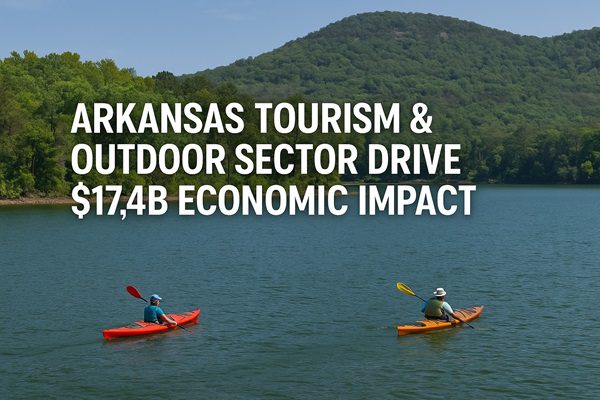
In a rousing nod to the power of natural assets and sensible planning, the Arkansas Department of Parks, Heritage, and Tourism has confirmed that the state’s visitor economy surged to a whopping $17.4 billion in 2024, up from last year’s already impressive figures. According to the latest data from Tourism Economics, some 52 million visitors descended upon the Natural State, leaving behind their footprints and a cool $10.3 billion in spending. That’s a 4% increase year-on-year, thank you very much.
And if you’re wondering whether this boom was confined to souvenir shops and sarsaparilla stands, think again. Add in the flow-on effects through the supply chain and local incomes, and the total economic wallop reaches that headline $17.4 billion. That’s not just numbers on paper; that’s jobs, businesses, and more than a few Arkansas families who can now sleep easier.
“Arkansas is becoming the place to be,” declared Governor Sarah Huckabee Sanders, likely with a hiking boot in one hand and a tourism brochure in the other. “We’ve got rivers, trails, mountains—and a plan to show it all off.”
That plan is part of the Natural State Initiative, helmed by the Governor’s husband, Bryan Sanders. It’s a rare bipartisan project in which the state’s natural charm and a savvy marketing push have joined forces and marched firmly into record-breaking territory.
Where the Money Flows—and Why It’s Sticking Around
Every single day, Arkansas racks up $28.2 million in visitor spending—a figure that would give some entire countries pause. That money isn’t vanishing into thin air either. It’s anchoring a robust visitor job market, with 71,633 direct jobs sustained across food, accommodation, and the broader tourism sector.
Add indirect employment into the mix—folks in warehousing, logistics, and supply chain support—and the tally climbs to over 102,000 jobs, or roughly one in every 18 workers across the state. That’s not just a seasonal sugar rush. It’s steady, sustaining work.
Hospitality led the charge, with food and beverage pulling in a record $3 billion—a 6.5% lift that may have something to do with those famous Southern portions and peach cobblers. Retail and recreation spending rose 5.8% and 4%, respectively, while the lodging sector held its own, up 3.3% courtesy of booming short-term rentals.
Even transport eked out a 0.6% rise, helped by calmer fuel prices and a rebound in road trip culture. Seems you can’t keep a good American highway down.
Outdoor Recreation: The Natural State’s Secret Weapon
But here’s where things get interesting. In a move that would make Henry David Thoreau proud, Arkansas has firmly hitched its economic wagon to the great outdoors.
Arkansas released detailed outdoor recreation economy data alongside its tourism figures for the first time ever, and what a debut! According to the Office of Outdoor Recreation and ARData, the sector added a mighty $7.3 billion to the state’s economy in 2023, employing 68,000 people.
To put that into perspective: outdoor recreation now comprises 2.5% of Arkansas’ GDP, eclipsing agriculture. You read that right: outdoor pursuits are now bigger than farming. Let that sink in while you bait your hook or oil your mountain bike chain.
Better still, it’s not all fishing rods and trail guides. A whopping 36% of outdoor recreation value comes from manufacturing, transport, and warehousing. That’s boots, bikes, kayaks, and gear made or moved by Arkansans, who earn average salaries of $84,600 in these roles, over 20% above the state average.
“Outdoor recreation in Arkansas isn’t a sideshow—it’s a full-blown economic engine,” said Jonas Crews, of Heartland Forward, a policy think-and-do tank based right in the thick of it.
Growth at the Speed of Sunlight
The stats are, frankly, staggering. Since 2019, outdoor amenity construction in Arkansas has surged by 52.7%—the fastest in the nation. Hunting, shooting, trapping, and fishing activities are also on the rise, with Arkansas ranking third in GDP growth for those pursuits, and eighth in fishing-related growth.
This isn’t just boom-and-bust stuff, either. It’s driven by long-term planning and some good old-fashioned Arkansas know-how. That mix of natural charm, manufacturing muscle, and modern logistics makes the sector remarkably resilient, immune to the seasonal lulls and global shocks that can decimate other tourism-dependent regions.
In 2024 alone, over 2,300 new outdoor jobs were created, pushing the total to 32,839, or 2.5% of all jobs statewide. And with the new ARData system tracking outdoor employment by region in near-real-time, the state’s only getting warmed up.
Tourism and Industry March in Lockstep
If there’s a lesson here, Arkansas isn’t just another pretty place—it’s a blueprint.
The state’s clever fusion of destination marketing and economic diversification has created a new growth story that blends small-town charm with industrial strength. Rural and urban communities benefit from the influx, with more local businesses, better-paying jobs, and an economic narrative grounded in the land.
The Department of Parks, Heritage, and Tourism uses this economic data to inform investment decisions, regional support programs, and industry development schemes prioritising growth and sustainability.
“Visitors come for the views,” said Shea Lewis, secretary of the department, “but they stay—and spend—because of our warmth, our wilderness, and the quality of our offerings.”
From the Ouachita Mountains to the Ozark Highlands, Arkansas is proving that with the right vision, tourism isn’t just a postcard—it’s a pillar.
Final Word: Lessons from the Natural State
The message couldn’t be clearer. At a time when many destinations are chasing viral fame or pouring money into flashy attractions, Arkansas is doing what it’s always done best: letting nature speak for itself, and investing in the infrastructure and community to support it.
From state parks to supply chains, trout streams to trailblazers, the Natural State is living up to its name in both spirit and bottom line.
And if you ask me, that’s a very good thing indeed.











