

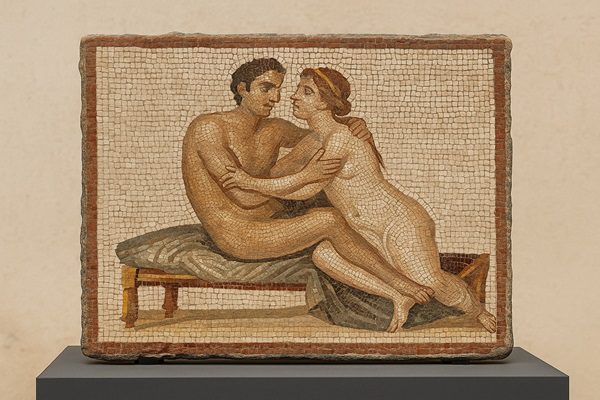
The Carabinieri Command for the Protection of Cultural Heritage has returned a mosaic depicting a pair of lovers to the Pompeii Archaeological Park. The mosaic was repatriated from Germany via a diplomatic expedition organised by the Italian Consulate General in Stuttgart, Germany.
The mosaic had been donated to a German citizen by a Wehrmacht Captain who was responsible for the military supply chain in Italy during World War II. His heirs returned it to the TPC Unit in Rome.
The precious find was delivered to the Pompeii Archaeological Park, to which the Ministry of Culture assigned it. The delivery took place in the presence of Major General Francesco Gargaro, Commander of the Carabinieri Command for the Protection of Cultural Heritage.
The mosaic is a panel, likely from the Vesuvian area, depicting an erotic scene. It may have decorated the floor of a bedroom in a Domus or villa.
The heirs of the last owner had contacted the Carabinieri of the TPC Nucleus in Rome, requesting information on how to return the mosaic to the Italian State.
The military personnel of the specialised command realised that they were dealing with a work attributable to the wartime plundering of works of art belonging to the Italian State. They conducted a series of investigations into the artifact and its provenance and worked towards its repatriation on September 16, 2023.
Thanks to the collaboration of the Office for the Protection of Archaeological Heritage of the Pompeii Archaeological Park, the artifact could be traced back to the Vesuvian area, albeit hypothetically, given the lack of certain data on its original context.
Pending further analysis and study, the panel will be temporarily displayed at the Pompeii Antiquarium to allow for its conservation, protection, and public access.
“Today’s return once again confirms the great commitment that the Carabinieri Command for the Protection of Cultural Heritage devotes to the reacquisition of national cultural heritage improperly present abroad,” stated General Gargaro. “This work is carried out daily thanks to a dense network of international relationships, consolidated over the years, which allows us to operate with precision and speed.”
“Every looted artifact that returns is a wound that heals, so we express our gratitude to the Protection Unit for their work,” said Gabriel Zuchtriegel, director of the Pompeii Archaeological Park. “The wound lies not so much in the material value of the work, but in its historical value; a value severely compromised by the illicit trafficking of antiquities. We don’t know the exact provenance of the artifact and likely never will; we will conduct further studies and archaeometric analyses to ascertain its authenticity and reconstruct its history to the extent possible.
The study, knowledge, and public enjoyment of this heritage are the lotus flowers that grow in the mud of thefts driven by the greed and selfishness of those who steal archaeological artifacts from the community.”
By Mario Masciullo
 BIO:
BIO:
My career in civil aviation took flight in 1960, beginning with British European Airways (BEA). In 1971, I joined East African Airways (EAA), and shortly thereafter, I was honoured to be selected as one of the qualified candidates for the managerial role at Malaysia & Singapore Airlines (MAS).
In 1972, following the decision by the Malaysian and Singaporean governments to separate the airline into two national carriers, I continued my professional journey with Singapore Airlines. I proudly served as the Marketing Manager for Italy, Greece, and Malta until 1987.
With a journalist’s license I had previously acquired, I decided to transition fully into journalism. My debut was with the Milan-based press agency Milanopress, and I have continued to write and collaborate with both Italian and international press ever since.
I remain active in the field and am a proud member of the Foreign Press Club in Italy, headquartered in Rome.











