

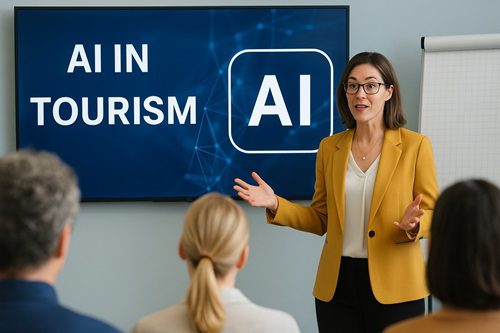
 A thunderclap has sounded across Australia’s tourism landscape — and it doesn’t come from the thundering hooves of wild brumbies or the crash of waves on Bondi Beach. It’s the unmistakable rumble of artificial intelligence (AI), and according to a major new report, the nation’s tourism operators had better get their digital boots on — or risk being outpaced by a fast-approaching future.
The 2025 edition of The State of Artificial Intelligence in Tourism, unveiled today by digital upskilling powerhouse Tourism Tribe, paints a sobering, if not slightly panicked, picture of a sector caught between curiosity and crisis.
The findings are stark. While a respectable 71% of Australian tourism operators and 79% of Destination Marketing Organisations (DMOs) have taken tentative steps into the AI arena, only a timid 19% say they feel confident using these tools. That’s barely enough to fill a minibus, let alone future-proof an industry responsible for billions in annual revenue and regional jobs.
A Tale of Two Tourisms
At the heart of the report lies a growing digital divide that’s putting pressure on the foundations of Australia’s travel economy. Well-funded DMOs are forging ahead, integrating AI into data analytics, content creation, and operational efficiency. Meanwhile, small-to-medium enterprises (SMEs), many family-run or regionally based, are grappling with the basics, toying with Canva’s Magic Studio or coaxing content from ChatGPT with limited success.
“The problem isn’t a lack of interest — it’s a lack of support,” said Liz Ward, co-founder and CEO of Tourism Tribe, in a call to action that carried all the urgency of a flare shot across a stormy sky. “AI is transforming how travellers research, plan and book. If we want to stay relevant, the time to act is yesterday.”
And indeed, the report doesn’t just sound the alarm — it lights the whole fire station.
Confidence Crisis and Skills Shortfall
Among the top barriers to AI adoption are technical skills gaps (40%), privacy and ethical concerns (33%), and constrained budgets (31%). That’s a dangerous cocktail of confusion and cost, particularly in regional areas where broadband still buffers and digital literacy lags.
Despite the obstacles, there’s cautious optimism. Over 85% of respondents believed AI would positively impact their organisations within two to three years. But thinking is not the same as being ready — and in this brave new world of machine learning and algorithmic marketing, being late to the party might mean never being invited.
“Ethics and Equity Must Come First”
In a show of leadership, Tourism Tribe urges policymakers and industry groups to roll out large-scale upskilling programs with a strong ethical backbone.
“If we don’t support SMEs, we risk creating an uneven playing field — one where only the cashed-up survive,” warned Fabienne Wintle, CIO and co-founder of Tourism Tribe. “The bush, the outback, the quirky hidden gems — they’re the heart of Australian tourism. Without help, they’ll be the first to fall behind.”
The report argues that regional and rural tourism businesses are particularly vulnerable, relying heavily on word-of-mouth and repeat visitation. Yet in the digital era, even word-of-mouth has gone online — often shaped by AI-generated search results, travel recommendations and itinerary suggestions from tools like ChatGPT or Google’s Gemini.
A Podcast to Guide the Way
To accompany the report, Tourism Tribe has launched a podcast episode titled “How Tourism Websites Can Be Found by AI.” The episode provides bite-sized, jargon-free advice for businesses looking to stay discoverable in an increasingly machine-driven search landscape.
As Liz Ward says, “We can’t afford to wait until we’re in crisis mode. We’ve got to prepare now — ethically, strategically, and inclusively.”
The Path Forward: Upskill or Untenable
The message is loud, clear, and delivered with the polite urgency you’d expect from a Qantas gate agent announcing the final boarding call: AI is not coming — it’s already here. And for Australia’s proud, resilient tourism operators, many of whom have weathered bushfires, border closures and economic batterings, it’s yet another test of adaptability.
This time, however, the challenge isn’t rebuilding — it’s reimagining.
The future of Australian tourism doesn’t lie in resisting change, but in embracing it — wisely, confidently, and with the community in mind. As Tourism Tribe’s findings suggest, the first step isn’t about expensive tech or flashy apps. It’s about education, ethics, and equipping every operator with the tools to thrive in tomorrow’s travel landscape, no matter how small.
The door remains wide open for those willing to learn. For those who are delayed, the next bus might not stop again.
By Michelle Warner











