


 Serial airline entrepreneur David Neeleman, founder and CEO of Breeze Airways, took the stage at Phocuswright to discuss his latest venture, the evolving landscape of low-cost air travel, and his unique approach to customer service and technology. In a conversation with Phocuswright Senior Vice President of Content Mitra Sorrells, Neeleman shared his insights on building a successful airline in a competitive market and his vision for the future.
Neeleman emphasized that Breeze Airways was founded to address a specific need in the market: providing non-stop service to underserved cities across the United States. He highlighted the airline’s focus on offering a “premium leisure” experience, combining affordable fares with optional upgrades for those seeking extra comfort and amenities.
“We throw out a $39 or $49 fare, and people say, ‘Great!’ And then we say, ‘Hey, for another 50 bucks, we can give you free wifi, free check bag, free carry-on bag, and three more inches of legroom.’ And they say, ‘That’s an awesome deal, I’ll take that!'”
Neeleman stressed the importance of “niceness” as a core value at Breeze, stating, “We start out by saying we’re seriously nice, so we just train all our people to be seriously nice. And that’s really the cheapest way that you can dazzle people.” He believes this customer-centric approach, combined with efficient operations and innovative technology, is key to Breeze’s success.
On the topic of AI, Neeleman highlighted its potential to personalize marketing efforts, improve predictive maintenance, and enhance customer service. He noted that Breeze’s reliance on text-based communication and a remote “Guest Empowerment Team” allows for greater efficiency and scalability.
On AI, he said: “From a customer perspective, we have this perfect database of all of our guests…So if a flight’s 15 minutes late, we can let them know. And or if there is a special, we know them in their travel habits, we can send them a special.”
Neeleman also addressed the challenges facing the airline industry, including the rising cost of fuel and the increasing competition. He expressed skepticism about the viability of sustainable aviation fuels, advocating instead for a focus on electrifying ground transportation.
“If you’re on the ground and you’re running down the road, then it makes sense economically to go electric. But if you’re flying, it makes no sense at all.”
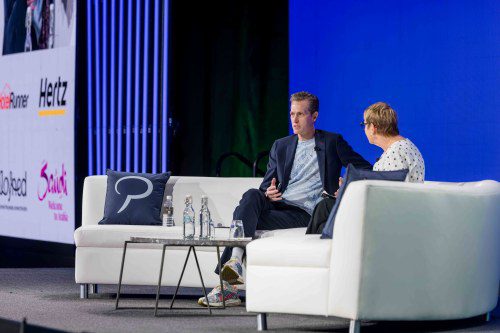
Image by Tavits Photography
Priceline CEO Brett Keller speaks AI, evolving products and the value of deals
Priceline CEO Brett Keller joined Phocuswright to reflect on his 25-year journey with the iconic travel brand, discussing its evolution from a “name your own price” pioneer to a leading online travel agency embracing AI-driven innovation. In conversation with Lorraine Sileo, Founder of Phocuswright Research, Keller highlighted Priceline’s commitment to value, technology, and customer experience.
Keller emphasized Priceline’s unique position in the highly competitive US market, stating, “We are a value player in North America in particular, we bring some of the best prices and experiences, I think, in travel here in this market.” He acknowledged the challenges of operating in a mature market, noting that Priceline must “hustle a lot more” to outpace competitors and capture growth.
The discussion touched on the history of Priceline’s “name your own price” model, its eventual shift towards more transparent pricing, and the enduring importance of opaque deals for both consumers and suppliers. Keller also highlighted the company’s investments in packaging solutions, particularly flight and car bundles, which offer significant value to travelers. He said: “We have built packaging services that allow you to do unique things like bundle two hotels together. In fact, our one of our strongest packaging products is actually flight plus car.”
Keller provided insights into Priceline’s dual-brand strategy within Booking Holdings, emphasizing the importance of both Priceline and Booking.com succeeding in the US market. He also discussed the growing significance of Priceline’s B2B business, which leverages its API to share inventory with partners and power white-label solutions.
The conversation turned to Priceline’s AI-powered chatbot, Penny, which is being integrated with OpenAI’s voice technology to enable real-time conversational booking experiences. Keller expressed optimism about Penny’s potential to personalize travel recommendations and streamline the booking process.
“She’s already starting to do that now. So she’s already taking conversations that you’re having currently, in the past, in the future…to more quickly customize specific offerings for you, especially when it comes to selecting a hotel.”
Looking ahead, Keller emphasized Priceline’s continued focus on product innovation and delivering value to consumers. He expressed optimism about the future of the US travel market, anticipating a rebound in leisure travel driven by a favorable economic environment.
“Travel is too complicated, too hard… AI is a huge weapon to solve pain points” says Wego chief
A panel of travel technology leaders discussed the transformative potential of new-age travel tech, focusing on AI, innovation, and the evolving landscape of distribution. The panel, moderated by Phocuswright Managing Director Pete Comeau and WebInTravel Founder Yeoh Siew Hoon, featured Ross Veitch, CEO and Co-Founder of Wego; Damien Scokin, CEO of Despegar; and Mike McGearty, Co-Founder and CEO of Mably Travel Technology.
The panelists shared their perspectives on the most exciting applications of new-age travel tech, with Veitch and Scokin highlighting the power of generative AI for personalized recommendations, while McGearty emphasized the potential of private LLMs to enhance security and efficiency across all aspects of the travel business.
“Using GenAI and the parallel systems, what you can build on top of them to help give better recommendations and advice [is interesting],” said Veitch.
The discussion explored the biggest promise of these technologies, with McGearty advocating for more reliable product offerings and Scokin emphasizing cost savings and increased efficiency. Veitch echoed the focus on product reliability, stating, “Travel is still, frankly, too complicated, too hard, and the AI powered systems are going to be a huge, huge weapon to help us solve a lot of these pain points throughout the whole journey.”
Scokin highlighted Despegar’s AI-powered travel assistant, Sophia, which combines generative AI with visual components to create a more engaging and human-like interaction. Veitch discussed Wego’s evolution from a metasearch platform to a transactional model, emphasizing the importance of automation and customer service in supporting direct bookings. McGearty outlined Mably’s mission to empower suppliers with technology for direct connectivity, enabling them to “own the customer” and offer seamless booking experiences.
“Customers want to book through many different channels…and a preference for a lot of customers is to book direct if they can”, Mably said.
A lively debate ensued on whether the current moment is ripe for disruption in the travel industry. McGearty argued for slaying giants who cling to outdated technology, while Scokin emphasized the transformative potential of AI to reshape business models and improve the customer experience. Veitch offered a more cautious perspective, acknowledging the disruptive potential of new technologies but highlighting the enduring power of established players like Google and Apple.
From vision to reality: Technologists take charge
A panel of technology leaders from Marriott International, American Express Global Business Travel (GBT), and MakeMyTrip gathered at Phocuswright to discuss the practical applications of emerging technologies, the challenges of implementation, and their visions for the future. Moderated by Norm Rose, Senior Technology and Corporate Market Analyst at Phocuswright, the panel featured Ankit Bhati, Chief Product Officer at MakeMyTrip; Marilyn Markham, VP of AI and Automation Strategy at Amex GBT; and Jeff Ronaldi, Vice President of Web and Mobile Products at Marriott International.
Each panelist shared their recent experiences with AI and other technologies. Bhati highlighted MakeMyTrip’s focus on AI-powered discovery, aiming to bring travelers to the platform earlier in their journey and personalize recommendations. Markham discussed Amex GBT’s efforts to establish a safe and productive environment for generative AI, focusing on employee education and addressing data security concerns. Ronaldi detailed Marriott’s experimentation with AI-powered search within its Homes & Villas platform, emphasizing the importance of real-world testing and balancing innovation with practical considerations like cost and performance.
“When you put something out in the wild…you obviously get, just like, a tremendous amount of new insights about, how do people use this? Aren’t people even ready for this new paradigm?” said Ronaldi.
The panelists acknowledged the complexities of implementing new technologies within large organizations. Bhati noted the need for internal talent development to effectively utilize AI and emphasized the importance of company-wide adoption. Markham highlighted the challenges of data security and regulatory compliance, particularly in a global operation with varying standards and concerns.
Ronaldi stressed the importance of addressing customer needs, ensuring scalability, and maintaining performance while integrating AI.
The discussion touched on the concept of personalization and the potential impact of self-sovereign identity. Ronaldi recognized the opportunity to reduce friction in the travel journey but emphasized the need to balance customer data ownership with the ability to personalize experiences. Bhati highlighted the importance of creating the right signals and collaborating with partners to effectively utilize data while respecting privacy.
The session concluded with each panelist sharing their key focus areas for 2025. Bhati emphasized MakeMyTrip’s goal of bridging the gap between discovery and booking, creating a more seamless end-to-end experience. Markham highlighted Amex GBT’s focus on internal AI adoption and transforming the customer experience. Ronaldi reiterated Marriott’s commitment to delivering personalized experiences and getting the “right product at the right time” to customers.
Steve Singh: “Massive change coming in corporate travel management”
Steve Singh, Managing Director of Madrona Venture Group and a prominent figure in the corporate travel technology space, joined Phocuswright for a discussion on the future of business travel, the role of AI, and his vision for the “perfect trip.” In an interview with Linda Fox, Executive Editor at PhocusWire, Singh shared his insights on the evolving landscape of corporate travel management and the need for innovation.
Singh, who previously co-founded Concur and now serves as Chairman of Direct Travel, expressed his excitement about the opportunities presented by AI and cloud-native technologies to transform the corporate travel experience. He emphasized the potential for cost reduction and service enhancement through AI-driven solutions.
“I think there’s going to be a massive change in the corporate travel management arena…driven by what tech stack you offer to your customers, frankly, the cost structure to deliver that.”
He highlighted Spotnana, a modern travel technology platform, as a key enabler of this transformation, stating that it could help reduce TMC cost structures by half. Singh addressed concerns about Spotnana potentially competing with existing TMCs, emphasizing its open platform approach and commitment to supporting partners.
“If you look at the system of record for travel, it’s archaic…We looked at this and said, can we come up with a modern version…make it completely extensible by anybody that’s adding value to the trip?”
Singh predicted a significant evolution in booking tools and expense management, driven by AI and conversational interfaces. He discussed the potential for AI-native applications to personalize the travel experience and proactively address traveler needs.
“You can’t drive AI into the application stack by saying it’s an add-on. You have to re-architect your entire application…where the insights and the actions that you take from that data actually fold into the application to change the behavior of the application.”
He also touched on Octo, an AI-powered travel assistant for unmanaged travel, expressing confidence in its potential to disrupt the market and provide TMC-like services in a digital format.
Singh reiterated his belief in the “perfect trip,” a vision he has championed for over a decade. He believes that advancements in AI and open APIs are making this vision a reality, enabling seamless communication and proactive problem-solving throughout the travel journey.
“If we have a disruption in a trip, why can’t I communicate with every other service provider that is downstream from that disruption and say, ‘Here’s the impact that it’ll have on you, or here’s the adjustments we need to make to that trip’?”
He expressed optimism about the future of the travel industry, emphasizing the human desire for connection and the enduring appeal of travel experiences. Singh also reflected on his learnings from his time at Concur, highlighting the importance of open platforms and the need to embrace change.











