

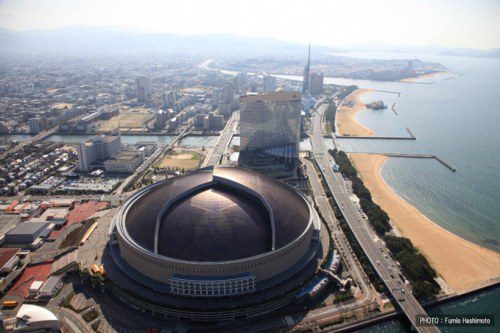
 We were visiting Fukuoka, and we went to a ballgame for my birthday. The Fukuoka team, SoftBank Hawks, were playing an Osaka team. As a boy, I partly grew up in Chicago and supported the Cubs. Although they could never make the playoffs, the stands were packed, and once, a Cub fan was always a Cub fan. So, I was expecting a similar experience. No, this was the 2023 version with nonstop band playing, chanting, cheerleaders, whistles, flags, and banners. I almost dread the home team getting a run! More action off the field than on. Despite the sound overload, it was all fun. Of course, as is tradition or culture, minimal mess was left behind. Everyone is responsible for their cups, wrappers, and plastic things and disposes of their rubbish. It’s a stadium cleaner’s dream!
Baseball was introduced into Japan in 1873 by an American teacher in Tokyo, Horace Wilson, and the game caught on very quickly through much of the island nation. Most Americans are, in fact, surprised to learn that the history of baseball in the land of Nippon goes back more than a century. Baseball is extremely popular in Japan. Japan’s twelve professional baseball teams have a loyal following from people of all ages.

Fans celebrations (C)SoftBank HAWKS
In Japanese, baseball is commonly called yakyū, combining the characters for field and ball. According to the Japan National Tourism Organization (JNTO), the atmosphere of Japanese baseball games is less relaxed than in the United States, with fans regularly singing and dancing to team songs.
It’s a relatively inexpensive activity to attend. You will probably spend more on the food if you get near a concessionary stand. Fans were very orderly and polite and did not get up and down constantly during the game. They would only get up between innings.
In Japan, it is a new level. Home players don’t get individual entrance music as they approach the plate—they get a special chant sung by the fans! And there is a different one to cheer on the batter. You can buy plastic boom sticks and bang them freely throughout the game to rally your team to success. The non-stop cheering is one of the most exciting aspects of attending a baseball game. They beat plastic bats, blow whistles, wave flags and banners, and know the words of every stadium’s organized chant and song.
Overall, we had a great first experience with Japanese baseball. Baseball is an old sport steeped in many traditions, and it was special to experience another version of these traditions that have been so familiar to me throughout my youth.

Stadium Scene (C)SoftBank HAWKS
Japanese star Shohei Ohtani reached another goal when he agreed to the largest contract in major North American team sports: a 10-year, $700 million contract with the Los Angeles Dodgers. He will now be compensated for his immense talent and star power.
The symbol of the Fukuoka SoftBank Hawks is the two lines of “Revolution Yellow,” which is also the symbol of SoftBank. Yellow is a colour that makes people cheerful, happy, and optimistic.
In the end, the Hawks didn’t win, but that didn’t seem to upset the fans. They got to let off lots of steam, see the game, sing and shout, eat something, and go home—all good value. Even if the hometown loses, a Japanese baseball game is hard to beat.
It was all entertainment. The best part was sharing it with my son, just like my Dad had taken me to many games as a young Cubs fan.
https://www.softbankhawks.co.jp/global/english/
Written by: Richard Coles
=======================================











