
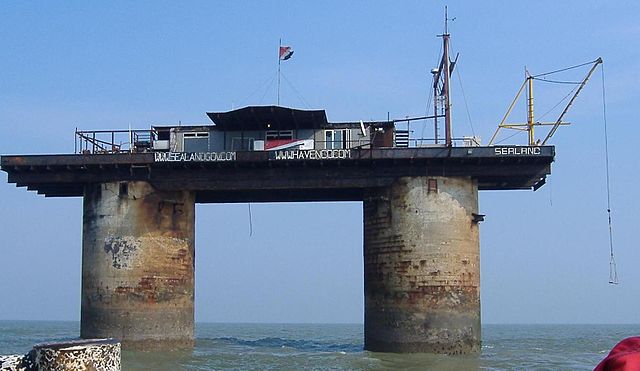
 Amid the North Sea, approximately twelve kilometres off the coast of Suffolk, a unique story unfolds on the world’s smallest self-proclaimed sovereign entity — the Principality of Sealand. While residing on an offshore platform known as HM Fort Roughs, or Roughs Tower, Sealand’s intriguing history spans from its creation during World War II to its unorthodox presence as an unrecognized micronation.
Designed initially as a Maunsell Sea Fort by the British during World War II, Roughs Tower’s primary objective was to shield vital shipping lanes against German mine-laying aircraft. With a floating pontoon base and a superstructure comprising two hollow towers, the fort was strategically positioned above the Rough Sands sandbar and deliberately submerged to secure its final resting spot. The fort, in international waters and beyond the then three nautical mile claim of the UK, was manned by 150–300 Royal Navy personnel throughout the war before decommissioning in the 1950s.
https://youtu.be/0pmdJofO5tI
However, the fort’s tranquillity was disrupted in February and August 1965 when Jack Moore and his daughter Jane, representing the pirate station Wonderful Radio London, occupied Roughs Tower. Then in 1967, Major Paddy Roy Bates, a British citizen and pirate radio enthusiast, assumed control of the fort, aiming to establish his own station, Radio Essex. Despite possessing the necessary equipment, Bates never began broadcasting. Instead, he declared the independence of Roughs Tower, rebranding it as the Principality of Sealand.
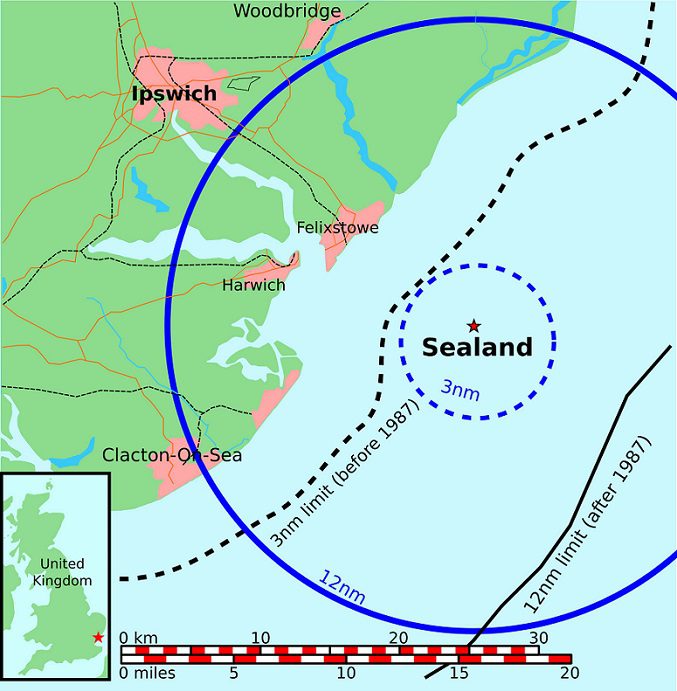
Map of Sealand and the United Kingdom, with territorial water claims of 3 and 12 nmi (6 and 22 km) shown.
The sovereign declaration faced its first legal hurdle in 1968 when British workmen entered what Bates claimed as his territorial waters. In response, Bates’ son, Michael, fired warning shots from Sealand, resulting in firearms charges in England. Nevertheless, as Sealand was beyond the UK’s territorial waters, the case couldn’t proceed, giving the Bates family a quasi-legal victory.
By 1975, Sealand was transforming into a semblance of a nation by introducing a constitution, a national flag, anthem, currency, and even passports. However, the narrative took a dramatic turn in August 1978 when Alexander Achenbach, self-proclaimed Prime Minister of Sealand, hired mercenaries to overthrow Sealand. While Bates and his wife were in Austria, Achenbach and his mercenaries seized Sealand and held Michael Bates hostage. Still, the Bates family retook control, capturing Achenbach and charging him with treason against Sealand.
Interestingly, Germany’s decision to send a diplomat from its London embassy to negotiate Achenbach’s release was perceived by Bates as de facto recognition of Sealand. In a bizarre twist, after the failed coup, Achenbach and his associate Gernot Pütz established the Sealand Rebel Government or Sealandic Rebel Government in Germany.
Sealand’s sovereignty claim became complex in 1987 when the UK extended its territorial waters to 12 nautical miles, effectively encompassing Sealand within its jurisdiction. Sealand continues to operate under the Bates family, selling “fantasy passports” despite being invalidated for international travel in 1997 following their misuse by an international money laundering ring.
Sealand faced further challenges, such as an electrical fault that sparked a fire on the platform in June 2006, which was repaired by November of the same year. An attempt to sell Sealand to The Pirate Bay, an online digital content index, in 2007 also fell through.
Sealand’s founding patriarch, Roy Bates, passed away at 91 on 9 October 2012, following which his son Michael took over the operations. Joan Bates, Roy Bates’s wife, passed away in 2016. While Sealand’s legal status remains contentious, with little chance of recognition due to its man-made structure, it holds the Guinness World Record for “the smallest area to lay claim to nation status.”
Despite Sealand’s lack of official recognition from any established sovereign state, the Bates family manages it as though it were a sovereign entity. Roy Bates called himself “Prince Roy” and his wife “Princess Joan”, while their son has been referred to as the “Prince Regent”. Currently, Sealand is inhabited by one or more caretakers representing Michael Bates, who resides in Essex, England.
To learn more about the fascinating world of Sealand, visit their official site.
Written by: Matthew Thomas