
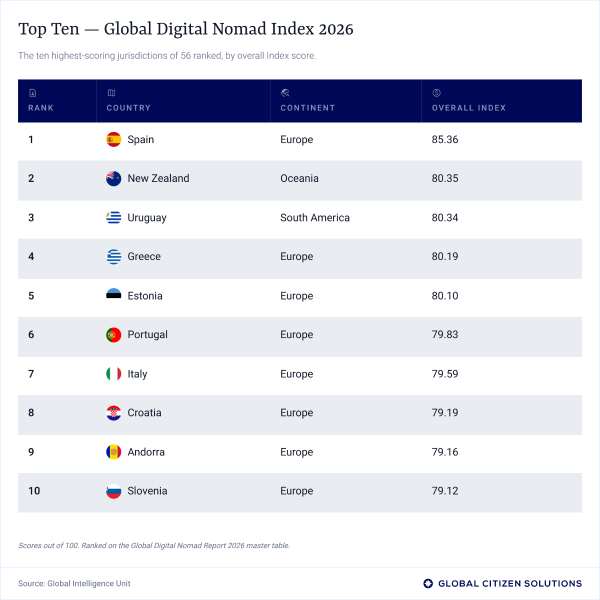
Spain is the world’s leading destination for digital nomads and remote workers for the third consecutive year, according to the Global Digital Nomad Report 2026, published today by the Global Intelligence Unit (GIU), the research arm at Global Citizen Solutions (GCS), a leading global citizenship and residency planning firm. Europe accounts for eight of the ten highest-ranked jurisdictions, but across the 56 programmes assessed, the report finds that getting in is now far easier than building a longer-term future.
Spain leads for the third consecutive year
Spain scores 85.36 out of 100, 5.01 points clear of New Zealand (80.35) and Uruguay (80.34). Its lead reflects a balanced combination of quality of life, international mobility, speed and ease of residence procedures. Even with an adjustment to the previous two years’ methodologies for GCS’ proprietary index, Spain wins again. Greece (80.19), Estonia (80.10), Portugal (79.83), Italy (79.59), Croatia (79.19), Andorra (79.16) and Slovenia (79.12) complete the top ten.
The report’s Global Digital Nomad Index assesses 56 jurisdictions across six dimensions and 19 indicators: Procedure, Citizenship and Mobility, Economics, Tax Optimization, Quality of Life, and Tech and Innovation. Rather than focusing on affordability or visa access alone, it examines the policies, economic conditions, infrastructure and quality-of-life factors that shape a destination’s appeal to internationally mobile professionals.
From pandemic stopgap to long-term strategy
Digital nomad visas spread rapidly after the COVID-19 pandemic, as countries introduced programmes to recover lost tourism revenue. In 2025, the Global Intelligence Unit found that 91% of the programmes then in place had been launched since 2020. That first wave is now consolidating. Several early programmes have closed, including the Cayman Islands’ ‘Global Citizen Concierge Programme’, Bermuda’s ‘Work From Bermuda’ initiative and Antigua and Barbuda’s ‘Nomad Digital Residence’, and others have been suspended. The programmes gaining ground take a longer view, designed not only to bring spending into local communities but to attract skilled professionals who stay, contribute and integrate.
Of the 56 jurisdictions covered in this year’s report, which distinguishes dedicated digital nomad visas from visitor permissions, freelance residence permits and general remote-worker routes, 96% launched in 2020 or later. Yet the pandemic was not the only driver: 23 arrived in 2023 or later, after most travel restrictions had lifted, and increasingly serve talent and residence goals rather than tourism recovery alone. Stricter classification criteria in this edition’s Index also mean fewer programmes qualify, reflecting both a sharper methodology and a policy landscape in which short-term tourism measures now sit alongside long-term residence and talent strategies.
Europe’s advantage lies in what follows arrival
Europe represents 22 of the 56 jurisdictions assessed – Quality of life, Schengen access, mobility rights and settlement prospects underpin that lead.
A race to retain talent
Most programmes have removed the basic barriers: 87.5% accommodate family members, 83.9% allow extension or renewal and 78.6% permit remote applications. 20 of the 56 routes (35.7%) now allow time under the relevant status to count toward permanent residency or citizenship. The central policy divide is no longer simply who can enter, but who can stay longer and whether those years count toward settlement.
“Digital nomad visas are now a widespread policy tool, but this year’s ranking shows how differently countries design them. Spain leads the 2026 index on the strength of its quality of life, a clear application process and a visa that counts toward long-term residence and citizenship. Across the 56 programs we assessed, however, only around a third let time on the visa count toward stable residence pathways. For many remote workers, the visa is a starting point rather than a pathway, and the more important decision is which residence route comes next.” — Dr. Laura Madrid, Lead Researcher, Global Citizen Solutions
“The remote professional needs a legal basis to work remotely, and clarity on their tax expectations. The digital nomad index was built to measure what remote professionals face beyond the first year, giving them added clarity into their options.” — Adalberto Pucca, Head of Global Sales and Development, Global Citizen Solutions
The leaders are not the cheapest
The ten highest-ranked destinations require an average annual income of USD 47,356, about 22% more than the USD 38,769 average across the Index. Their competitive edge lies in stronger liveability and mobility outcomes rather than price.
Tax advantages alone do not secure a top-ten place
Five jurisdictions earn a perfect Tax Optimization score, yet none reaches the overall top ten, while many leading European destinations tax residents on worldwide income. Favourable fiscal treatment may appeal to specific remote-worker profiles, but it does not automatically offset weaker quality of life, mobility or settlement pathways.
From attraction to integration
The report concludes that the next phase of competition for internationally mobile professionals will be shaped less by how easily countries admit remote workers and more by the longer-term opportunities available once they arrive, including access to residency and citizenship. Governments seeking to differentiate their offer can focus on legal certainty, residence continuity, mobility rights and family stability, not only on headline visa conditions.
Methodology
The Global Digital Nomad Index 2026 is based on a ranked master table and indicator dataset covering 56 jurisdictions, collected in September and October 2026. Programme categories include dedicated digital nomad visas and other long-stay or visitor routes commonly used by remote workers.