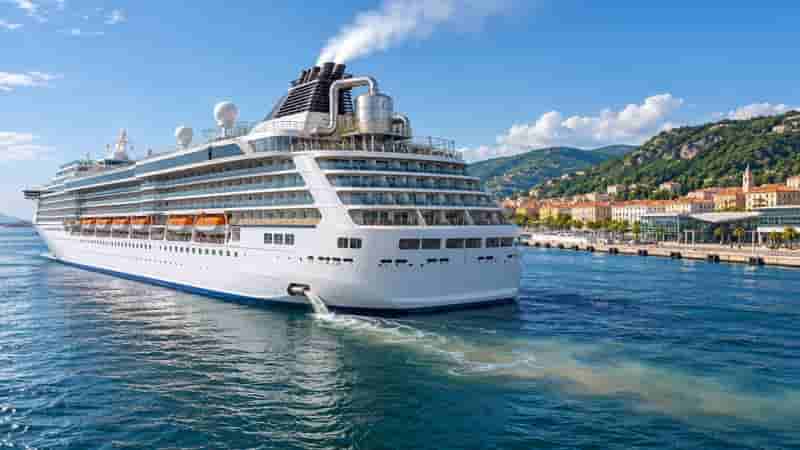
Cruise ships promise sparkling seas and dazzling sunsets. But an awkward environmental question is gaining momentum: when ships clean pollution from their exhaust, where does the waste go?
First, a quick explanation. A cruise ship scrubber is not the unfortunate crew member washing dishes in the galley. It is an exhaust gas cleaning system (EGCS), installed to reduce sulphur oxides released when ships burn certain marine fuels.
And while scrubbers help clean the air, some also discharge contaminated washwater into the sea. Suddenly, the environmental arithmetic becomes rather less reassuring.
Why do ships use scrubbers?
Some vessels burn heavy fuel oil, a thick petroleum product that may need heating to flow through fuel systems. When high-sulphur fuel is burned, the exhaust contains sulphur oxides, pollutants linked to respiratory problems and environmental damage.
Since January 2020, the International Maritime Organisation (IMO) has generally limited sulphur in marine fuel to 0.50 per cent by mass. In designated Emission Control Areas, the limit is 0.10 per cent.
Operators can use compliant low-sulphur fuel or an approved scrubber that achieves equivalent reductions in sulphur oxide emissions. Scrubbers can make cheaper, higher-sulphur fuel economical, depending on equipment and running costs.
They are not magical machines, however. They do not remove every pollutant, nor do they eliminate a ship’s carbon dioxide emissions.
Three systems, one uncomfortable question
There are three principal arrangements.
Open-loop scrubbers use seawater to wash pollutants from exhaust gases, then discharge the used water overboard, subject to applicable rules.
Closed-loop scrubbers recirculate wash water, typically using chemicals to maintain performance. They produce smaller quantities of concentrated bleed-off water, which may be treated and discharged where allowed, or retained for disposal ashore.
Hybrid scrubbers switch between these operating modes according to local rules and conditions.
The important distinction is between exhaust emissions and washwater. An open-loop system does not simply pump smoky exhaust into the ocean. It transfers some pollutants into water that can contain metals, acidic compounds, and polycyclic aromatic hydrocarbons (PAHs).
Research assessed by European environmental authorities has identified risks to marine organisms, including from toxicity and localised acidification. Those risks are particularly concerning around ports, enclosed bays and sensitive coastal habitats.
So, yes, cleaner air is welcome. But cleaning the air should not automatically mean making the water somebody else’s problem.
What do international rules allow?
The IMO permits approved scrubbers as an alternative way of meeting sulphur emission standards under MARPOL Annex VI.
Its 2021 EGCS Guidelines set discharge-water quality criteria and monitoring requirements. Separate IMO guidance helps governments assess environmental risks when considering tighter restrictions.
Crucially, IMO approval is not a free pass to discharge everywhere. Countries and ports can impose stricter rules.
That is precisely what is happening.
Europe sets the clock ticking
The OSPAR Commission, which coordinates marine protection in the North-East Atlantic, adopted a significant decision in 2025.
Under OSPAR Decision 2025/01, participating governments are to implement national prohibitions on scrubber washwater discharge in relevant internal waters and port areas.
The target dates are 1 July 2027 for open-loop discharge and 1 July 2029 for discharge from any scrubber operating mode, including closed-loop bleed-off.
There are qualifications. Governments can notify OSPAR of postponements of up to three years, and the decision does not automatically prohibit discharge throughout all territorial seas. The Commission is separately considering a wider geographical scope.
Nevertheless, cruise ships calling at North-East Atlantic ports face a clear direction of travel. Operators will need appropriate fuel, onboard retention capacity or other compliant arrangements.
It is not the end of scrubbers everywhere. It is an increasingly firm warning about what they may put overboard.
Asia and the Gulf tighten controls
Singapore has prohibited open-loop scrubber washwater discharge in its port waters since 1 January 2020. China restricts such discharge in specified areas, including inland river emission control areas, coastal port waters within designated areas and the Bohai Sea.
The Port of Fujairah in the United Arab Emirates also prohibits open-loop scrubber use in its waters.
These are not identical national bans. Operators must check each port’s requirements.
So where does Australia stand?
Australia permits scrubber washwater discharge, subject to the IMO’s applicable quality and operating requirements. The Australian Maritime Safety Authority (AMSA) says there is no nationwide prohibition, including in Australian waters associated with the Great Barrier Reef Marine Park.
Controls exist: systems need approval, discharge water must meet quality criteria, and scrubber residues cannot be dumped overboard. Ports may impose additional requirements.
But Australia’s position differs from places moving towards broader discharge restrictions.
For a country that enthusiastically markets its reefs and coastlines, that contrast deserves examination. The issue is not whether Australia has regulations. It is whether the existing regulations adequately protect sensitive marine environments.
Portland sends another warning
Across the Pacific, Portland City Council in Maine voted unanimously on 16 November 2026 to prohibit open-loop scrubber washwater discharge from cruise ships at its city-owned terminals. The restriction is due to take effect on 1 January 2027.
Environmental campaign group Portland Cruise Control estimates the change could prevent around 32 million US gallons of washwater entering Casco Bay during a cruise season. That is a campaign estimate, not a measured annual discharge total.
Seattle has prohibited scrubber washwater discharge by cruise ships while berthed since 2020. In California, separate marine fuel rules generally require specified cleaner fuels for covered ocean-going vessels within 24 nautical miles of its baseline.
Different approaches, but a shared concern: protecting coastal waters.
What does this mean for cruise passengers?
For cruise lines, changing requirements mean switching fuels, installing suitable holding tanks, arranging shore disposal, and conducting careful voyage-by-voyage compliance checks. For passengers, it raises questions about environmental claims in glossy brochures.
Scrubbers have helped reduce sulphur oxide emissions. That benefit is real and should be acknowledged. Yet the growing restrictions show that air-quality gains cannot be judged in isolation from marine pollution.
Australia need not copy every overseas rule without examining the evidence. It should, however, ask whether its current approach remains appropriate as the science and international practice evolve.
After all, travellers book a cruise to admire the ocean, not to wonder what the ship might be washing into it.
Perhaps it is time Australia got its scrubber act together.
By: John Alwyn-Jones – © 2026.
Read Time: 5 minutes.
Author Bio:
 John Alwyn-Jones is one of those rare figures who can make the business of travel sound positively adventurous.
A lifelong communicator with the polish of a broadcaster and the curiosity of a journalist, he’s spent decades shaping stories and strategies across tourism, aviation, and the cruise world. He’s led from the front as CEO, director, mentor, and advisor, and still brings warmth and wit to every boardroom and microphone.
Known for his sharp insight into global cruise lines and destinations, John has an old-school belief in professionalism, tempered with the sparkle of someone who’s genuinely seen the world. He’s not just in the travel business; he’s made it an art form.