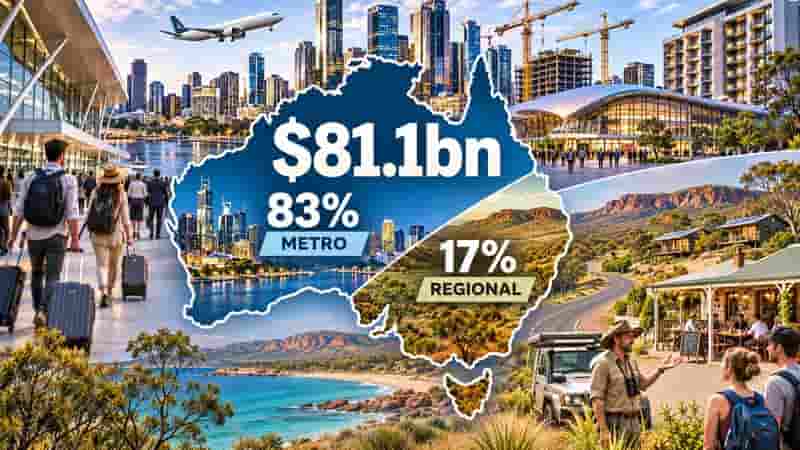
Australia’s record $81.1 billion tourism investment pipeline promises new airports, hotels and jobs. But with around 83 per cent of its value in major urban areas, who will share the rewards?
Australia has a new $81.1 billion tourism headline, and it is large enough to make even the most seasoned hotel developer reach for a second calculator.
The figure, released by Tourism Research Australia (TRA) on 18 November, covers 479 tourism-related projects worth at least $20 million each, assessed as at 30 June 2026. It is a record investment pipeline, up $13.6 billion, or 20 per cent, against the comparable June 2025 figure.
Before anyone starts spending it, though, there is a small matter of definition.
This is not $81.1 billion of money already spent, nor a single government grant. It is the estimated value of projects proposed, being planned or under construction. Some will proceed. Others may change, stall or disappear. A promise to build a hotel is not the same as handing a guest the room key.
Where the $81.1 billion sits
The latest TRA Tourism Investment Monitor places $41.5 billion in arts, recreation and business services, $24.4 billion in aviation and $15.2 billion in stand-alone accommodation.
Of the 479 projects, 203 worth $44.2 billion were under construction at the reporting date. Another 237, valued at $33.3 billion, were in planning. The remaining 39 proposals were worth $3.7 billion.
The growth figures also deserve a careful reading. TRA’s June 2026 report uses a comparable 2025 baseline of $67.5 billion, while its earlier 2024–25 monitor had put that year’s pipeline at $74.5 billion. Readers should not mistake the reported annual rise for a simple subtraction between the two original headline totals.
Nor is all the hotel growth new. The report reclassified 35 developments worth $4.8 billion from its separately reported mixed-use category into stand-alone accommodation after further information became available.
A further 142 mixed-use developments worth $69.1 billion are tracked separately, not added to the $81.1 billion headline because much of their value is not purely tourism-related.
It is a formidable pipeline. It is not a blank cheque.
The regional divide is hard to ignore
Here is the number that should command the attention of regional tourism operators: just about 17 per cent of the main pipeline’s value lies in regional Australia.
That works out to approximately $14.1 billion: $9.1 billion in arts, recreation and business projects, $4.2 billion in stand-alone accommodation and just $0.8 billion in aviation. The remaining 83 per cent sits in TRA’s capital-city category, which includes the Gold Coast.
New South Wales leads with $23.3 billion, followed by Queensland on $20.1 billion and Victoria on $15.4 billion. Together they account for roughly 73 per cent of the national total.
Greater Sydney has $21.3 billion, or 92 per cent of NSW’s pipeline. Greater Brisbane and the Gold Coast account for $14.9 billion, or 74 per cent of Queensland’s.
There are reasons for this concentration. Large airports, exhibition centres and event venues need large markets. Brisbane’s preparations for the 2032 Olympic and Paralympic Games add another powerful draw.
Yet a busy terminal in Sydney does not automatically translate into a busy café in Dubbo. Visitors still need affordable transport, compelling reasons to travel onwards and businesses ready to welcome them.
The investment split shows where projects are located. It does not, on its own, prove where every future tourism dollar or job will end up.
Airports open doors, but travellers may pay
One project that has moved beyond the drawing board is Western Sydney International Airport. Passenger flights began on 25 October 2026, with the first international service following the next day.
Alongside upgrades at other airports, greater capacity can help airlines establish routes and give advisers more choices when selling Australia.
There is a catch. The Australian Competition and Consumer Commission warned in March that large airport capital programs could push up charges to airlines and, in turn, airfares.
More infrastructure is welcome. More expensive access is less appealing, especially for regional travellers already watching every dollar.
Thousands of rooms, not yet ready to book
Across stand-alone and mixed-use developments, TRA identifies potential capacity for approximately 57,400 accommodation rooms nationwide. About 14,200 are in regional Australia.
The regional total includes roughly 9,000 rooms in stand-alone projects and 5,100 in mixed-use schemes; the published components do not add precisely to the headline figure because the underlying estimates are rounded.
These are pipeline estimates, not completed rooms. A new hotel can bring guests, contracts and work to a town. It can also struggle if air access, staffing or year-round demand fails to keep pace.
The difference between a thriving destination and an expensive collection of empty beds is rarely settled at the ribbon-cutting.
Jobs and local businesses: the real test
Australia already had 726,300 filled tourism jobs in the June quarter of 2026, according to the Australian Bureau of Statistics, a rise of 4.1 per cent over the year.
Trade and Tourism Minister Don Farrell said in the 18 November announcement: “More investment means more opportunities for local businesses and more local jobs.”
That is a reasonable ambition, not yet a measured outcome of these pipeline projects. The useful questions are how many contracts reach local suppliers, whether staff get lasting careers and what remains when the construction crews leave.
Queensland also faces a practical constraint. Its Audit Office warns that 2032 Games works will compete with other infrastructure for labour, contractors and materials. That is an economy-wide construction risk, not a finding that the tourism pipeline itself is already delayed.
First Nations tourism businesses must also have genuine opportunities to lead, own and benefit from experiences built around their culture and Country. Being featured in a brochure is no substitute for sharing in the business.
Growth is forecast. Fair distribution is not
TRA says visitors spent $192.4 billion in Australia during 2025. Its tourism forecast projects annual visitor spending of about $233 billion by 2030, in nominal dollars, which include the effects of inflation.
That forecast measures spending in a future year. It should not be confused with the cumulative value of projects in the investment pipeline.
Australia’s updated THRIVE 2030 action plan calls for stronger regional tourism, competitive small businesses, an effective workforce and greater First Nations participation. Those aims offer a useful yardstick.
Success should be measured in regional visitor nights, contracts awarded locally, sustainable jobs, accessible experiences and a fair return for host communities. The size of a new building is a poor substitute for those outcomes.
The $81.1 billion pipeline is a serious vote of confidence in Australian tourism. But the ultimate test is not how many cranes rise over the capital cities. It is how far the benefits travel once those cranes come down.
By: Michelle Warner – © 2026.
Read Time: 6 minutes.
Author Bio:
 Michelle Warner has always carried stories the way others carry passports lightly, faithfully, and with purpose. She learned her craft in newsrooms, shaping sentences with care, before swapping deadlines for departures as a flight attendant with some of the world’s great airlines. Years aloft sharpened her eye for character and deepened her fondness for the small, dignified rituals of travel, the quiet kindness of strangers, the poetry of arrival, the patience learned between time zones.
Now grounded by choice, Michelle has come home to writing with the same calm authority she once brought to turbulent cabins. Her prose blends an editor’s discipline with a traveller’s wonder, tinged with humour and reverence for the golden age of travel. Each piece feels like a handwritten boarding pass, gracious, observant, and unmistakably alive.