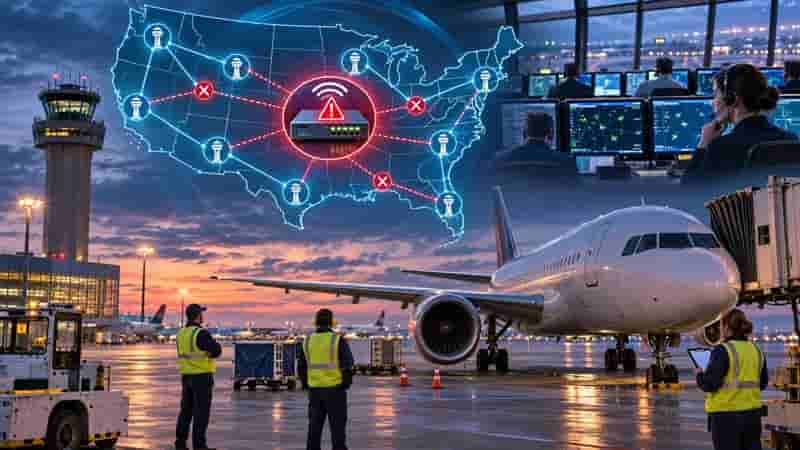
A routine telecommunications upgrade is under scrutiny after America’s air traffic control network faltered, grounding departures nationwide and leaving airlines with a weekend of disruption.
A network router is now under scrutiny for helping to achieve what most airline schedules would regard as unthinkable: a nationwide halt to US departures.
Not every aircraft in the sky was grounded. But on Friday, 13 November 2026, the Federal Aviation Administration (FAA) ordered departures halted nationwide after controllers began receiving unstable communications and radar information. The restriction lasted more than four hours. Its consequences lasted considerably longer.
By Saturday, investigators were examining work performed by defence and technology contractor L3Harris Technologies during the conversion of old copper lines to fibre. The investigation has identified a network overload, but has not established whether defective equipment, installation error or another fault triggered it.
A small component, an enormous system, and one question Washington can no longer avoid: how did an apparently local problem travel so far?
The router that overwhelmed the network
US Transportation Secretary Sean Duffy said maintenance was underway at at least one remote FAA facility when a router began flooding other devices with more than 1,000 connection attempts every four to five seconds.
The resulting instability interfered with communications between controllers and aircraft and disrupted radar data reaching control facilities. Reuters reported that 17 of the FAA’s 22 en-route air traffic control centres were affected.
Those centres manage aircraft crossing American airspace, arranging the handovers that allow flights to move safely between regions. When information becomes intermittent, the consequences are not confined to the room containing the equipment.
This was not a simultaneous physical failure of every US radar installation. FAA officials said no control centre had completely lost its communications systems. The concern was the reliability of information flowing through a shared network.
Controllers could keep aircraft already airborne moving under established safety procedures. But with the extent of the fault uncertain, the FAA stopped further departures.
Four hours grounded, a weekend in disarray
The nationwide ground stop began at approximately 3.54 pm Eastern US time on Friday and was lifted at 8.15 pm. Officials said more than 3,500 aircraft already airborne were brought to safe landings. The Department of Transportation reported more than 8,000 flight operations resumed that evening.
The disruption did not politely end when the restriction did.
According to FlightAware figures reported by Reuters, more than 6,400 flights were cancelled on Saturday and about 8,000 delayed. Another 875 flights on Sunday had already been cancelled by Saturday night. These were wider network totals, not a final accounting of services attributable solely to the communications failure.
Aircraft and crews had finished Friday in the wrong places. Some pilots and cabin crews reached their duty limits. A flight ready to depart can still be cancelled when the aircraft supposed to operate it is on the other side of the country.
FAA Administrator Bryan Bedford said airlines expected normal schedules to return by the end of Sunday, US time. That was a recovery forecast, not proof that every passenger’s journey had been repaired.
L3Harris responds as investigators examine two states
Duffy identified L3Harris as the contractor working on the copper-to-fibre changeover. Reuters reported that investigators were also examining possible router problems at sites in Arkansas and Texas.
Neither location has been conclusively identified as the source, and there has been no final finding of contractor negligence.
In its official statement on 14 November, L3Harris said it was cooperating with the FAA investigation and took the disruption seriously. The company said it and its telecommunications partners had completed more than 70 per cent of the planned conversion from copper to fibre.
That response belongs in the story. Naming the company conducting the work is one thing; proving why the equipment malfunctioned is quite another.
Officials have reported no evidence of a cyberattack or a link to the FAA’s separate artificial-intelligence system. Neither explanation should be promoted as established fact.
Sixty routers: the next precaution
The FAA has taken a broader precaution while testing continues. FAA technology officials said the function associated with the problem had been disabled on roughly 60 similar routers nationwide, pending further work with L3Harris.
That step suggests investigators are looking beyond the original installation to the possibility of a wider vulnerability in how comparable equipment behaves.
It does not establish that 60 routers failed, or that the original unit has been proved defective.
Duffy also said the FAA would review the timing of maintenance at smaller facilities. Work at remote sites had sometimes been performed during daytime hours because it was not expected to affect the whole network. Friday’s events provided a rather spectacular reason to revisit that assumption.
The billion-dollar legacy problem
The wider problem is not new. Bedford said the FAA spends about US$1 billion a year maintaining its older telecommunications network. Congress has already provided US$12.5 billion for a separate air traffic control modernisation programme; Duffy is seeking a further US$50 billion for broader aviation and airport infrastructure.
Those figures should not be bundled into a single approved project. Bedford specifically distinguished the maintenance work under investigation from the separately funded modernisation programme, and the additional US$50 billion is a request, not money already authorised.
Aviation sells the future remarkably well: quieter aircraft, better connectivity and sophisticated flight decks. Yet the infrastructure supporting those aircraft still includes decades-old technology.
An aeroplane can cross an ocean on autopilot. Getting permission for it to leave the ground should not depend on a network being overwhelmed by maintenance traffic.
Why Australia should care
The FAA’s decision was American. Its consequences were not.
Qantas reported limited delays during the disruption, while Australian passengers faced potential missed US domestic connections and changes to trans-Pacific schedules. Flights from America may be delayed at departure; travellers already airborne towards the United States could land but still find onward services unavailable.
Australian travel advisers should continue checking each sector of an affected itinerary and any rebooking conditions. The lifting of the ground stop does not, by itself, confirm that a particular booking is back on track.
For now, investigators have a credible technical lead, a contractor’s cooperation and additional safeguards in place. They do not yet have a definitive answer about fault or responsibility.
The FAA brought the aircraft down safely. Its next challenge is to demonstrate that routine work on the ground cannot bring the whole timetable down with it.
By: Jason Smith – © 2026.
Read Time: 6 minutes.
Author Bio:
 Jason Smith didn’t learn travel from textbooks. He learned it in airports, taxis and hotel lobbies, watching the business unfold long before he played his own part. Half American, half Asian, he grew up around the quiet workings of tourism, where people come and go, and stories rarely stand still.
Bangkok came first, then formal study, then a career that carried him through Singapore, Malaysia and Vietnam. Each place left something behind. In the end, Thailand felt like home, along with a senior role in hotel sales.
Then everything stopped. Borders shut, planes grounded, and Jason found himself back in America with time to reflect.
Now at Stephen’s EGT Media, he writes travel as it really is, not polished, not perfect, but human, and all the better for it.