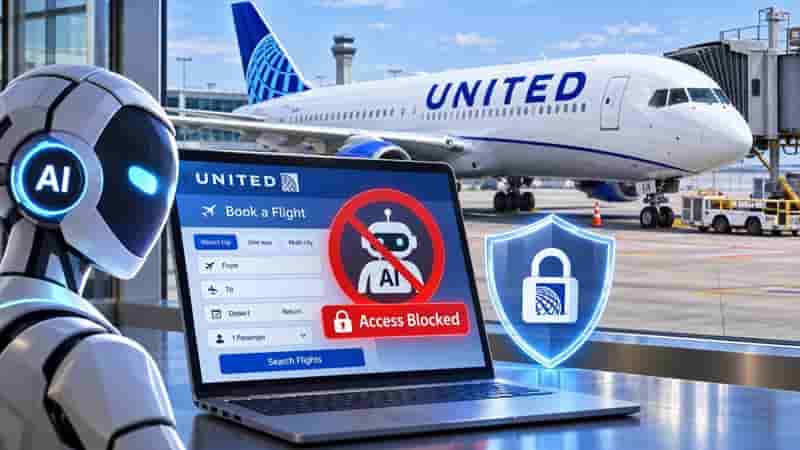
United’s restrictions reach travel agencies as well as consumer bots. The bigger issue is who controls the customer when software starts making the booking.
Airlines have spent years persuading passengers to book directly. United Airlines now faces a customer who sends software to do the shopping.
On Wednesday, 11 November, the US carrier announced restrictions on unauthorised artificial intelligence agents using its booking channels. The measures cover United’s platforms and access through travel agencies and aggregators, with changes to booking, ticketing and distribution policies.
United’s stated reasons are entirely practical. Giving a third-party assistant account credentials could expose personal information, trigger unwanted purchases or consume MileagePlus miles. It also raises an awkward question at check-in: can software make a declaration that regulations require a passenger to acknowledge?
The answer, for United, is that an unauthorised machine should not be doing the job.
There is a wider argument about how airlines sell seats. Technology could complete the entire purchase without a traveller seeing the airline’s sales pitch.
The risk is not merely losing a website visit. It is surrendering influence over the point at which a customer decides what to buy.
A new intermediary, with old questions
Airline distribution has never been as simple as the passenger, the ticket and the aircraft. Global distribution systems, online travel agencies, metasearch companies and loyalty platforms already occupy valuable positions between carriers and their customers.
An AI agent that searches schedules, compares fares, selects flights and makes purchases would add another, potentially powerful, participant. It might be excellent at finding a connection. It might also decide which carriers merit consideration in the first place.
Aviation analyst Henry Harteveldt told CBS News that United appeared reluctant to create an intermediary more influential than existing booking businesses. He also pointed to the cost of automated flight searches.
Those are commercial considerations, not motives United has formally claimed. Its public statement concentrates on customer security and regulatory risk. Both arguments can be true without being interchangeable.
The change is narrower than some headlines suggest. Researching flights with AI is not automatically forbidden. United fares can still appear through comparison services. The restriction concerns unauthorised agents accessing United’s channels and making or servicing bookings.
Travel advisers have more to consider
The surprise is how far United’s policy reaches into professional distribution.
Business Travel News reports that accredited travel agencies cannot supply United content to personal AI agents for activities including discovery, search, booking, ticketing or servicing. Even systems owned and operated by an agency need the carrier’s specific permission. Breaches can attract sanctions, including the loss of United ticketing authority.
That matters more to an agency than the fate of any particular chatbot.
Australian travel management companies are exploring software to handle routine servicing, rebook disrupted journeys and manage complex itineraries. Fewer repetitive tasks and quicker after-hours responses are attractive.
But an approved booking tool is not the same as an autonomous agent using airline content without permission.
Nor has United banned conventional travel advisers. Authorised agency booking channels remain available. For Australian businesses considering new AI systems, the immediate question is contractual: what precisely is the technology authorised to access, and by whom?
The disagreement among airlines
United is not speaking for every carrier.
American Airlines says some AI tools may facilitate purchases through authorised distribution partners. Delta supports authenticated interactions with safeguards for sensitive transactions. And Southwest took a different route on 6 October, launching a ChatGPT integration that lets travellers discover and compare its flights before sending them to Southwest’s website to complete a purchase.
Southwest has welcomed AI into the shop window without handing over the till.
JetBlue president Marty St George has sounded a different note again. Speaking at the Skift Commerce Summit, he acknowledged that new intermediaries could eventually charge for directing bookings, adding costs to an industry hardly known for abundant margins. Yet, as Reuters reported, St George put it plainly: “We should be responsive to what customers want.”
The airlines are not necessarily divided over whether AI will matter. They are divided over how much control to yield, how soon and on whose terms.
Who answers when something goes wrong?
United says it will honour bookings made by AI agents before 11 November. Reporting on its revised conditions also indicates it has reserved cancellation rights for reservations made or serviced by prohibited agents. That does not mean widespread cancellations have taken place; the extent of enforcement has not been established.
There are questions no clever search function can dispose of. Who authorised a change? Was the passenger shown the applicable conditions? Who takes responsibility when a well-intentioned digital assistant turns a straightforward connection into an expensive mistake?
The established travel adviser offers something that cannot simply be added as a software feature: professional accountability.
None of this means AI will retreat from travel. United itself says it will keep assessing how these tools interact with its services, leaving room for future authorised arrangements.
What it does mean is that the next contest in airline distribution will not be decided solely by which machine can find the lowest fare.
It will also be decided by who is trusted to make the booking and who is left to fix it.
By: Jason Smith – © 2026.
Read Time: 4 minutes.
Author Bio:
 Jason Smith didn’t learn travel from textbooks. He learned it in airports, taxis and hotel lobbies, watching the business unfold long before he played his own part. Half American, half Asian, he grew up around the quiet workings of tourism, where people come and go, and stories rarely stand still.
Bangkok came first, then formal study, then a career that carried him through Singapore, Malaysia and Vietnam. Each place left something behind. In the end, Thailand felt like home, along with a senior role in hotel sales.
Then everything stopped. Borders shut, planes grounded, and Jason found himself back in America with time to reflect.
Now at Stephen’s EGT Media, he writes travel as it really is, not polished, not perfect, but human, and all the better for it.