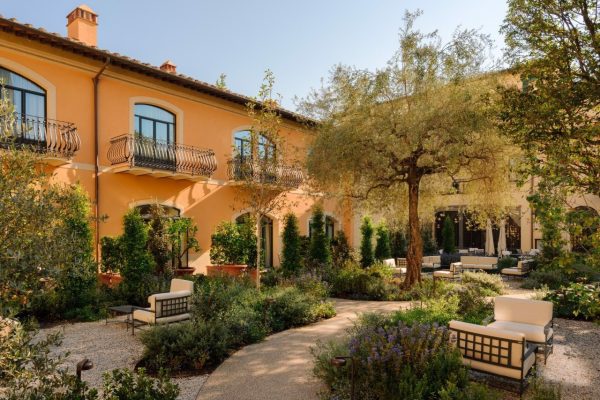
Firenze, a five-star boutique hotel by Dei Cavalieri Collection, has officially opened its doors, bringing a prestigious historic residence in the heart of the Tuscan capital back to life. Located at Borgo Pinti 27, just a short walk from the Cathedral and the city’s main attractions, the palazzo now welcomes guests to a place where historic charm meets contemporary comfort, creating an intimate, refined stay with a distinctly Florentine character.
With 37 rooms spread across the main palazzo, the historic Limonaia and the Scuderia, a lush private garden and a food offering inspired by the local area, Palazzo Monnalisa embodies a concept of understated luxury, defined by authenticity, beauty and attention to detail.
The opening marks a new chapter for Dei Cavalieri Collection, the hotel group owned by the Bernardelli family, which has been a leading name in Italian hospitality for three generations. The group continues its commitment to enhancing historic buildings and transforming them into destinations that tell the story of their surroundings.
A Palazzo Steeped in Centuries of History
The origins of Palazzo Monnalisa date back to the 14th century, when the building was constructed as a merchant courtyard house, with workshops and warehouses serving the commercial activities of medieval Florence. Its history is also closely intertwined with that of Borgo Pinti, the ancient street on which the palazzo stands, once located outside the city walls before later being incorporated into the urban fabric.
The street has long been closely connected with Florentine artistic life. Among its illustrious residents was the sculptor Jean de Boulogne, known as Giambologna, who in 1608 purchased the nearby Palazzo Bellini delle Stelle, directly opposite Palazzo Monnalisa, and turned it into his home and workshop.
From the 15th century onwards, the building was gradually transformed into a prestigious aristocratic residence, home to several prominent Florentine families. These included the Ferrantini, who hosted the Patriarch of Constantinople in 1439 on the occasion of the Ecumenical Council, and the Neri family, whose history is linked to Saint Philip Neri. Born in 1515 and known as Pippo il Buono, he is traditionally believed to have been born in one of the palazzo’s rooms.
In the 17th century, the property passed to the Marzichi-Lenzi family, an important Florentine merchant dynasty from which the building takes its historic name and which was granted the title of count by Grand Duke Cosimo III.
The palazzo’s historical and artistic value was recognised as early as 1901, when the building was included in the list of monuments drawn up by the Directorate General of Antiquities and Fine Arts, confirming its significance within the city’s architectural heritage.
Another significant chapter in its history began in 1956, when the palazzo became the residence of Countess Oslavia Ciardi Duprè, who turned it into a meeting place for artists, intellectuals and members of the European aristocracy. Her former apartment is now home to the Contessa Grand Room, the hotel’s most distinctive accommodation.
Acquired by the Bernardelli family in 2017, the complex has undergone a major restoration and redevelopment project, carried out with respect for its historical, artistic and architectural heritage. Wooden coffered ceilings, Florentine terracotta floors, and artworks and sculptures belonging to the Duprè family now coexist with a classic-contemporary aesthetic, returning to the city a residence that tells the story of its past through a new hospitality experience.
Numerous architectural details still bear witness to the palazzo’s past: from the former convent courtyard, now home to the reception, to the characteristic wine window, and the coat of arms featuring a bull’s head on the main entrance façade on Borgo Pinti, a reminder of the Marzichi-Lenzi family. The result is a residence that retains its original soul, reinterpreted through a classic-contemporary aesthetic that brings original materials and historic features into dialogue with the needs of modern hospitality.
Each room with its own Identity
Staying at Palazzo Monnalisa means enjoying an experience that differs from that of a traditional hotel. The distinctive layout of the complex, with spaces spread across the Historic Palazzo, the Limonaia and the Scuderia, preserves the character of a private residence, with intimate passageways, unexpected views and spaces that each tell a different story.
The 37 rooms vary in size, outlook and architectural details, balancing timeless elegance with contemporary comfort. The colour palette draws on the warm tones of Florentine tradition, from cream and beige to earthy shades and terracotta, while terracotta floors, wooden ceilings and refined finishes complement furnishings with clean lines.
Some rooms feature precious historic ceilings, while others overlook the tranquillity of the inner garden, with four accommodations offering direct access to it.
The property’s highlight is the Contessa Grand Room, an exclusive accommodation of approximately 75 square metres set within the former apartment of Countess Oslavia Ciardi Duprè. Its wooden coffered ceiling, original fireplace and generous proportions make it one of the most authentic expressions of the palazzo’s charm, where the past becomes an integral part of the guest experience. The spacious bathroom is a setting devoted to wellbeing, featuring a large walk-in shower and a striking freestanding bathtub designed for moments of complete relaxation.
A secret garden in the heart of Florence
One of Palazzo Monnalisa’s most striking features is its private garden, a green oasis tucked among the architecture of the historic centre, offering a sense of tranquillity just steps away from the city’s liveliest streets.
Ornamental plants and the design of a Florentine-style Italian garden create a space that forms the property’s green heart and a natural extension of its communal areas.
A place to enjoy at a slower pace, whether taking a break after a day exploring Florence, reading in the shade of the greenery or simply savouring the pleasure of silence.
It is precisely this contrast between the vibrancy of the city centre and the garden’s secluded atmosphere that makes Palazzo Monnalisa such a distinctive destination: an urban retreat that feels like a private residence, removed from the city’s pace while remaining right at its heart.