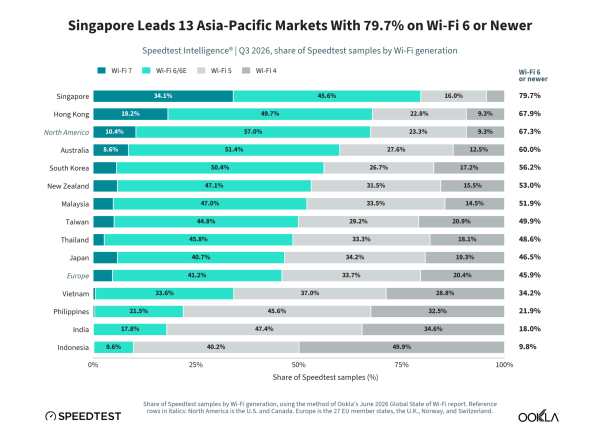
Wi-Fi 6 or newer accounts for 79.7% of Speedtest® samples in Singapore but only 9.8% in Indonesia, while most phones that support Wi-Fi 6 in Indonesia, India, and the Philippines still connect through older routers.
Homes across Asia-Pacific connect over four generations of Wi-Fi, from Wi-Fi 4 to Wi-Fi 7. The region’s leaders match or beat North America on Wi-Fi 6 adoption, while in other markets most phones that support Wi-Fi 6 still connect through older routers. The gap between Wi-Fi 4 and Wi-Fi 7 matters more as broadband plans get faster and regulators open the 6 GHz band, which the latest generations of Wi-Fi are built for. We used Speedtest Intelligence® data from Q3 2026, with trends back to Q1 2024, to compare 13 Asia-Pacific markets, with North America and Europe as reference points.
Key Takeaways:
- Adoption of Wi-Fi 6 or newer standards varies widely across 13 Asia-Pacific markets, with Singapore ahead of North America and Indonesia at an early stage. Singapore had 79.7% of Speedtest samples on Wi-Fi 6 or newer in Q3 2026, against 67.3% in North America. Indonesia had 9.8%, with 49.9% still on Wi-Fi 4.
- Most phones that support Wi-Fi 6 in Indonesia, India, and the Philippines still connect through older routers. In Q3 2026, 79.9% of these phones in Indonesia ran at Wi-Fi 5 or older at home, along with 72.7% in India and 54.4% in the Philippines. Homes that migrated from Wi-Fi 4 to Wi-Fi 5 saw median download speed roughly double or more in all nine markets compared, though some also moved to a faster plan.
- Router upgrades need fast enough plans to pay off, as India and Singapore show. Indian homes that migrated from Wi-Fi 5 to Wi-Fi 6 saw no gain in median download speed (−0.2%), with 72.4% of Indian connections testing below 100 Mbps. In Singapore, where 15.5% tested below 100 Mbps, the same migration added 131.3%. Router and plan upgrades work best as a pair.
- The share of Speedtest samples on Wi-Fi 6 or newer standards has grown in all 13 markets since early 2024. Between Q1 2024 and Q3 2026, it rose by 32.4 percentage points in Singapore and nearly quadrupled in Vietnam, to 34.2%, against a rise of 6.3 percentage points in Indonesia.
- Outside Singapore, 6 GHz use is still low, and much of Wi-Fi 7 runs on older bands. In Q3 2026, 17.0% of Singapore’s Speedtest samples were on 6 GHz, against 2.5% in South Korea, which has opened the full band, and 0.1% or less in India, Indonesia, the Philippines, and Vietnam. Even in Singapore, only 36.9% of Wi-Fi 7 samples used 6 GHz.
- Wi-Fi 7 nearly doubled in Singapore and grew even faster in seven other markets in a year. Singapore’s Wi-Fi 7 share rose from 18.2% to 34.1% of Speedtest samples between Q3 2025 and Q3 2026, against 10.4% in North America. Australia, New Zealand, Japan, South Korea, Taiwan, Malaysia, and Thailand grew 2.4 to 3.9 times from smaller bases, reaching between 2.7% and 8.6%.
Wi-Fi 6 or newer ranges from 79.7% in Singapore to 9.8% in Indonesia
Each new Wi-Fi generation is faster and copes better with many devices online at once. A phone and a router usually connect at the newest generation they both support, so a Wi-Fi 6 phone on an older Wi-Fi 5 router runs at Wi-Fi 5. For this report, we measured the share of Speedtest samples from Android devices on each Wi-Fi generation in each market.
Singapore leads the 13 markets, with 79.7% of its Speedtest samples on Wi-Fi 6 or newer in Q3 2026, ahead of North America at 67.3%. Policy helped drive that lead. The Infocomm Media Development Authority (IMDA) committed up to S$100 million (~US$74 million) in 2024 to bring 10 Gbps broadband into homes. Operators bundled Wi-Fi 7 routers with those plans, as we reported in our June 2026 report, The Global State of Wi-Fi, so for many households a faster line came with a new router. Hong Kong, in second place, matches North America at 67.9%.
Most of the rest of the region sits between Europe, at 45.9%, and North America. In Australia, South Korea, New Zealand, and Malaysia, more than half of samples are on Wi-Fi 6 or newer, from 51.9% in Malaysia to 60.0% in Australia. Taiwan (49.9%), Thailand (48.6%), and Japan (46.5%) are just short of half. Broadband speed and Wi-Fi generation tend to go together, but not always. Australia’s median fixed download speed of 180.57 Mbps is well below Thailand’s 303.66 Mbps, yet a larger share of Australian samples are on Wi-Fi 6 or newer.
The gap to the leaders is widest in the Philippines, India, and Indonesia. Wi-Fi 6 or newer accounts for 21.9% of samples in the Philippines, 18.0% in India, and 9.8% in Indonesia. In Indonesia, almost half of samples (49.9%) are still on Wi-Fi 4, a standard dating back to 2009. Slow plans play a large part. Median fixed download speeds were 63.96 Mbps in India and 52.62 Mbps in Indonesia in Q3 2026, a fraction of Singapore’s 476.02 Mbps. Older routers pull those medians down too, but even Wi-Fi 5 samples recorded median download speeds of only 92.19 Mbps in India and 95.88 Mbps in Indonesia. At those speeds, Wi-Fi 6 adds little extra speed over Wi-Fi 5.
Most phones that support Wi-Fi 6 in Indonesia, India, and the Philippines still connect through older routers
Many phones in the region support a newer Wi-Fi generation than the router they connect to. We looked at phone models that support Wi-Fi 6 or newer and measured the share whose home Wi-Fi connections ran at Wi-Fi 5 or older. Home Wi-Fi is the network a phone used most often in the quarter.
In Q3 2026, 79.9% of Indonesia’s phones that support Wi-Fi 6 ran at Wi-Fi 5 or older at home, the highest share of the 13 markets, followed by India at 72.7% and the Philippines at 54.4%. Singapore sits at the other end at 9.7%.
Homes still on Wi-Fi 4 have the most to gain. We compared homes that migrated off Wi-Fi 4 between Q3 2025 and Q3 2026 with homes on the same provider that stayed on it. Homes that migrated to Wi-Fi 5 saw median download speed roughly double or more in all nine markets shown in the chart. The gain was 99.0% in India, 192.9% in Indonesia, and 245.2% in the Philippines, against changes of 1.1%, 11.9%, and −1.6% for homes that stayed on Wi-Fi 4. The gains hold even for homes that kept the same phone model. Some of these homes will also have moved to a faster plan, since operators often supply a new router with a plan upgrade, so the gains reflect router and plan together.
Beyond Wi-Fi 4, the broadband plan decides whether a newer router helps. Indian homes that migrated from Wi-Fi 5 to Wi-Fi 6 saw no improvement in median download speed (−0.2%). In Q3 2026, 72.4% of Indian home broadband connections tested below 100 Mbps. A Wi-Fi 5 connection can typically carry several hundred megabits per second, so on most Indian plans a newer router has little extra speed to deliver. In Singapore, where only 15.5% of connections tested below 100 Mbps, the same migration added 131.3%. Across the other 11 markets, the gain ranged from 29.5% in Taiwan to 94.5% in Australia.
Wi-Fi 4 is the exception. It holds back even modest plans, which is why migrating off it brought large gains in every market we compared, India included. Homes that migrated straight to Wi-Fi 6 or newer did better still in eight of the nine markets, up to 527.1% in Australia. India was the outlier, at 89.1% against 99.0% for homes that migrated to Wi-Fi 5. For India, Indonesia, and the Philippines, the upgrade that matters most today is migrating off Wi-Fi 4.
Wi-Fi 6 or newer has gained ground in all 13 markets since early 2024
Wi-Fi 6 or newer has grown in every market since Q1 2024. Singapore added 32.4 percentage points to reach 79.7% of Speedtest samples in Q3 2026, and Australia added 27.3 to reach 60.0%. Vietnam rose from 8.9% to 34.2%, and India from 2.2% to 18.0%. Indonesia moved least, from 3.5% to 9.8%.
Growth continued in all 13 markets in the year to Q3 2026, though nine of them grew more slowly than the year before, including Singapore and South Korea, where most samples are already on Wi-Fi 6 or newer.
Over the past year, Malaysia added the most, 9.2 percentage points, followed by Australia (9.1) and Singapore (8.6). Indonesia added the least, 3.7 percentage points.
Among homes that migrated off Wi-Fi 4 between Q3 2025 and Q3 2026, about half in Australia and Taiwan skipped Wi-Fi 5 for Wi-Fi 6 or newer (51.5% and 47.4%). In India and Indonesia, most stopped at Wi-Fi 5 (84.3% and 87.3%).
Outside Singapore, 6 GHz use is still low, and much of Wi-Fi 7 runs on older bands
Older Wi-Fi runs on the 2.4 GHz and 5 GHz bands, which are often crowded, especially in apartment blocks where neighbors’ networks overlap. The 6 GHz band adds a large block of fresh spectrum that only Wi-Fi 6E and Wi-Fi 7 devices can use. It has room for extra-wide channels, which means faster speeds and steadier connections when many devices are online at once. Wi-Fi 7 routers do not have to use it, though. They can also run on 2.4 GHz and 5 GHz, and some work only on those bands.
Regulators have opened the band to different extents, mainly because mobile operators also want its upper half for 5G and, later, 6G. Markets that open the whole band get more of the wide channels. Japan, Singapore, and India have opened only the lower part to Wi-Fi, India most recently in January 2026, while South Korea opened the full band in 2020.
Singapore had 17.0% of its Speedtest samples on 6 GHz in Q3 2026, up from 10.7% a year earlier, with only the lower part of the band open. Hong Kong (5.9%), Japan (5.0%), and Australia (4.5%) follow. South Korea, which has opened the full band, sits at 2.5%. To use 6 GHz, a home needs a Wi-Fi 6E or Wi-Fi 7 router. In South Korea, only 7.0% of samples were on one of these, against 38.5% in Singapore.
In the Philippines, India, Indonesia, and Vietnam, 6 GHz has barely started, with 0.1% of samples or fewer on the band in Q3 2026. That includes India, eight months after it opened the lower band, and Indonesia, Vietnam, and the Philippines, which opened it between July 2024 and May 2025.
Even where homes have Wi-Fi 7, much of it runs on older bands. In Q3 2026, 36.9% of Singapore’s Wi-Fi 7 samples were on 6 GHz, and between 19.0% and 34.2% in Japan, Australia, New Zealand, Hong Kong, South Korea, and Taiwan. The share fell over the year in Australia, from 35.3% to 26.8%, and in New Zealand, Malaysia, and Thailand, as Wi-Fi 7 spread to more homes. Signals on 6 GHz also do not travel as far indoors, so phones often fall back to 5 GHz.
Where Wi-Fi 7 does run on 6 GHz, it was faster than on older bands in every market with enough data. In Singapore, Wi-Fi 7 samples on 6 GHz recorded a median download speed of 1,275.13 Mbps, against 657.82 Mbps on 2.4 or 5 GHz, though faster plans may account for part of that gap.
Wi-Fi 7 nearly doubled in Singapore and roughly tripled in seven other markets in the past year
Wi-Fi 7 adoption shows where operators and households are buying premium routers, whichever band those routers end up using.
Singapore’s Wi-Fi 7 share nearly doubled in a year, from 18.2% of Speedtest samples in Q3 2025 to 34.1% in Q3 2026, and Hong Kong’s rose from 10.4% to 18.2%. Both are well ahead of North America. Wi-Fi 7 grew faster, from a smaller base, in Australia, New Zealand, Japan, South Korea, Taiwan, Malaysia, and Thailand. It started the year at 3.0% of samples or less in each and ended it at between 2.7% and 8.6%, growth of 2.4 to 3.9 times, a pace similar to North America’s rise from 3.8% to 10.4%.
Qualcomm, Broadcom, and MediaTek showed Wi-Fi 8 chips at CES and MWC in 2026, and the IEEE expects to finalize the standard in 2028. Wi-Fi 8 will arrive in a region whose homes already span four generations. At one end, Singapore and Hong Kong are moving through Wi-Fi 7. At the other, Wi-Fi 5 is already the most common generation in India and the Philippines, while Indonesia still has almost half of its samples on Wi-Fi 4. For all three, the upgrade that matters most is still migrating homes off Wi-Fi 4.
To receive more data-driven insights on Wi-Fi and fixed broadband performance in markets around the world, subscribe to Ookla Research™.