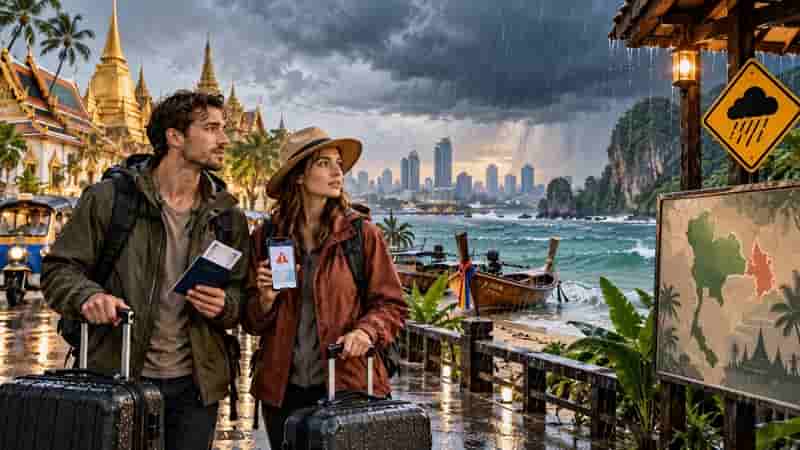
Australia has not issued a blanket warning against visiting Thailand. But heavy rain, closed Cambodian border crossings and tighter visa rules have added some fine print to the holiday brochure.
Thailand has spent decades perfecting the art of making Australians feel welcome. The beaches are inviting, the food is magnificent, and the hospitality can make an airport transfer feel like the start of a proper holiday.
Unfortunately, the weather does not read tourism brochures. Nor do border guards, immigration officers or travel insurers.
As Australians plan escapes to Bangkok, Phuket, Krabi and the islands, several warnings deserve attention. They do not mean the Land of Smiles has closed for business. They do mean that travellers should check exactly where they are going, what they are booking and what their insurance actually promises.
According to the Australian Government’s Smartraveller advice, updated on 15 October and still current on 25 October 2026, the nationwide recommendation is to exercise a high degree of caution. More serious restrictions apply in specific border regions.
That distinction matters. A beachfront stay in Phuket is not the same proposition as an overland journey beside the Cambodian frontier. Treating them as interchangeable is rather like confusing a Sydney Harbour cruise with a voyage around Cape Horn.
Cambodia border: closed crossings and real danger
The most severe warning concerns the Thailand–Cambodia border. Canberra advises Australians not to travel within 10 kilometres of the land frontier in parts of seven Thai provinces: Sa Kaeo, Buriram, Si Saket, Surin, Ubon Ratchathani, Chanthaburi and mainland Trat.
The reason is not bureaucratic fussiness. Armed clashes, including military strikes and violence, have affected the border, and landmines remain a threat. Smartraveller says all land crossings between Thailand and Cambodia are currently closed.
That rules out casually adding a land-border hop to a regional backpacking itinerary. Travellers hoping to combine the two countries should review both governments’ entry advice, consider lawful alternatives and verify any transport arrangements before paying.
The restriction applies to specified areas near the border, not every town or beach in the named provinces. Location, not simply the province printed on a booking confirmation, determines the risk. Certain border temples and surrounding areas also fall within the no-travel zone.
Thailand’s frontier with Myanmar presents separate security concerns, including occasional fighting and possible crossing closures. Travellers heading into remote border districts should check conditions rather than assume an old itinerary remains workable.
Far south: a different and continuing warning
Canberra separately advises Australians to reconsider their need to travel to Yala, Pattani and Narathiwat, where a long-running insurgency has involved attacks and bombings.
This is a serious regional warning, not a verdict on all of southern Thailand. Holidaymakers travelling through the south should check province names and routes carefully. The difference between a familiar resort area and a security-sensitive district can matter far more than it looks on a small map.
Large demonstrations may also occur in Bangkok and elsewhere. Travellers should avoid protests, follow local directions and allow for unexpected road closures. The World Bank and International Monetary Fund meetings cited in Smartraveller’s 15 October update ended on 18 October; those meeting dates should not be mistaken for a continuing event.
Phuket, Krabi and the weather’s unwelcome encore
While security warnings are concentrated in certain areas, severe weather can reach places that Australians know rather well.
The Thai Meteorological Department’s forecast issued on 25 October predicts continuing rain across southern Thailand from 25 to 28 October, with heavy falls and isolated very heavy rain. It warns that accumulated rainfall could cause flash floods, overflowing waterways and landslides, particularly in low-lying districts and areas near hillsides.
The detailed 25 October west-coast forecast identifies heavy rain in Ranong, Phang Nga and Phuket, with isolated very heavy rain in Krabi, Trang and Satun. On the Gulf side, heavy rain is forecast in Surat Thani and Nakhon Si Thammarat, with isolated very heavy rain in Phatthalung, Songkhla, Pattani, Yala and Narathiwat.
These are forecasts for affected provinces, not claims that every resort has flooded. Weather can differ sharply between neighbouring locations, and conditions may change during the day.
The department also warns that waves in both the Andaman Sea and Gulf of Thailand can exceed two metres during thunderstorms. Boats are urged to avoid storm areas. Travellers heading for island ferries, diving excursions or open-water transfers should check with operators before leaving their accommodation.
Thunderstorms and gusty winds are also forecast across parts of northern, northeastern, central and eastern Thailand from 25 to 27 October, including the Bangkok region. Again, a weather alert does not mean flights have been cancelled. It is a reason to monitor the airline and leave more time between connections.
A useful detail often lost in the sunny marketing photographs: Thailand does not have one uniform wet season. Weather patterns in Koh Samui and the south-east differ from those around Phuket. Choosing an island based solely on the calendar can be an expensive way to meet a rain cloud.
New entry rules: 30 days, not 60
Perhaps the most consequential change for travellers planning longer holidays is at immigration.
Under Thailand’s revised tourist visa-exemption arrangements, effective 15 September 2026, eligible holders of ordinary Australian passports can visit visa-free for up to 30 days, rather than the former 60-day allowance. The change is confirmed by a Royal Thai Embassy notice.
A fortnight on a beach may fit comfortably within that period. A leisurely six-week journey through Thailand may not. Anyone planning a longer stay should arrange the appropriate visa or seek authoritative advice about an extension, which is subject to immigration approval. Do not assume an extension is automatic.
Smartraveller also warns that people making repeated visa-free entries without a justifiable reason may be limited to two entries in a calendar year. Border officials make the final decision on admission, so frequent visitors should confirm the rules that apply to their plans.
Australian passports must have more than six months of validity remaining when travellers enter. Travellers should also be ready to show accommodation details, sufficient funds and proof of onward or return travel. A reassuring smile at immigration is welcome, but it cannot replace the paperwork.
The free arrival card that should stay free
Most non-Thai travellers entering by air, land or sea must submit a Thailand Digital Arrival Card (TDAC) online within the three days before arriving. It is free and not a visa.
Use the official Thai Immigration Bureau portal, not a lookalike site asking for payment. Travellers transiting through Thailand without passing immigration control are generally exempt; those entering the country must meet the applicable arrival-card requirements.
The practical approach is refreshingly old-fashioned: check the official website, complete the form carefully and keep a copy of the confirmation where it can be found without rummaging through an entire holiday’s worth of emails.
Scooters, insurance and the bill nobody wants
Not every travel hazard arrives with a government warning banner. Some come with two wheels and an attractive daily rental rate.
Motorcycle and scooter crashes pose serious risks. Travellers need the correct licence and any required international driving permit, proper protective equipment and insurance that genuinely covers the vehicle and activity. A rental shop offering the keys does not prove the rider is legally licensed or insured.
Marine activities deserve equal care. Check weather and sea conditions, choose reputable operators, use the required safety equipment and decline trips when the vessel or arrangements look unsafe. Travellers should also take precautions against drink spiking, methanol-contaminated alcohol, theft and scams.
Medical treatment in Thailand can be costly. No reciprocal agreement provides Australian tourists with free healthcare, and the Australian Government will not pay private medical or evacuation bills. Read the travel insurance Product Disclosure Statement, especially the exclusions for motorcycling, diving, declared weather events, travel to higher-risk areas and medical evacuation.
An insurer’s fine print is rarely anyone’s idea of beach reading. It becomes riveting, however, when a hospital asks for a deposit.
Thai laws are not optional holiday extras
Thailand’s laws on vaping, drugs and online conduct are stricter than some Australian visitors may expect. Electronic cigarettes, vaporisers and refills are illegal, including for personal use.
Cannabis is restricted to medical use under specified conditions, including a prescription from a locally recognised practitioner. Public consumption remains illegal. A cannabis shopfront should not be treated as permission to use it recreationally.
Some medicines prescribed legally in Australia are restricted in Thailand and may require advance documentation or a permit. Travellers should check before departure, not at the customs counter. Respect local religious customs, and be particularly careful with public or online comments about the monarchy.
Mosquito-borne diseases, including dengue, are another reason to pack repellent and obtain appropriate medical advice before travel.
Thailand remains welcoming; preparation is the ticket
For Australian holidaymakers and the travel trade, the message is one of proportion. There is no nationwide Australian ‘do not travel’ advisory for Thailand. There are, however, serious exclusions around the Cambodian border, heightened concerns in the far south, an active weather warning and entry rules that have changed substantially.
Check Smartraveller before booking and again before departure. Recheck the Thai Meteorological Department before road journeys and boat excursions. Confirm transfers and cancellation terms with the airline or operator. Agents should explain the risks plainly, rather than leave the essential details hiding behind an infinity-pool photograph.
Thailand still offers the hospitality, flavours and scenery that have made it such an enduring Australian favourite. A little preparation helps ensure the only surprise is how quickly the holiday ends.
Useful emergency contacts: Tourist Police 1155; police 191; medical emergencies 1669; Australian 24-hour Consular Emergency Centre +61 2 6261 3305 (from overseas).
By: Kanda Limw – © 2026.
Read Time: 8 minutes.
Author Bio:
 Kanda Limw is one of those rare people every office quietly depends on. She doesn’t fuss or make a fuss; she notices what needs doing and gets on with it, often before anyone else has drawn breath.
Years behind the scenes have taught her that good administration isn’t about control; it’s about care. Diaries align, tensions soften, loose ends disappear. When the day threatens to tilt, Kanda steadies it without drama.
Her reliability feels reassuringly old-fashioned. She listens properly, remembers the small things, and does what she says she will.
Kanda has no appetite for the spotlight. Yet ask anyone who works alongside her, and they’ll tell you when she’s there, everything runs just a little smoother.