

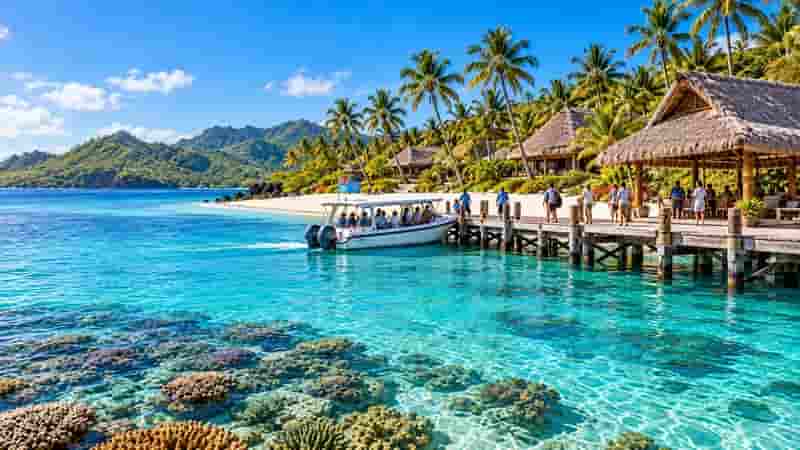
Fiji’s visitor numbers are setting new records, but a booming holiday trade raises an awkward question: who pays to keep paradise paradise?
A familiar moment happens on a Fiji holiday. The aircraft doors open, warm air rolls down the aisle, and the prospect of another week of emails suddenly seems silly. Beyond the terminal are a beach, a cold drink, and a Fijian welcome that has sold more holidays than a warehouse full of glossy brochures.
And, judging by the numbers, the world has remembered the address.
Fiji is enjoying another extraordinary run of visitor arrivals. Yet the industry’s next challenge is not merely to fill aircraft and resorts. It is to ensure the roads, water systems, workers, villages, and reefs can share in the success without being worn thin by it. A destination can sell the dream brilliantly. Delivering it, year after year, is harder work.
The records keep coming
The Fiji Bureau of Statistics recorded 986,367 visitor arrivals in 2025, an annual high and a modest 0.3 per cent increase on 2024. That was tantalisingly close to one million, though a record is a record even without the champagne-friendly extra digit.
Then 2026 raised the stakes. July brought 105,791 visitors, the first month in Fiji’s recorded series to pass 100,000. August followed with 99,963 arrivals, another monthly record. September delivered 95,970, up 3.9 per cent on September 2025 and the highest September total on record. The latest figure, released on 16 October, is provisional and not a full-year 2026 result.
Australians remain the destination’s most dependable admirers. In September, they accounted for 46,302 arrivals, followed by 22,207 from New Zealand. Together, those two markets supplied more than seven in every ten visitors. The United States was next, contributing 9,358 arrivals.
For Australian travel advisers, that is excellent news. Fiji is a relatively short flight away, familiar without feeling ordinary, and attractive to couples, families, honeymooners and multi-generational groups. It also has one rare advantage in an increasingly impersonal travel business: hospitality that feels like an invitation rather than a transaction.
But strong demand does not give Fiji a blank cheque.
Bigger numbers do not always mean bigger returns
In 2025, Fiji earned an estimated FJ$2.814 billion from international tourism, up 10.9 per cent from 2024. That is the encouraging part. Tourism is generating substantially more spending even as the annual visitor count grows only slightly.
The shorter-term figures offer a useful warning. The statistics bureau’s detailed June-quarter 2026 report puts tourism earnings at FJ$708.1 million, down 4.9 per cent from FJ$744.2 million a year earlier, despite strong arrivals. That does not mean the boom is over. It means arrival counts alone cannot tell us whether the industry is earning enough, charging sensibly or spreading its rewards.
An important distinction exists between a visitor who stays longer, eats locally, books a guide, and buys Fijian-made goods, and one whose spending barely escapes an all-inclusive resort. Both count as an arrival. Their contribution to the wider economy may differ greatly.
The question for Fiji, therefore, is not just how many people come. It is how much lasting value each visit leaves behind.
Are Fiji’s resorts running out of room?
Not on the national evidence. The bureau reported a 59.5 per cent room occupancy rate for the June quarter of 2026 among the licensed accommodation businesses covered by its survey. That is hardly proof the country has run out of beds.
National averages, however, can conceal local pressure. A luxury beachfront resort sought by Australian families during school holidays is not interchangeable with a room in another region or a different price bracket. Nor does a vacant room solve a missing ferry seat, a shortage of trained chefs or a delayed airport transfer.
The geography matters. Nadi, Denarau, the Coral Coast, the Mamanuca Islands and parts of the Yasawas are well established in the holiday trade. Their success rests on dense networks of airlines, operators, roads, boats, suppliers and hotel staff. Expanding room stock without expanding those supporting services could turn the easy tropical escape into something resembling a supermarket queue, albeit with better palm trees.
Hotel projects are in the pipeline, and Fiji’s tourism ministry has highlighted proposed investments in its western tourism region. But a proposal is not an open resort. Operators and travel agents should treat announced projects as future capacity, not rooms available to sell today.
The people behind the smiles
Fiji’s real competitive advantage is neither a swimming pool nor an imported marble bathroom. It is the people who make visitors feel welcome. That advantage needs care.
Across the economy, employers face skilled-labour shortages, high input costs and supply-chain pressure. The Australia Fiji Business Council highlighted those concerns in October, pointing to competition for workers from Australia and New Zealand as well as rising business costs.
In August, Tourism Minister Viliame Gavoka spoke publicly about the scale of Fiji’s hospitality workforce needs and the importance of building rewarding local careers. The policy challenge is obvious. New hotels require chefs, engineers, cleaners, reception staff, drivers and managers. Training takes time; retaining experienced workers can be harder still.
A larger tourism economy that relies on underpaid staff or offers too few career paths will eventually undermine the very welcome visitors come to enjoy. Better wages, professional development and links with local farms, fisheries and small suppliers are not merely social extras. They are part of a sound business model.
A smiling greeting is priceless. The worker delivering it still has bills to pay.
Paradise needs pipes, roads and reliable connections
A five-star resort may have a spectacular view, but it also needs dependable water, electricity, waste collection and sewage treatment. Travel advertising rarely features those essentials. They become headline material only when something goes wrong.
Fiji’s infrastructure challenge is not imaginary. At a tourism convention in January, the country’s senior finance officials warned that growth depended on coordinated action on public assets, infrastructure and labour supply. New investment must be planned around the capacity of the communities serving it, not simply the attractiveness of the beachfront site.
This is why Fiji’s northern development plans deserve more attention than another luxury pool opening near Nadi. The Na Vualiku tourism programme aims to improve essential services, transport access, environmental management, and business opportunities in Vanua Levu. It is part of a longer-term effort to spread tourism beyond the busiest southern and western corridors.
Fiji’s 2026–27 budget allocated FJ$20 million to Na Vualiku, alongside support for smaller tourism enterprises and domestic air services. Getting these basics right could create new visitor experiences while giving more communities a direct economic stake in tourism.
The opportunity is enormous. So is the responsibility to grow at a pace local infrastructure can support.
The next Fiji holiday may be somewhere new
Ask an Australian traveller about Fiji and the answer often begins with Denarau or an island resort reached by boat. There is much more to discover.
Vanua Levu offers Savusavu, diving, rainforests, and a slower holiday pace. Taveuni has waterfalls, walking trails and striking natural scenery. Inland villages, local food experiences, and smaller community-run ventures add depth to a destination too often reduced to a hammock photo.
None of this means every remote corner should become a mass-market resort strip. Quite the reverse. Low-impact accommodation, locally guided experiences and practical transport links can help tourism reach new places without sacrificing what makes them special.
It also gives travel advisers a fresh conversation to have with clients who think they have already done Fiji. They may have only seen one small part of it.
The reefs cannot be an afterthought
Fiji’s beaches and reefs are part of its commercial appeal, but they are also living ecosystems and community resources. Climate change, coral stress, coastal erosion, waste and pressure on marine habitats make environmental protection a business necessity, not just an attractive paragraph in a sustainability brochure.
Fiji has already set out its direction in the National Sustainable Tourism Framework 2024–2034. It calls for tourism that strengthens communities and protects the ocean, environment and cultural heritage. Tourism Fiji’s Loloma Hour also encourages guests to spend some of their holiday contributing to conservation or community activities.
Such initiatives are welcome, provided they go beyond a photo opportunity. Resorts and operators must also manage their own water and energy use, handle waste responsibly, and respect local customary rights and conservation rules.
Selling crystal-clear lagoons has little commercial future if the industry fails to look after the water.
Government has heard the message
At Tourism Fiji Industry Day in September, Deputy Prime Minister and Tourism Minister Viliame Gavoka put the new philosophy neatly: “Our ambition must be value over volume, quality over quantity”. This sensible shift in emphasis comes after years when visitor totals dominated the conversation.
The Government has also passed the Tourism Act 2026, intended to establish broader standards and recognition for tourism operators, including smaller and community-based enterprises. As the ministry outlined in August, implementation requires regulations, systems, and a managed transition; passing the law should not be confused with every provision already being operational.
The test will be practical. Can an owner-operated tour business navigate the rules? Can travellers identify responsible operators? Will better standards improve visitor safety and confidence without crushing the very small businesses Fiji wants to encourage?
The answers will matter long after the publicity from the next arrival record fades.
What Australian travel advisers should tell clients
Fiji remains an exceptionally appealing holiday choice. Record demand isn’t a reason to avoid it, and national occupancy figures don’t support sweeping claims that paradise is full. But advisers should look beyond the headline price and ask more exacting questions.
Check availability early for school holidays and sought-after island resorts. Confirm boat transfers and domestic connections, especially when international arrival times are tight. Discuss how different regions suit different travellers: a family seeking a full-service resort does not necessarily want the same holiday as a diving couple or a repeat visitor after a village-based cultural experience.
Ask operators about staffing, accessibility, conservation practices and what is actually included in the package. Consider locally owned experiences and restaurants alongside familiar international brands. Encourage clients to leave enough room in the itinerary to enjoy Fiji rather than spend half the holiday chasing the next connection.
Above all, sell the destination accurately. A beautiful photograph may win attention, but dependable advice wins repeat bookings.
Paradise’s biggest test is still to come
Fiji has earned its tourism success. Visitor figures are genuine, Australians’ affection is longstanding, and new investment offers the prospect of broader prosperity. No sensible observer would want to turn that opportunity away.
But Fiji is now approaching a more demanding stage of development. More visitors bring revenue, jobs and international attention. They also increase demands on workers, infrastructure, transport, natural resources and local communities. The task is to keep those demands in balance.
The best measure of success in five or ten years will not be the size of a record-breaking arrival chart. It will be whether Fijians are better off, visitors still receive that unmistakable welcome, and the reefs, beaches and villages remain worth crossing an ocean to see.
Paradise has always been Fiji’s greatest selling point. Keeping it that way is the next big job.
By: Jill Walsh – © 2026.
Read Time: 10 minutes.
Author Bio:
 Jill Walsh has always kept a pen close and a suitcase closer. She started in media releases, then learned the trade by escorting press trips around the world, discovering which stories travel well and which need a sharper edit.
Before long, she wasn’t just promoting destinations; she was representing them, translating civic ambition and local pride into words people actually wanted to read. These days, semi-retired and happily so, Jill has traded departure boards for deadlines, joining old friend and colleague Stephen at EGT Media on a casual basis.
Her patch is the business end of wanderlust: balance sheets, route maps, tender wins and the numbers that quietly decide where travellers go. She writes with dry humour, clean prose and an old-school respect for facts a steady voice when the market starts shouting.











