

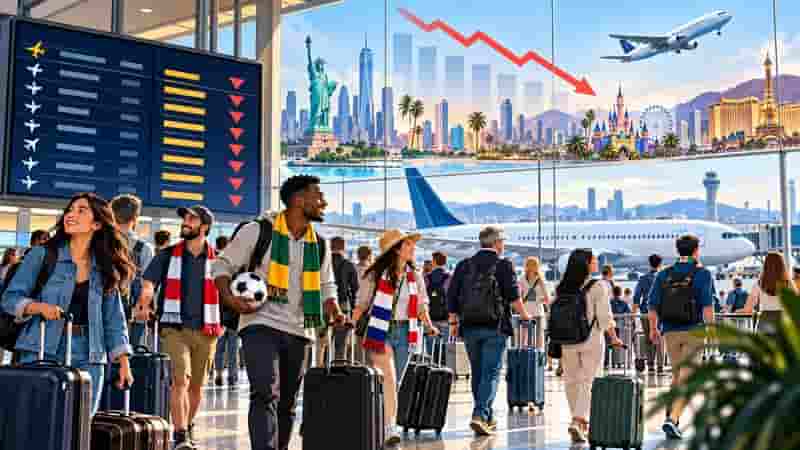
Football brought the crowds, colour and noise. But the latest US travel figures tell a quieter story. Even as the FIFA World Cup kicked off in June, air arrivals from abroad fell in the second quarter of 2026.
The US National Travel and Tourism Office (NTTO) reports that 10.3 million foreign visitors arrived by air from April to June. That was 6.1% fewer than a year ago.
The result may worry hotels, airlines and tour firms. The world’s biggest football event offered a chance to boost travel. The fans came. Yet the wider market did not share their zeal.
World Cup fans turn out, but the wider market slips
The NTTO estimates that 471,000 air travellers came to the US for the World Cup during the quarter. About 341,000 came from overseas, 38,000 from Canada and 91,000 from Mexico. The figures are rounded.
These fans made up 4.6% of overseas air visitors, 1.9% of arrivals from Canada and 10.3% of those from Mexico. Football was a clear draw, especially for those south of the border.
There is a catch. The event began on 11 June and ran into July. So the April-to-June figures cover only its first weeks, not the full World Cup. One quarter is too soon to show the event a red card.
The figures also do not prove the World Cup caused the fall. They show that a major sports event coincided with a fall in air arrivals. That is a key point for tourism planners.
Overseas visitors lead the decline
Overseas markets saw the sharpest fall. Arrivals sank 8.0% to 7.4 million. Air arrivals from Canada fell 0.9% to 2.0 million, while Mexico slipped 0.5% to 886,000.
The United Kingdom was the top overseas market, with about one million visitors. Next came India with 602,000, Brazil with 461,000, Japan with 423,000 and Germany with 368,000.
The top states were familiar names. Florida drew an estimated 2.7 million foreign air visitors. New York drew 2.6 million and California 2.2 million. Texas recorded 924,000 and Nevada 846,000. A guest may visit more than one state, so these totals overlap.
New York City led with 2.6 million visits. Miami drew 1.3 million, while Los Angeles and Orlando each drew about 1.2 million. Las Vegas had 829,000.
The spend per trip shows what is at stake. Overseas guests spent an average of US$1,938 and stayed 17.5 nights. Canadian guests spent US$1,129 and stayed 9.4 nights. Guests from Mexico spent US$1,537 and stayed 9.5 nights.
For the travel trade, fewer guests can mean fewer room nights, tours and meals sold. Yet this survey does not show how much total tourism income changed.
Americans are still travelling, just not quite as much
The outward flow tells its own story. Some 20.7 million US residents flew abroad in the quarter, down 2.0% from a year ago. Overseas trips fell just 0.1%, while trips to Canada rose 3.0%. Mexico was the weak spot. Air trips there fell 12.2%.
Italy was the top overseas choice for US travellers, with 1.8 million visits. The UK came next with 1.7 million. France had 1.4 million, Spain 1.1 million and the Dominican Republic 937,000.
US residents who went overseas spent an average of US$2,120 abroad per trip and stayed 13.9 nights. This is an average trip, not the nation’s full travel trade balance.
What the figures mean for tourism
For travel destinations, the lesson is clear. A global event can fill stadiums and bring new guests. But it may not reverse a wider fall in travel. Airlines and hotels still need to win guests after the final whistle. The survey doesn’t explain why fewer people came. Fares, costs and travel plans all deserve more study. For tourism teams, the task is to turn a big event into more stays and longer trips.
The next quarter’s results should give a fuller view of the World Cup, including July. For now, the NTTO numbers tell a plain story. The football crowds were real. So was the fall in air arrivals.
By: Maria D’Souza – © 2026.
Read Time: 4 minutes.
Author Bio:
 Maria D’Souza brings a suitcase of experience to the travel industry, shaped by Victoria, Queensland and New South Wales. A seasoned traveller, she has explored, collecting practical insight no brochure, however glossy, can provide.
Maria studied communications at RMIT University and also holds a Bachelor of Arts, giving her a foundation in storytelling, people and the fine art of getting a message across clearly. Her professional journey has included roles with various travel agencies, where she developed a strong understanding of customers, destinations, and the occasional itinerary that decided to misbehave.
Away from the office and airport lounge, Maria plays netball, bringing the same teamwork, energy and sharp eye she applies to travel. Warm, capable and endlessly curious, she combines industry knowledge with genuine enthusiasm for helping others discover the world and return home with stories worth telling.











