

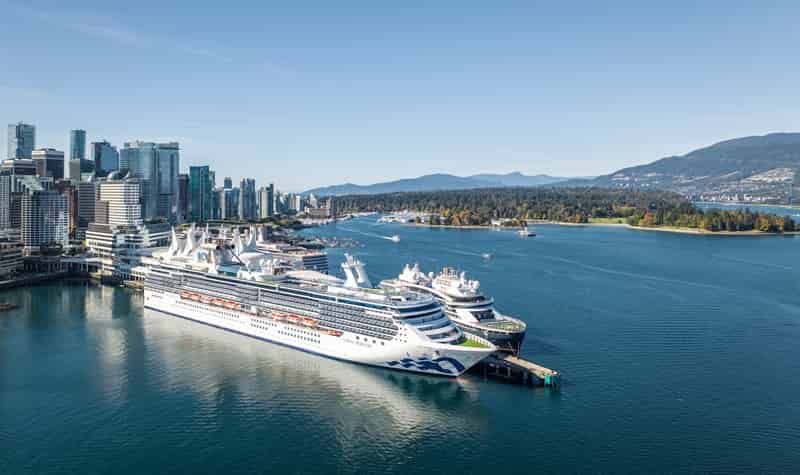
Canada Place has celebrated its 40th year as an Alaska cruise homeport with record traffic, longer visitor stays and a fresh challenge: making growth greener.
Vancouver has found a rather agreeable way to make waves. Its cruise ships have brought more than holidaymakers and camera phones to the waterfront. They have delivered an estimated C$1 billion-plus economic boost to the city, and Canada Place has completed its busiest cruise season on record.
The figures are substantial. The Port of Vancouver reported almost 1.4 million passenger visits and 358 cruise ship calls during the February–October 2026 season. Passenger visits rose 18 per cent from about 1.2 million in 2025, while ship calls climbed 19 per cent from 300. For the city’s hotels, restaurants, retailers and tour operators, that is a great deal more than a handsome view from the harbour.
One point needs care when reading those figures. These are passenger visits, not necessarily 1.4 million different people. The billion-dollar total is the port authority’s estimate of local economic activity. It is not a tally of passenger spending alone.
Jeff Scott, the port authority’s vice-president of operations and supply chain, welcomed the result:
“We are thrilled to celebrate another successful cruise season, with more than $1 billion injected into the local economy as cruise lines and passengers increasingly make Vancouver a core part of their Alaska adventure,”
Alaska’s gateway is also a destination
Part of Vancouver’s appeal lies farther north. Canada Place is a key homeport for Alaska cruises. From here, guests sail through the Inside Passage for sea views, wildlife and small coastal towns. Yet the latest numbers suggest the city itself is becoming more than a place to board a ship and locate the buffet.
According to the Pacific Rim Cruise Association’s latest Cruise Passenger Survey, 76 per cent of passengers spend time in Vancouver before or after sailing. That is up from 70 per cent in 2023. The survey found that each spends an average of C$1,144 on hotels, food, shopping, tours and other local treats.
Guests stay an average of 1.4 nights before or after a cruise. Those from outside North America stay 2.6 nights. That gives local firms more chances to sell a room, a tour or a good meal. None of those sales is likely if a guest goes straight from aircraft to gangway.
Royce Chwin, president and CEO of Destination Vancouver, captured the shift neatly in the port authority’s announcement:
“Cruise passengers are making Vancouver part of their journey, not simply the place where it begins or ends,”
The message for travel advisers is plain. A Vancouver-based Alaska cruise need not be sold as a floating holiday with an airport transfer attached. A few days in town can add depth to the trip. They may also give guests a reason to return.
Why a cruise call matters on dry land
The impact begins before the first passenger comes ashore. A homeport is where ships turn around between voyages. Crews and suppliers load food, top up fuel, do repairs, and prepare for the next sailing. That work supports marine services, transport operators and suppliers well beyond the cruise terminal.
The port says each call generates C$3 million in local economic activity on average. Across 358 calls, that points to more than C$1 billion. But a broad average is not the same as a full audit of each visit.
A Cruise Lines International Association study of Vancouver, published in August 2026, adds useful context. It looked at 2024, not the latest season. Direct spending by cruise lines and guests came to C$802 million. The wider impact reached C$1.4 billion, once knock-on effects were counted. These two studies cover different years and use different methods. Their totals cannot be added together. Both show how cruise trade can reach far beyond the dock.
This is why the annual cruise debate should be about more than a queue of large white ships. The real prize is getting visitors to stay, spend, and explore without letting growth overwhelm the very destination they came to enjoy.
Forty years at Canada Place and still growing
The timing could hardly be better for a birthday celebration. In 2026, Canada Place marked 40 years as an Alaska cruise homeport, having supported more than 10,000 sailings since 1986. The waterfront landmark has become part of Vancouver’s identity, its distinctive white roofline almost as familiar as the mountain backdrop.
The season opened on 26 February with Disney Cruise Line’s Disney Wonder. It ended with the departure of Norwegian Cruise Line’s Norwegian Encore early on 13 October.
A new heavyweight also arrived. Princess Cruises’ Star Princess called on 27 September. At 177,882 gross tonnage, it became the largest cruise ship by gross tonnage to visit the terminal. It passed the Norwegian Encore record of 169,116. Gross tonnage measures a ship’s enclosed internal volume, not its weight, though the name has confused landlubbers for years.
The port collected another accolade when the World Travel Awards named it North America’s Leading Cruise Port for 2026. That marked two consecutive wins and five total. It is a useful feather in the cap, even if a trophy is rather easier to accommodate than another shipload of passengers.
Faster boarding, with less standing about
A record season can expose a terminal’s weak spots. That is most clear when several ships swap guests at once. Canada Place has been addressing the unglamorous but vital business of moving people from kerbside to cabin.
The port says facial scans, introduced in 2024, have cut the relevant US border check by as much as 94 per cent. That step can now take less than 10 seconds. The port also reports that average embarkation takes less than 30 minutes. These are two different measures. Not every guest can expect to breeze through every part of the terminal in seconds.
The port also plans new lifts at key arrival points to improve accessibility and passenger flow. Such measures rarely make it into the holiday brochure, but anyone who has navigated a crowded terminal with luggage will appreciate their value.
Elise Ferguson, vice-president of cruise operations at Canada Place for terminal operator SSA Marine, credited the range of organisations involved:
“I’m incredibly proud of the safe, efficient and welcoming experience we delivered for guests. No one stands alone in that success—it reflects the incredible collaboration of SSA Marine, cruise lines, ILWU workforce, government agencies and the port authority.”
More ships, less smoke: the next test
Record traffic brings responsibilities as well as revenue. Vancouver’s next challenge is to increase cruise capacity while limiting ships’ impact in port and on the surrounding marine environment.
Work is planned on the Canada Place Shore Power Expansion Project, supported through Transport Canada’s Green Shipping Corridors Program. Shore power lets compatible vessels connect to British Columbia’s relatively low-emission electricity grid instead of running onboard engines while berthed.
The port says the project could prevent 3,300 tonnes of greenhouse gas emissions per season. It likens that to taking 770 petrol-powered cars off the road for a year. Construction and commissioning schedules remain important: the emissions reduction is a projection, not an already achieved result.
About 80 per cent of cruise ship calls involve shore-power-capable vessels, the port says. That does not mean every ship can plug in on every visit. The practical measure of success will be how many additional connections the expanded system actually delivers.
Canada Place first installed shore power in 2009. The port authority estimates that its shore-power facilities, including container terminals, have prevented about 55,000 tonnes of greenhouse gas emissions since then. The port also runs its voluntary ECHO Program. It asks ships to slow down in parts of the Salish Sea to help protect whales from noise. The port reports that cruise-line participation reached about 85 per cent in 2026.
These are useful steps. They do not erase all of cruising’s impact on the planet. The industry must show results, not just promise a greener horizon.
The next tide is already coming in
Early bookings point to another strong 2027 season. The port’s announcement did not give a final forecast for ships or passengers. Norwegian Cruise Line has outlined seven-day Alaska voyages aboard Norwegian Jade from May to September, with Vancouver serving as the embarkation and disembarkation port.
Norwegian Cruise Line president Marc Kazlauskas said in the announcement:
“Homeporting in this remarkable city gives our guests the freedom and flexibility to extend their vacation and immerse themselves in everything Vancouver has to offer, from its spectacular natural beauty to its vibrant culture and world-class attractions.”
For cruise lines, that combination of infrastructure and destination appeal helps fill ships. For Vancouver’s tourism operators, it offers business before and after every sailing. And for travellers, it makes an Alaska holiday an opportunity to discover more of Canada’s Pacific coast.
Vancouver has proven it can attract ships and visitors. Now comes the more demanding voyage: keeping the welcome warm, the operation smooth and the environmental cost in check. A billion-dollar season is a splendid result. Making the next one better, not just bigger, would be the real achievement.
By: Sandra Jones – © 2026.
Read Time: 8 minutes.
Author Bio:
 Sandra has spent a working lifetime quietly rescuing journeys, one itinerary, one anxious caller, one impossible connection at a time. Years at Australia’s finest travel agencies taught her the art of calm: how to find a flight in a fog of cancellations, soothe a traveller when luggage wanders, and turn nine frantic days in Europe into something resembling sense. Qualified, seasoned, and endlessly patient, she learned that good travel advice is part logistics and part listening.
But the storyteller in her was always waiting its turn. Writing offered a new map, a way to turn experience into reflection, detail into delight. At EGT Media, Sandra now writes the truths only insiders know: the mishaps, the laughter, the grace found between gates and goodbyes. She reminds us that travel, for all its fuss, is still one of life’s better ideas.











