

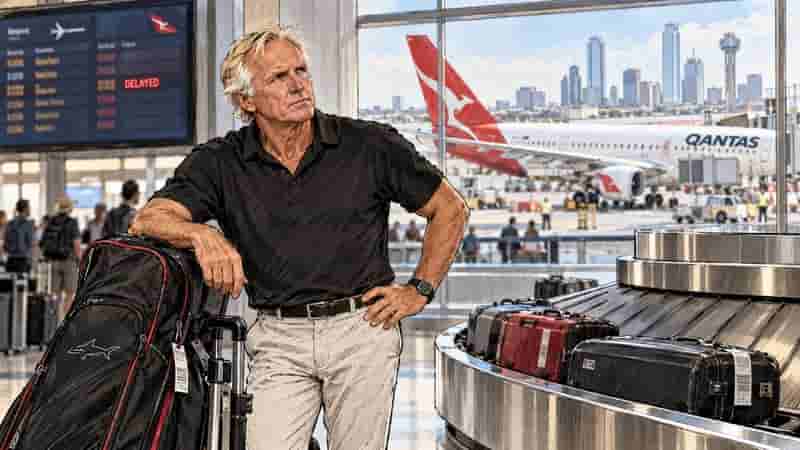
The Shark has bitten the Flying Kangaroo after a late Sydney-Dallas flight, an hour waiting for a suitcase and a long-haul journey without Wi-Fi. But Qantas has an explanation, and its punctuality figures tell a more complicated story.
Greg Norman has taken another mighty swing, but this time no golf ball was in sight. His target was Qantas, and the Australian golfing great’s scorecard for a recent Sydney–Dallas flight made distinctly uncomfortable reading for the Flying Kangaroo.
The former world No. 1, now 71, complained publicly after his flight left Sydney roughly three hours behind schedule. Having endured the lengthy journey to Texas, he said he then waited about an hour for a single suitcase to appear. Throw in a lack of onboard Wi-Fi, and even a man accustomed to playing the long game was running out of patience.
The outburst is especially awkward for Qantas because Norman was once one of its high-profile ambassadors. He promoted the national carrier for years and helped champion its Qantas Golf Club initiative. This wasn’t an outsider taking a cheap shot; it was a familiar face of the brand questioning whether the airline still deserves his loyalty.
The Shark’s patience reaches the rough
Norman aired his frustrations on Instagram in October, opening with a reminder of his longstanding support for Australia’s national airline.
“I have always tried to support my national airline @Qantas,” he wrote, before describing its reputation, in his experience, as the “never on-time” airline.
His complaint was specific: a late departure from Sydney, followed by waiting for his luggage in Dallas-Fort Worth. Norman’s account of the baggage delay remains unverified against airport handling records.
The golfer also asked whether profit was taking precedence over customer care, reputation and service. His criticism of Wi-Fi was equally sharp. In an age when travellers can conduct business, message home, and watch entertainment above the clouds, he found the lack of a connection on such a long flight hard to accept.
And when you have spent much of your career flying around the world, being stuck on a superjumbo without internet access may feel like missing a short putt on the 18th.
Qantas explains the delayed flight
Qantas has not disputed that Norman’s flight was delayed. The airline said engineers were resolving a fuelling issue before departure, and contemporary reporting put the aircraft’s arrival in Dallas two hours and 35 minutes behind schedule.
An important distinction: Norman referred to a departure delay of about three hours, while the airline’s confirmed arrival delay was shorter. Both figures can be accurate, and you shouldn’t mistake one for the other.
A fuelling problem is not a matter any responsible airline should brush aside to protect its timetable. Aircraft safety must come first, even if it leaves passengers with a long, frustrating wait.
That does not mean the airline escapes questions about how effectively it communicates delays, handles luggage and looks after customers once a disruption occurs. A safe arrival is non-negotiable; a good passenger experience should not be optional.
Why was there no Wi-Fi?
The connectivity complaint also needs context. Norman was reportedly travelling aboard a Qantas Airbus A380, a fleet where Wi-Fi installation is still underway.
According to Qantas’ official Wi-Fi information, all its Boeing 787 and Airbus A330-200 aircraft have Wi-Fi, along with most A330-300 aircraft. Its A380 rollout remains incomplete, and connectivity can also depend on route coverage and technical conditions.
In other words, Norman’s experience does not mean every Qantas international flight is disconnected. However, it highlights a gap between the connectivity passengers increasingly expect and what some aircraft can currently deliver.
For travellers on lengthy premium-priced services, that gap can seem wider than the Pacific.
‘Never on-time’? The numbers deserve a look
Norman’s description makes a cracking headline, but it is his personal assessment, not a statistical verdict on the entire airline.
In its 2026 Annual Report, Qantas reported that 83 per cent of its international flights arrived on time in the 2025–26 financial year, up two percentage points from the previous year.
That is a materially different picture from the suggestion that its aircraft are habitually late. Yet averages are cold comfort to an individual passenger whose journey has gone wrong. Norman was judging the flight he experienced, not an annual spreadsheet.
Perhaps the more useful lesson is that airlines are remembered one journey at a time. Punctual flights rarely make headlines; troublesome ones can travel around the world on social media before the last suitcase reaches the carousel.
Could Emirates reel in The Shark?
Norman floated Emirates as a possible alternative, pointing favourably to reliability, Wi-Fi and comfort.
There is a small irony in that suggestion. Qantas and Emirates have an established codeshare partnership, allowing passengers to access parts of one another’s networks. But an Emirates-operated flight is still a different onboard experience from a Qantas-operated one.
More importantly, Emirates would not offer Norman a like-for-like non-stop Sydney–Dallas service. Reaching Dallas through its network would mean taking a substantially less direct route.
The Shark may be prepared to swim a little further in search of calmer waters. Whether the extra travel time is worth it is another question entirely.
Bigger ambitions, bigger expectations
Qantas, meanwhile, has an ambitious long-haul agenda. Its new seasonal Sydney-Las Vegas service is scheduled to begin on 29 December 2026, operating three times a week until 12 March 2027 using Boeing 787 Dreamliners.
Further ahead, its Project Sunrise programme is planned to introduce non-stop Sydney-London flights in October 2027, followed by Sydney-New York in mid-2028. Tickets for the New York route are scheduled to go on sale in August 2027. The dates remain subject to necessary approvals and aircraft delivery milestones.
These are impressive advances in aviation. They will also spotlight the everyday details of the customer experience: honest communication, dependable operations, working technology, and bags arriving when they should.
Norman, for his part, did not condemn everyone wearing a Qantas uniform. “Ground staff excellent,” he wrote, while urging management to restore the pride he associated with the carrier’s “Spirit of Australia” identity.
That distinction matters. Frontline employees are often the people left to steady the ship when an operation hits rough weather.
Ultimately, this is more than a famous golfer airing a travel grievance. It reminds us that the affection Australians have for Qantas is an asset the airline must keep earning, flight after flight.
The Shark has delivered his verdict. The Flying Kangaroo has explained.
Now comes the harder part: making sure the next customer remembers the journey for all the right reasons.
By John Alwyn-Jones – © 2026.
Read Time: 6 minutes.
Author Bio:
 John Alwyn-Jones is one of those rare figures who can make the business of travel sound positively adventurous.
A lifelong communicator with the polish of a broadcaster and the curiosity of a journalist, he’s spent decades shaping stories and strategies across tourism, aviation, and the cruise world. He’s led from the front as CEO, director, mentor, and advisor, and still brings warmth and wit to every boardroom and microphone.
Known for his sharp insight into global cruise lines and destinations, John has an old-school belief in professionalism, tempered with the sparkle of someone who’s genuinely seen the world. He’s not just in the travel business; he’s made it an art form.











