

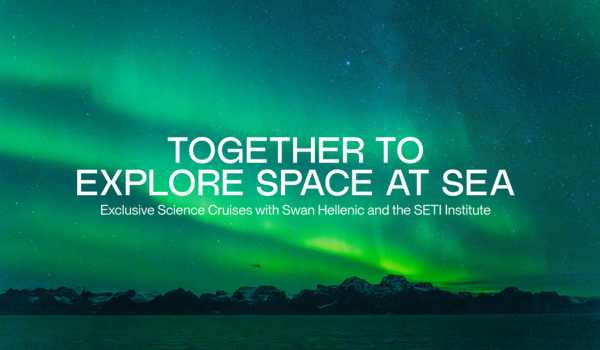
Cultural expedition cruise pioneer unveils six exceptional voyages accompanied by leading experts exploring the origins of planets, the nature of our Universe and the search for life beyond Earth.
Swan Hellenic has announced full details of its 2027 Explore Space at Sea Series, created in partnership with the SETI Institute, an organisation that grew out of NASA’s High Resolution Microwave Survey and has spent more than 40 years searching for extraterrestrial intelligence.
The series will feature six renowned SETI Institute scientists, each accompanying one of six exceptional cultural expedition cruises. Travelling with Swan Hellenic guests, they will share specialist insights into astronomy, astrophysics, astrobiology and planetary science, exploring both the latest discoveries and the enduring search for life beyond Earth.
From Antarctica and the Southern Hemisphere sky to volcanic landscapes and the Arctic, from Asia Pacific to West Africa, the series will explore how observations on Earth can help scientists understand distant planets, stars and potential forms of life beyond our own world.
So, let’s meet Swan Hellenic’s 2027 SETI Institute scientists and the voyages they will accompany.
Ross Beyer – Planetary Scientist, Carl Sagan Center, SETI Institute
Accompanying the voyage “Cruising the Pacific Islands: New Caledonia, Vanuatu and Solomon Islands”, from Auckland to Honiara, 21 March–3 April 2027, aboard SH Minerva.
https://www.swanhellenic.com/cruise/cruising-the-pacific-islands-new-caledonia-vanuatu-and-solomon-islands-2027-03-21
Beyer studies the geomorphology, surface processes and topography of planetary bodies through remote sensing and photogrammetry. A co-investigator on NASA’s HiRISE, New Horizons and VIPER missions, he has helped investigate landscapes on Mars, the Moon and icy worlds including Europa, Enceladus and Charon. During the voyage, he will relate the volcanic and tectonic landscapes of the Pacific Ring of Fire to similar processes on other planets.
Uma Gorti – Chair of Astronomy and Astrophysics, Carl Sagan Center, SETI Institute
Accompanying the voyage “Patagonia and the Wild Atlantic: Cruise to the Falkland Islands”, from Ushuaia to Montevideo, 25 March–8 April 2027, aboard SH Vega.
https://www.swanhellenic.com/cruise/patagonia-and-the-wild-atlantic-cruise-to-the-falkland-islands-2027-03-25
Gorti studies how stars and planets form, using computational models to investigate the gas and dust surrounding young stars. She works with data from observatories including Hubble, ALMA and the James Webb Space Telescope. Her lectures will explore the southern sky, star-forming regions, astronomy and navigation, as well as Antarctic balloon experiments and cosmic rays detected beneath the ice.
Derek Kozel – Principal Investigator, GNU Radio Project
Accompanying the voyage “West Africa Coast and Atlantic Islands”, from Dakar to Lisbon, 5–14 May 2027, aboard SH Diana.
https://www.swanhellenic.com/cruise/west-africa-coast-and-atlantic-islands-cruise-2027-05-05
Kozel leads the GNU Radio project, one of the world’s most widely used open-source tools for radio systems. His research at Carnegie Mellon University and Cardiff University focuses on radio science, instrumentation and machine learning. He will introduce guests to the science of radio signals and the technologies that enable researchers to explore and understand the Universe.
Bill Diamond – President and CEO, SETI Institute
Accompanying the voyage “From Canada to Iceland Along the Viking Routes”, from Halifax to Reykjavík, 20–31 May 2027, aboard SH Vega.
https://www.swanhellenic.com/cruise/cruise-from-canada-to-iceland-along-the-viking-routes-2027-05-20
Bill Diamond is President and CEO of the SETI Institute. A Silicon Valley technology veteran, he has more than 30 years’ experience in laser photonics, optical communications, X-ray imaging and semiconductor technologies, including senior executive roles at several technology companies. He will offer guests a broad perspective on the SETI Institute’s work and the scientific and technological challenges involved in the search for life beyond Earth.
Megan Seritan – Deputy Manager, Ring-Moon Systems Node, NASA Planetary Data System, SETI Institute
Accompanying the voyage “From Iceland to Svalbard”, from Reykjavík to Longyearbyen, 31 May–10 June 2027, aboard SH Vega.
https://www.swanhellenic.com/cruise/cruise-from-iceland-to-svalbard-2027-05-31
Seritan studies how geological features reveal the history of planetary magnetic fields. Her research has focused particularly on the Moon’s ancient magnetic field. During the voyage, she will connect Iceland’s volcanic landscapes and the magnetic record preserved in lava with the planetary science contained in NASA’s archives.
Janice Bishop – Chair of Planetary Exploration, Carl Sagan Center, SETI Institute
Accompanying the voyage “South Atlantic Cruise: from South Africa to Antarctica”
departing from Cape Town and returning to Ushuaia, 29 October to 18 November 2027, aboard SH Diana.
https://www.swanhellenic.com/cruise/south-atlantic-cruise-from-south-africa-to-antarctica-2027-10-29
Bishop researches Martian rocks and minerals at the SETI Institute and NASA Ames Research Center, investigating Mars’s early climate, geochemistry and potential past habitability. Her work combines hyperspectral analysis, laboratory studies and fieldwork in planetary analogue environments such as Antarctica. She will explore the connections between the Antarctic cold desert and Mars, including the search for minerals and biosignatures associated with life.
Each scientist will bring a distinct perspective to Swan Hellenic’s 2027 Explore Space at Sea Series, giving guests the opportunity to engage directly with researchers whose work is helping to expand our understanding of Earth and the Universe beyond it.
Mario Bounas, Chief Commercial Officer of Swan Hellenic, commented: “We are delighted to celebrate the fifth year of our successful partnership with the SETI Institute and to continue it with six new Explore Space at Sea voyages in 2027. Each voyage connects remarkable destinations with some of the most fascinating questions in science, offering our guests the opportunity to see what others don’t, both on Earth and far beyond it.”











