

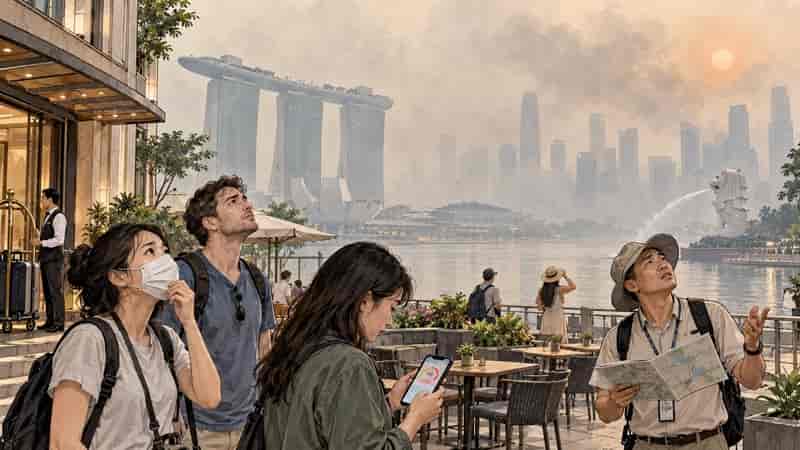
Singapore has spent decades making a virtue of doing things properly. Trains arrive, hotels sparkle, Changi Airport seldom misses a chance to impress, and even the gardens seem to have read the rulebook. Unfortunately, smoke from burning forests does not take instructions from the Singapore Tourism Board.
A worsening haze episode has brought unhealthy air, disrupted outdoor attractions and event plans, and pushed parts of the visitor economy into damage-control mode. Smoke is drifting across borders from fires in Indonesia, but Singapore’s tour operators, restaurants, hotel guests, and airlines are feeling the consequences.
This is not a citywide tourism shutdown. Singapore remains open for business. Yet reports of sharp declines at individual visitor-facing businesses show the haze is more than an unattractive addition to holiday photographs. For the travel trade, the challenge is to protect travellers, communicate honestly, and keep adaptable itineraries ready.
Air quality turns a Singapore holiday grey
Singapore’s National Environment Agency (NEA) reported 24-hour Pollutant Standards Index (PSI) readings of 118 to 168 at 4 pm on 14 October, placing air quality in the Unhealthy range. At that time, one-hour concentrations of PM2.5 fine particles capable of penetrating deep into the lungs ranged from 139 to 251 micrograms per cubic metre.
The numbers need careful reading. The 24-hour PSI guides general planning and health precautions; the one-hour PM2.5 figure helps assess more immediate outdoor exposure. They are not interchangeable.
Conditions worsened in western Singapore on 15 October, when its 24-hour PSI reached 212 at noon, within the Very Unhealthy range. By 3 pm, the west had returned to the Unhealthy range, with a reading of 196, illustrating just how quickly the situation can change.
The NEA warned that southeasterly winds could continue carrying smoke from Kalimantan towards Singapore, while fires and haze were also being observed over Sumatra. Rain may provide temporary relief, but it doesn’t guarantee the problem has passed.
Outdoor tourism operators report booking losses
The clearest commercial warning has emerged from businesses whose products rely on fresh air.
On 12 October, Channel NewsAsia (CNA) reported that some outdoor tourism operators had seen booking declines of up to 30 per cent, with customers postponing or cancelling activities that require prolonged time outside.
Walking tours, scooter experiences, cycling activities and outdoor excursions are particularly exposed. A visitor can change restaurants with little fuss; rearranging a pre-booked group excursion is rather more complicated.
The reported declines are not an industry average. Individual operators have also pointed to factors such as airfares and hotel costs. Nevertheless, haze is now a documented operational and commercial concern, rather than merely a risk described in a contingency plan.
For guides and tour companies, flexibility could make the difference between a rebooking and a refund. Shorter routes, less strenuous experiences, indoor alternatives and clear decisions on whether to proceed all deserve attention. Advisers should check directly with suppliers before telling customers that an activity is operating as advertised.
Alfresco restaurants feel the smoke
Outdoor dining has also taken a hit. On 14 October, CNA reported that some food and beverage businesses had seen trade fall by as much as 60 per cent.
At Shahi Maharaja Restaurant and Bar on Boat Quay, the owner reported a 60 per cent fall in business, fewer walk-in customers and cancelled reservations. Tourists who might ordinarily choose a riverside table showed a stronger preference for dining indoors.
These are figures from particular establishments, not proof that Singapore’s restaurant sector has lost 60 per cent of its revenue. Indeed, businesses near the Formula One festivities reported strong trade during the race weekend. The haze does not affect every location, business or traveller equally.
But the contrast sharpens the business lesson. A destination can still attract crowds while particular operators suffer. For restaurants heavily dependent on outdoor ambience, sustained haze directly threatens sales.
Hotels confront a more complicated guest experience
The impact on hotels is harder to measure, but no less relevant to service standards.
A five-star hotel can control its linen, lighting and lobby fragrance. It cannot promise a clear view from the rooftop bar. Outdoor pools, terrace dining, garden functions, and walking itineraries may need to be modified based on prevailing conditions.
Management teams should review indoor air filtration, entrances and outdoor-air systems, and plans for guests who prefer to limit exposure. Staff working in open-air areas may require different duties or additional precautions. Where a booked experience changes, hotels should explain the alternatives and applicable refund or cancellation conditions without waiting for a complaint at reception.
No verified sector-wide figure exists for haze-related hotel cancellations, lost room nights, or occupancy declines. Claims of a general hotel slump would therefore go beyond the evidence. The immediate story is about operational resilience, guest confidence and the risk of reduced spending on experiences surrounding the hotel stay.
Sports facilities close, reopen and move again
The haze has already visibly affected outdoor events.
On 15 October, Sport Singapore temporarily closed outdoor and non-air-conditioned ActiveSG facilities in affected regions. As readings improved during the afternoon, some facilities in southern and western Singapore reopened, while closures remained in parts of the east and central region under the ActiveSG facility advisory. Visitors were urged to check the latest listing and not assume a morning closure would last all day.
Organisers also cancelled the ISCA Run scheduled for 17 October at Gardens by the Bay, which had been expected to draw roughly 3,000 participants. The decision illustrates the burden on organisers who must weigh ticket-holder expectations against public-health advice.
For conference planners and incentive travel organisers, outdoor team-building sessions, harbour receptions and post-conference sightseeing now require realistic alternatives. A ballroom may be sheltered; the welcome cocktail party on the lawn is another matter.
Firefly flight cancellations widen the travel impact
The haze has also crossed from leisure activities into airline operations.
Malaysian carrier Firefly announced cancellations affecting services between Sultan Abdul Aziz Shah Airport at Subang, near Kuala Lumpur, and Singapore’s Seletar Airport because of weather and haze conditions. The airline’s official notice listed disrupted services through 15 October; subsequent reporting on 14 October indicated cancellations had been extended to 16 October.
Firefly said it was contacting affected passengers about available transfers to Malaysia Airlines services operating between Kuala Lumpur International Airport and Singapore Changi, subject to seat availability, or refunds under the published arrangements.
This should not be mistaken for a general suspension of flights to Singapore or the closure of Changi Airport. The disruption concerns specific services and airports. For agents, that distinction is essential: verify the flight number and obtain the carrier’s current position before advising a traveller.
Singapore has a great deal at stake
Singapore’s visitor economy had strong foundations before the latest smoke arrived. The Singapore Tourism Board recorded 16.9 million international visitor arrivals and a record S$32.8 billion in tourism receipts for 2025. Average hotel occupancy reached 81.9%.
For 2026, the board projected 17 million to 18 million visitor arrivals and S$31 billion to S$32.5 billion in tourism receipts. These are earlier forecasts, not final outcomes, and a few days of haze cannot sensibly be translated into a precise annual revenue loss.
Australia is particularly interested. It was one of Singapore’s leading tourism-spending markets in 2025, and the city-state remains an important holiday, business, and transit destination for Australians.
That explains why this story matters to travel advisers well beyond Singapore. The risk extends across attractions, restaurants, event venues, transport providers and the smaller businesses whose profits depend on visitors getting out and exploring.
Formula One provides a useful counterpoint
Singapore’s Grand Prix was completed on 11 October, with Max Verstappen taking victory at Marina Bay. It was a significant demonstration of the city’s ability to stage a major international event amid difficult conditions.
Ahead of the race, organisers and authorities had prepared haze-related contingencies. Yet strong crowds and reports of busy restaurants around the race precinct showed demand hadn’t disappeared.
Dramatic headlines tempt us to think the whole industry is on its knees. The evidence tells a more interesting story. Major events can continue successfully while outdoor tours lose bookings and individual alfresco restaurants lose customers. Resilience and hardship can exist on the same street.
The point for the meetings and events industry is not to abandon Singapore. It is to build realistic weather and air-quality responses into contracts, programmes and communications.
The cause lies beyond Singapore’s borders
Widespread forest and peatland fires in Indonesia, particularly in Sumatra and Kalimantan, are driving the smoke. Dry weather linked to a strong El Niño has intensified conditions, while peat fires can continue smouldering for long periods.
The ASEAN Specialised Meteorological Centre has warned that persistent dry conditions may keep hotspot activity and transboundary haze elevated. Increased rainfall later in the month could offer some relief, but its timing and impact remain uncertain.
Indonesia is deploying large firefighting resources. However, the broader regional haze problem cannot be resolved by hotel maintenance teams or tourism promotion campaigns. It demands sustained fire prevention, land management and cross-border cooperation.
Tourism operators can do little about wind direction. They can do considerably more about their duty of care.
Advice for Australian travellers
Australia’s Smartraveller continues to advise travellers to exercise normal safety precautions in Singapore. The government nevertheless warns that smoke haze can occur between June and October and recommends checking local air-quality advice.
That is not a reason to disregard the pollution. It is a reason to distinguish an environmental health concern from a blanket warning against travel.
Singapore’s Ministry of Health advises healthy people to reduce prolonged or strenuous outdoor exertion when the 24-hour PSI is Unhealthy and avoid it when the index is Very Unhealthy. Children, pregnant women, older people and those with chronic heart or lung disease should follow more restrictive guidance.
N95 masks are generally not required for brief exposure, such as a routine commute. For vulnerable people who must remain outdoors for several hours in Very Unhealthy conditions, a properly fitted N95 may reduce exposure. Those with severe heart or lung conditions should consult a doctor if using a mask could make breathing difficult. Visitors should not assume they qualify for Singapore’s targeted distribution of free masks.
Reducing exposure matters more than relying on a mask to rescue an unsuitable itinerary. Travellers should consult NEA’s haze dashboard, check directly with suppliers, carry required medication and seek medical advice when needed.
Hotels, travel advisers and event organisers should also protect staff. Singapore’s Ministry of Manpower advises employers to reduce prolonged or strenuous outdoor work at Unhealthy PSI levels, avoid it at Very Unhealthy levels where practicable, and provide appropriate additional protection for essential work.
Clear thinking is Singapore’s best response
Singapore has built an enviable global reputation through competence, connectivity and hospitality. Haze has not undone it. But the smoke has exposed a weakness no destination can tackle through branding alone.
The most effective response is practical: publish accurate operating information, move suitable experiences indoors, put employee and guest health first, and avoid promising either instant relief or inevitable catastrophe.
The sky may be grey. The advice to the travel trade should be crystal clear.
By: Michelle Warner – © 2026.
Read Time: 10 minutes.
Author Bio:
 Michelle Warner has always carried stories the way others carry passports lightly, faithfully, and with purpose. She learned her craft in newsrooms, shaping sentences with care, before swapping deadlines for departures as a flight attendant with some of the world’s great airlines. Years aloft sharpened her eye for character and deepened her fondness for travel’s small, dignified rituals: the quiet kindness of strangers, the poetry of arrival, the patience learned between time zones.
Now grounded by choice, Michelle has come home to writing with the same calm authority she once brought to turbulent cabins. Her prose blends an editor’s discipline with a traveller’s wonder, tinged with humour and reverence for the golden age of travel. Each piece feels like a handwritten boarding pass, gracious, observant, and unmistakably alive.











